


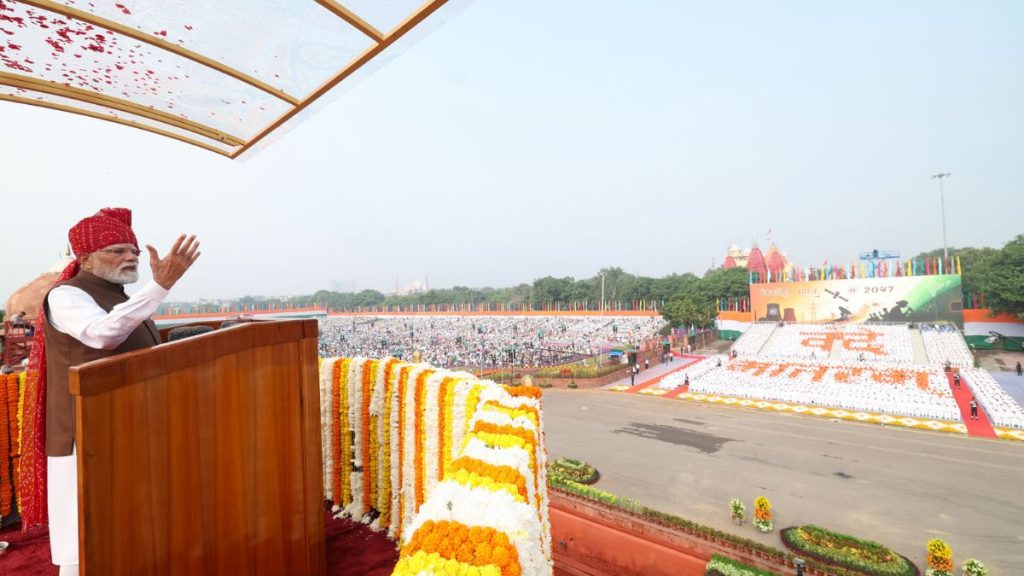
New Delhi: Addressing the nation from the Red Fort on India’s 80th Independence Day, the prime minister, Narendra Modi, announced plans for a “modern and vibrant network of civil defence,” saying citizens would be familiarized with “advanced emergency systems and protocols.”
Modi said the nature of warfare is changing and that wars are “no longer fought only at the border,” He pointed to refineries, banking systems and data centres as examples of infrastructure that can now be targeted in modern conflict, arguing that civil defence systems built for the wars of the last century “have become outdated.”
India has had a formal, statutory civil defence framework since 1968, although efforts to prepare civilians for emergencies predate the law. Modi’s announcement builds on that existing system, with the government yet to spell out how the proposed volunteer force will be structured or how it will differ from the network already in place.
To understand the significance of the announcement, it is important to look at how India’s civil defence system has evolved since it was first formalised in 1968.
What civil defence actually is?
Civil defence is not a branch of the armed forces. Under the Civil Defence Act, 1968, it covers non-combat measures to protect people, property and places against hostile attack, including measures taken before, during or after an attack. The law also provides for the raising of Civil Defence Corps and for rules governing the system.
At the central level, civil defence is administered through the Ministry of Home Affairs, while states and Union territories handle much of its implementation, including the training of volunteers. The government’s Civil Defence Warriors portal describes the system’s activities as covering warning, evacuation, rescue, emergency response and support during disasters.
Before 1962, India’s civil-protection arrangements were limited and largely informal. The 1962 war with China, followed by the 1965 war with Pakistan, prompted a wider reassessment of civilian preparedness, leading to the Civil Defence Act in 1968.
The framework was later expanded. The Civil Defence (Amendment) Act, 2009 added disaster management as an additional role for the Civil Defence Corps, alongside its original wartime function. According to the India Code database, the amendment was passed by Parliament in 2009 and notified in 2010.
How the network operates today
The Civil Defence Act applies across the country, but civil defence units are not raised uniformly everywhere. According to the Civil Defence Warriors portal, activities are currently organized in 259 categorized towns across 36 states and Union territories, while 100 additional districts have been identified as multi-hazard-prone for future civil defence infrastructure.
Civil defence volunteers serve in a voluntary and largely honorary capacity, though states and Union territories can provide training and duty allowances when volunteers are called up. The portal states that the present target strength for civil defence volunteers nationally is 14.11 lakh, of which 5.38 lakh have been raised so far, meaning the existing corps is currently filled to roughly a third of its sanctioned strength.
Civil defence, tested
The system was activated during the heightened security situation that followed the Pahalgam terror attack and Operation Sindoor in 2025. The Union home secretary reviewed civil defence preparedness with state chief secretaries ahead of a nationwide mock drill, with senior officials from civil defence and the National Disaster Response Force involved in the planning, according to Business Standard’s report on the government’s disclosures.
In Jammu & Kashmir, 2,818 civil defence volunteers were deployed for health, fire and emergency services, livestock management and related support during that period.
Chandigarh offers a ground-level example of how such preparedness works in practice. In May 2025, nearly 3,800 people registered on the first day of a civil defence enrolment drive, far exceeding the initial target of 300. A subsequent batch of around 400 volunteers completed training in first aid, rescue operations, evacuation and emergency communication, working alongside army and police personnel.
Such exercises show that civilian preparedness is not a new idea in India. What is new in Modi’s announcement is the proposed scale and modernization of the network.
Why Modi says the system needs an overhaul
Traditional civil defence was designed around the physical consequences of military attack. But the vulnerabilities of a modern, connected society extend well beyond the traditional battlefield.
In his speech, Modi specifically named refineries, banking systems and data centres as targets in contemporary conflict, infrastructure that can be disrupted without a single shot fired near a border.
That reframing shifts the emphasis of civilian preparedness towards protecting and maintaining the systems people rely on every day: power, communications, financial services, transport and healthcare. It also puts more weight on whether ordinary citizens know how to respond when those systems are disrupted, how warnings are communicated, where to go, how evacuation works, and how trained volunteers can assist emergency services.
How civil defence differs from Home Guards and the Territorial Army
Civil defence is sometimes confused with two other organizations that involve civilian participation, but their roles are distinct.
Home Guards are a voluntary force raised under state and Union territory laws, serving as an auxiliary to the police. Their duties can include assistance with law and order, traffic management and emergencies, and they receive duty or training allowances under rules set by their respective states.
The Territorial Army, by contrast, is part of the military system. It allows gainfully employed civilians to serve in a part-time military capacity while retaining their primary professions. Personnel can be called out for military service and are paid accordingly when embodied for training or deployment.
Civil defence volunteers are different from both. Their primary role is civilian protection, emergency preparedness and disaster response. They are not part of the armed forces and are not intended to replace military formations.
What a modernised network could look like
The government has not yet set out the full structure of the proposed force, its size, recruitment process, training curriculum, equipment or funding remain to be announced.
The existing system already trains volunteers in emergency communication, first aid, rescue, evacuation and disaster response, conducted at local, state and national levels, with specialized instruction provided through institutions such as the National Civil Defence College in Nagpur.
A modernized network could plausibly place greater emphasis on digital warning systems, resilient communications, critical-infrastructure preparedness and more frequent mock exercises, though these remain likely directions rather than details formally announced by the government.
That history is what makes Modi’s announcement significant. Civil Defence was built in the 1960s to prepare civilians for a very different kind of war, air raids, blackout drills, physical attack. Six decades and one amendment later, it also covers earthquakes and floods. What Modi signalled from the Red Fort is a third evolution, a civil defence system built for an era when a crisis is as likely to hit a data centre or a bank’s servers as it is a city street.
The volunteer force he described is not being built from nothing. It is being built on a corps that already exists in law, is already active in 259 towns across the country, and was already called upon during the tensions with Pakistan last year.
The announcement builds on an existing civil defence framework that has evolved significantly since the 1960s. The proposed modernization would broaden the focus of civilian preparedness to address the changing nature of security threats and the growing vulnerability of critical infrastructure.