


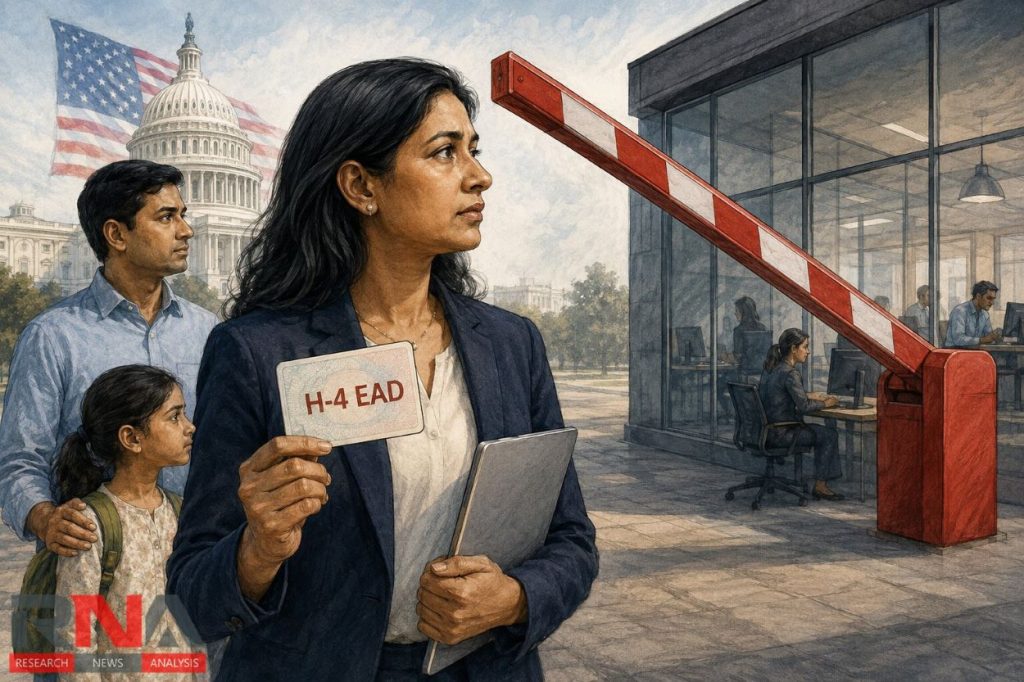
New Delhi: The administration of the US president, Donald Trump, has revived a proposal to withdraw employment eligibility from certain H-4 visa holders married to H-1B professionals. The measure could have its greatest impact on Indian families, although no formal rule has been published and existing work rights remain unchanged for now.
The proposal, titled “Removing H-4 Dependent Spouses from the Classes of Noncitizens Eligible for Employment Authorization”, appears on the Department of Homeland Security’s (DHS) long-term regulatory agenda under RIN 1615-AD14. Its official summary says the department intends to reverse a 2015 rule that allowed qualifying H-4 spouses to apply for Employment Authorization Documents (EADs).
The listing does not specify when a proposed rule will be released, making the announcement an indication of policy intent rather than an immediate change in law. DHS would first have to publish a detailed Notice of Proposed Rulemaking, invite public comments and consider those submissions before issuing any final regulation.
Consequently, H-4 spouses holding valid EADs may continue to work, while eligible applicants can seek authorization under the existing rules. The treatment of unexpired permits, pending applications and future renewals cannot be known until DHS publishes the proposed regulation and any transitional provisions.
An H-4 visa allows the spouse and unmarried children below the age of 21 of an H-1B worker to live in the United States, but the status itself does not confer permission to work. Employment authorization is available only to qualifying spouses, not children, and requires a separate application to US Citizenship and Immigration Services.
Under the rule that took effect on May 26, 2015, an H-4 spouse may apply for an EAD if the principal H-1B worker is the beneficiary of an approved I-140 immigrant petition or has received an extension under provisions governing lengthy green-card cases. Unlike an H-1B visa, the resulting authorization is not tied to one employer and permits job changes, self-employment and entrepreneurship.
The measure was introduced to ease the financial and personal strain on families waiting for employment-based permanent residence, a process that can be exceptionally long for Indian applicants because of annual country limits and accumulated demand. DHS also argued in 2015 that allowing spouses to work would help American employers retain highly skilled H-1B professionals who might otherwise relocate with their families.
Historical figures underline why Indians would bear a disproportionate share of any rollback. A Congressional Research Service report found that USCIS had approved 126,853 H-4 EAD applications by December 25, 2017, of which 93 per cent went to people born in India and 93 per cent to women.
Those figures counted initial approvals, renewals and replacement documents rather than 126,853 separate workers, an important qualification when estimating the number of people potentially affected. More recent DHS data cited by Reuters showed that over 258,000 H-4 holders had received work authorization since 2015, including more than 25,000 in the preceding year.
Ending the programme could therefore force many dual-income households to depend on the earnings and immigration status of a single H-1B worker. Employers could also lose experienced staff, while the United States may become less attractive to foreign professionals whose spouses have established independent careers.
Supporters of tighter immigration controls argue that withdrawing H-4 employment eligibility would reduce competition for jobs and reinforce the administration’s emphasis on protecting American workers. Business organizations and immigration advocates counter that the affected spouses are often highly educated professionals and that removing them from the workforce would create recruitment, retention and labour-turnover costs.
Trump’s first administration pursued a similar rescission but did not finalize it, and DHS formally withdrew that initiative in 2021. The revived effort comes despite the US Supreme Court’s refusal in October 2025 to hear a challenge to the 2015 rule, leaving intact an appellate judgment that DHS possessed the legal authority to grant the permits.
That court outcome established that the government could operate the H-4 EAD programme, but it did not prevent a later administration from attempting to repeal it through the regulatory process. Any finalized rollback could face fresh litigation over its reasoning, procedure and treatment of families and employers that relied on the decade-old policy.
For the moment, reports that H-4 spouses have already lost their right to work are premature. The proposal remains on a long-term agenda without a publication date, and its real scope will become clear only when DHS releases the draft regulation.