


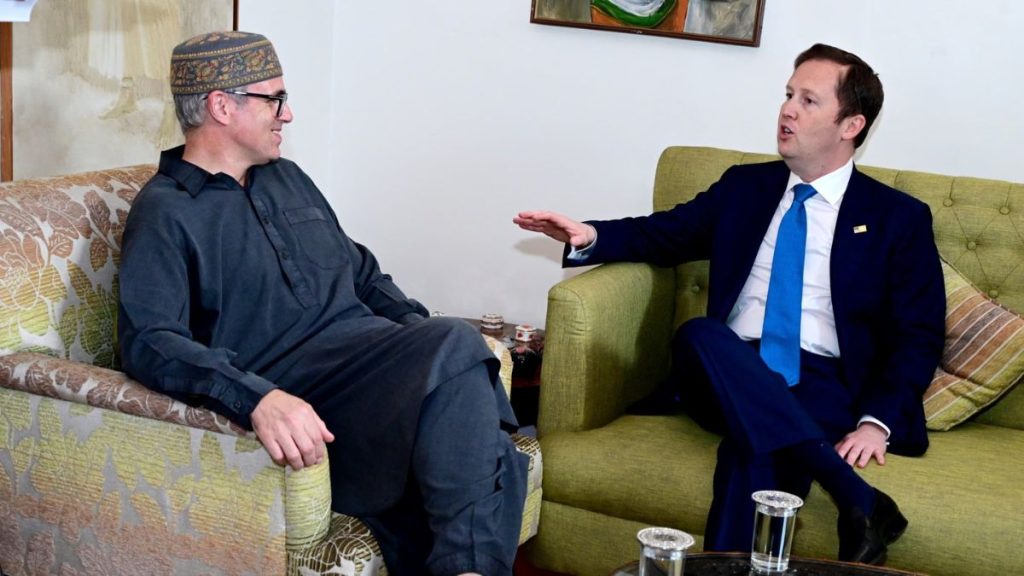
New Delhi: The US ambassador to India, Sergio Gor, met Jammu & Kashmir chief minister, Omar Abdullah in Srinagar on Wednesday during his first visit to the Union territory since taking office. Gor described Jammu & Kashmir as an “important part of India” and said Washington would review its travel advisory for the region.
The meeting also covered economic cooperation, with Gor and Abdullah discussing opportunities in tourism, horticulture and what Abdullah described as the “new economy”. Gor later said the talks were “very warm” and “very cordial”, with follow-up discussions expected in New Delhi and Washington.
Gor’s comments on the travel advisory were cautious. He did not announce any change to the US guidance, saying Washington regularly reassesses its travel warnings.
“The United States puts out travel warnings and every so often, we re-evaluate those travel warnings. I cannot make any big announcements here today, but it is something we are going to look at,” Gor said.
He later said Washington would look at whether the warning should be downgraded, while pointing to steps taken by New Delhi and the Jammu & Kashmir government to improve safety.
“So, we will be looking at if the travel warning that is imposed and recommended by the United States is something that should be downgraded because, as I said earlier, this is a beautiful area,” Gor said.
The distinction matters because the current US advisory still lists Jammu & Kashmir at Level 4, or “do not travel”, citing terrorism and civil unrest. It specifically identifies Srinagar, Gulmarg and Pahalgam among tourist areas where violence has occurred.
Gor’s visit therefore marks a discussion about a possible change in the advisory, rather than the change itself.
Abdullah said the meeting had a specific focus on what the US could do for Jammu & Kashmir.
“It was a very good meeting. We had an opportunity to discuss the relations between our two countries but with specific focus on what the US can do with Jammu & Kashmir,” he said.
In a post on X, Gor said he and Abdullah had discussed ways to “deepen economic collaboration” and create opportunities that would benefit both countries.
Abdullah’s own post highlighted tourism, horticulture and the new economy as areas where Jammu & Kashmir and the US could widen and deepen engagement.
Why Gor’s visit matters
The visit comes against a backdrop in which security and tourism in Jammu & Kashmir remain closely connected.
On August 10, a parliamentary panel recommended an integrated security and surveillance system for major tourist destinations in Jammu & Kashmir. Its recommendations included wider CCTV coverage, centralized monitoring, regular vulnerability assessments and security audits, along with clearer standard operating procedures between agencies before the peak tourist season.
The recommendations followed the April 2025 Pahalgam terrorist attack, in which 26 people were killed. The panel also noted the importance of security arrangements to maintaining tourist confidence and supporting the sector’s continued growth.
That makes the timing of Gor’s comments significant without requiring any assumption about a change in US policy. Washington is reviewing its own assessment of travel risks, while Indian authorities have separately been examining security arrangements at tourist destinations.
Security operations were also continuing in parts of Jammu & Kashmir on the day before Gor’s visit. Security forces conducted searches in Udhampur, Reasi and Kathua following reports of suspected movement, including operations in the Sadini forests in Reasi and villages near the International border in Kathua.
The second part of Gor’s visit was economic. His discussions with Abdullah were not limited to tourism but also included horticulture and broader economic opportunities. This discussion is particularly important because Jammu & Kashmir has been trying to expand economic activity beyond its traditional tourism base, with horticulture as an important part of the region’s economy.
For Gor, the visit also provided an opportunity to engage directly with the elected government in Jammu & Kashmir. It was the first meeting between a serving US ambassador and Abdullah since Timothy Roemer, 21st U.S. Ambassador to India, met him in 2011.
Abdullah, for his part, had already made clear in a statement that he did not intend to use this meeting to raise complaints about issues that he believes must be addressed by New Delhi. He said “our matters are not going to be resolved in Washington, they will be resolved by the government of our country.”
The meeting largely focused on practical engagement, including: security, tourism, economic opportunities and the future of US-Jammu & Kashmir ties.
For now, the most concrete outcome is Gor’s statement that Washington will review its travel advisory. Whether that eventually results in a formal downgrade or not remains a decision for the US government to announce.
The other immediate takeaway is the economic focus. Both Gor and Abdullah have publicly identified areas such as tourism and horticulture for greater cooperation, giving the visit a broader agenda than the travel warning alone.
Gor is scheduled to continue his visit with a trip to Ladakh on Thursday.