


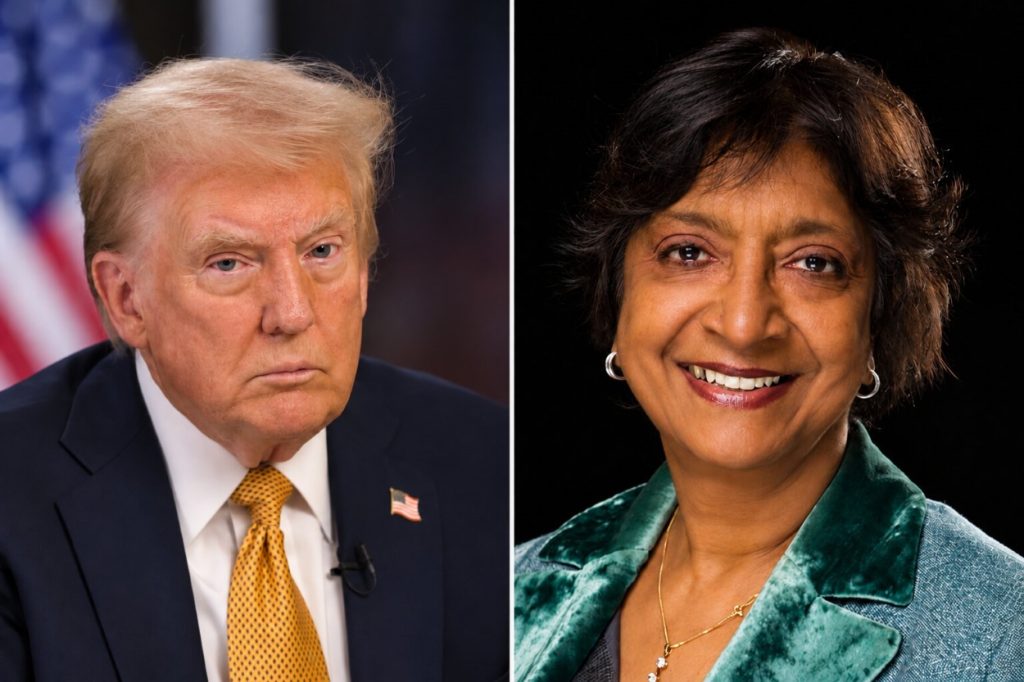
New Delhi: The US president, Donald Trump, amplified criticism of Navanethem “Navi” Pillay after the Indian-origin South African jurist was named the winner of the 2026 Nobel peace prize on Thursday. He reposted a message accusing the former United Nations human rights chief of hostility towards America and Israel, following an announcement that honoured her contribution to peace through international law.
The message shared on Truth Social, posted by the account @Schoenlaw, described Pillay as an “unabashed hater of America and Israel” and accused her of supporting terrorists. It also attacked the Norwegian Nobel committee’s judgment, arguing that Trump’s diplomatic initiatives deserved recognition instead.
The post praised the Abraham Accords, efforts to secure the release of hostages and Trump’s attempts to resolve international conflicts, while dismissing Pillay’s investigation into Israel’s conduct in Gaza. Those accusations were the original author’s assertions, which Trump circulated through a repost.
The Nobel committee’s announcement presented a different assessment, recognizing Pillay’s decades of work to strengthen legal accountability for war crimes, crimes against humanity and genocide. It warned that international legal institutions were under pressure as power politics increasingly displaced respect for established rules.
The committee did not mention Trump or Israel in its citation, framing the award around the relationship between justice and lasting peace. Its stated reasoning emphasized the responsibility of states and individuals to obey the law, alongside the importance of protecting judges and institutions from political attacks.
Pillay, 85, learned of the award while attending a legal gathering in Nuremberg, Germany, where Nazi leaders were tried after the Second World War. In her initial response, she joked about sharing the prize with Trump, who has repeatedly said he deserves the honour.
Behind the exchange lies a substantive dispute over the Gaza war and the authority of international investigations. Pillay chaired the UN’s independent commission of inquiry on the occupied Palestinian territory, including East Jerusalem, and Israel, which concluded in September 2025 that Israel had committed genocide in Gaza.
Israel rejected that finding, accusing the commission of bias, and also condemned the Nobel award. The inquiry’s conclusion was an investigative finding rather than a binding court judgement, a distinction that matters when assessing its legal significance.
The allegation in the repost that Pillay rewarded Hamas also requires context from the commission’s published record. In its earlier investigation into the October 7, 2023 attacks, the commission found that Hamas and other Palestinian armed groups had committed war crimes, including attacks on civilians, murder, torture and hostage-taking.
Pillay’s career extends well beyond the Israeli-Palestinian conflict, beginning with legal work under apartheid in South Africa. Born in Durban into a family of Indian Tamil descent, she established her own law firm in 1967 and later pursued advanced legal studies at Harvard University.
According to the Nobel committee’s biographical account, she served on South Africa’s high court, the international criminal tribunal for Rwanda and the international criminal court (ICC). She was the UN high commissioner for human rights from 2008 to 2014 and currently serves as an ad hoc judge at the International Court of Justice in the genocide case against Myanmar.
Her work at the Rwanda tribunal helped establish that rape and sexual violence could constitute genocide, an important development in international criminal law. The committee cited that contribution as part of a broader record of expanding accountability for atrocities and giving victims access to justice.
The award also comes amid Trump’s confrontation with the ICC, whose judges and prosecutors have faced US sanctions. Welcoming Pillay’s selection, the Stockholm International Peace Research Institute, or Sipri, said the decision reinforced the role of international law at a time when powerful states were challenging its institutions.