


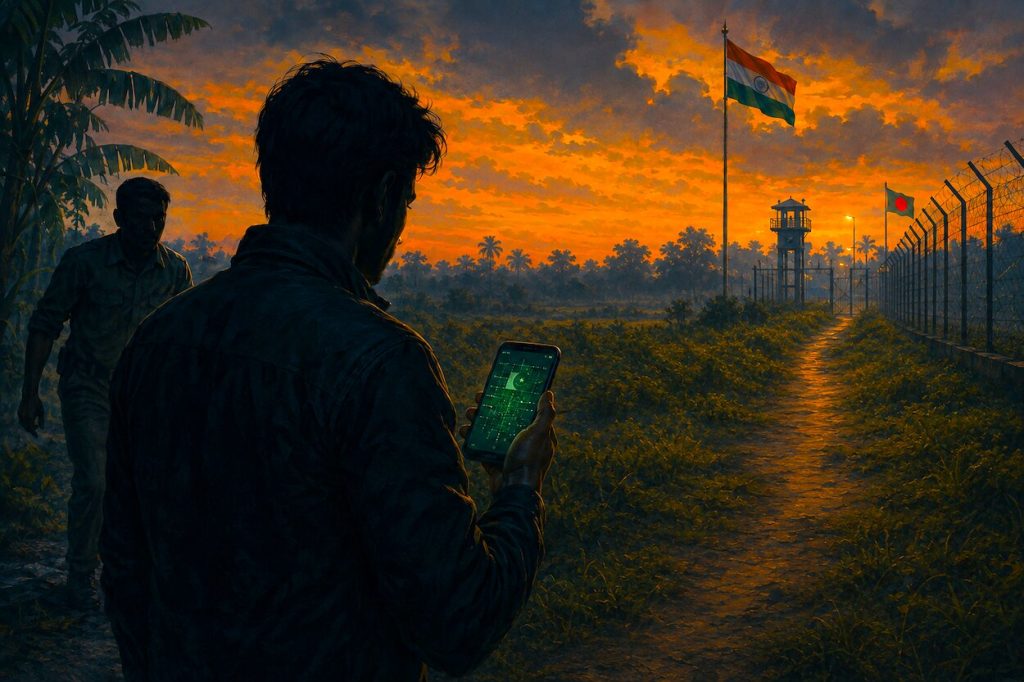
New Delhi: A West Bengal Police’s special task force (STF) arrested a suspected Pakistani national near the India-Bangladesh border for allegedly gathering information on military and railway movements. A second man, accused of helping him obtain fraudulent Indian identity documents and establish himself in the country, has also been taken into custody.
The principal suspect has been identified as Rana Rauf, alias Wahab Alam, a purported resident of Faisalabad in Pakistan, according to officials talking to media. He was intercepted in the Bongaon area of North 24 Parganas district early on Wednesday, reportedly while attempting to cross into Bangladesh.
Investigators suspect Rauf maintained links with Pakistan’s Inter-Services Intelligence and collected information that could be of intelligence value. His nationality and the precise nature of his alleged association with the Pakistani agency are still being independently established.
Officials said Rauf entered India illegally through Nepal in 2012 after spending some time in the neighbouring country. He subsequently settled in West Bengal and allegedly assumed the identity of Wahab Alam using forged documents, including an Aadhaar card and voter identity card.
Electronic devices and other material recovered during the operation are being examined for evidence of espionage. Investigators are particularly scrutinizing photographs of railway stations, tracks and train movements, besides documents purportedly connected with the Indian Army.
The STF is also tracing telephone numbers to which some of the photographs were allegedly transmitted. Investigators are trying to determine the identity of the recipients, whether information was sent outside India and if payments were made through hawala or other informal financial channels.
The second accused has been identified in some reports as Muhammad Izaz, a carpenter living in Kolkata’s Topsia area. He allegedly knew Rauf from Nepal and later helped him secure fraudulent Indian documents and establish a local support system.
Reports differ over the sequence of the arrests, with some saying Izaz was detained first and information obtained during his interrogation led officers to Rauf. The STF is questioning both men to establish whether they were part of a wider network and to identify anyone who may have assisted Rauf during his long stay in India.
The latest arrests come less than two weeks after the STF uncovered a separate suspected Pakistan-linked network allegedly involved in collecting information on political leaders. In that case, as RNA Media had reported, the agency arrested Mohammad Hamim Mondal, an alleged Jaish-e-Mohammed associate, his close associate Arpita Sarkar and college student Aditya Singh.
Mondal was accused of monitoring the movements and security arrangements of the chief minister, Suvendu Adhikari, and gathering information about other political figures. The investigation also uncovered an alleged honeytrap and blackmail operation intended to establish contact with politicians and members of their families, as the RNA Media report said.
Sarkar allegedly helped develop contacts with potential targets, while Singh was accused of supplying photographs and other information to the group. Investigators claimed that members of the network communicated with Pakistan-based handlers, although the allegations have yet to be tested in court.
The timing and broad pattern of the two investigations have prompted the STF to examine possible overlaps between Pakistan-linked contacts operating in West Bengal. However, authorities have not publicly established any direct operational connection between Rauf and the alleged JeM-linked module involving Mondal, Sarkar and Singh.
The latest case has renewed scrutiny of clandestine networks that allegedly exploit forged identity papers, social media, informal financial channels and porous cross-border routes. Investigators are now expected to reconstruct Rauf’s movements and contacts since 2012 and determine how he was able to live under an assumed identity for more than a decade.