


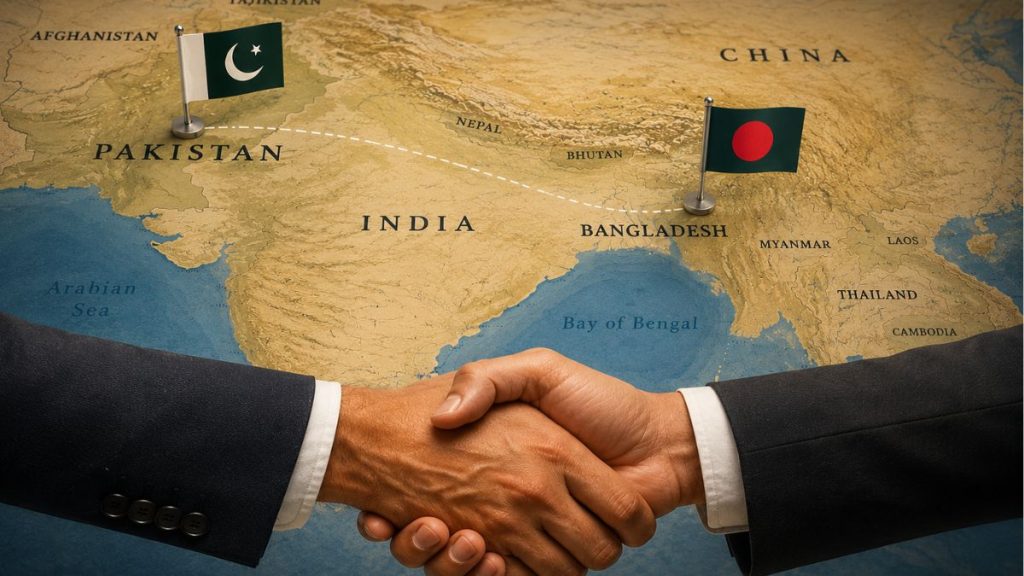
New Delhi: A six-member delegation from Bangladesh’s directorate general of forces intelligence (DGFI) travelled to Islamabad on August 15 on an undisclosed mission, according to reports. The visit comes as Bangladesh weighs its ties with both Pakistan and India, with New Delhi publicly signalling its readiness to host Bangladesh’s prime minister, Tarique Rahman.
The delegation was led by Colonel Magfuz-ul-Bari and included five other officers. They travelled from Dhaka’s Hazrat Shahjalal International Airport to Islamabad via Bangkok on a Thai Airways flight, according to reports.
The purpose of the visit has not been publicly disclosed. The Economic Times reported that the delegation travelled to Pakistan amid growing intelligence-level engagement between Dhaka and Islamabad. Other reports said the officers met their counterparts in Pakistan’s Inter-Services Intelligence (ISI).
The visit follows an earlier trip to Islamabad on April 1 by the DGFI’s director general, Major General Kaisar Rashid Chowdhury, who had taken charge of the agency earlier this year. He travelled with three other DGFI officers and met senior Pakistan Army and ISI officials.
That Pakistan visit came less than a month after Maj Gen Chowdhury’s trip to New Delhi on March 1, where he held two days of discussions with senior Indian national security officials. The sequence is notable, the DGFI chief visited New Delhi in March, then Islamabad in April, and a larger DGFI delegation has now travelled to Pakistan again.
This comes against a changing diplomatic backdrop between Dhaka and New Delhi. Earlier in August, reports suggested Rahman could visit New Delhi in the second half of the month. Preparations were reportedly under way in both capitals by August 14 for a possible two-day visit, which would have been Rahman’s first trip to India as prime minister, covering trade, connectivity, energy, border management and regional security.
India has continued to signal that it wants the engagement to go ahead. India’s high commissioner to Bangladesh, Dinesh Trivedi, said on Tuesday that the prime minister, Narendra Modi, wanted Rahman’s proposed visit to be “memorable,” and that the two leaders needed to meet. He said Rahman would receive an “honourable reception” in India.
There is no public information on what the delegation discussed in Pakistan, or whether the meetings involved operational intelligence cooperation. Some reports have suggested the visit reflects an expanding Pakistani footprint in Bangladesh, but this remains an assessment rather than an officially established fact.
A friendship that’s been warming for a while
What is clearer is that defence and intelligence contacts between Bangladesh and Pakistan have become more visible since the political change in Dhaka. The April visit by the DGFI chief, followed by this delegation-level engagement, suggests the channel between the two security establishments remains active.
The pattern goes back further than this trip. Pakistan’s Chairman of the Joint Chiefs of Staff Committee, General Sahir Shamshad Mirza, made a four-day visit to Dhaka, meeting Bangladesh’s military leadership and the head of the then-interim government, Muhammad Yunus. Officials on both sides later confirmed a Joint Intelligence Mechanism had been set up to coordinate between the ISI and the DGFI.
Separately, 12 senior Bangladeshi civil servants travelled to Lahore in May for a leadership programme at Pakistan’s Civil Services Academy, funded by Islamabad. Dhaka has also expressed interest in acquiring Pakistani-made JF-17 fighter jets and Fatah-series rocket systems, according to reports, though no confirmed order has been announced.
For Pakistan, stronger ties with Bangladesh offer a chance to rebuild defence relations that have remained limited since Bangladesh’s independence in 1971. For Dhaka, engagement with Islamabad can form part of a broader effort to maintain ties with multiple regional powers rather than depend on a single partner.
Should India be alarmed?
Bangladesh shares a long border with India and is close to its northeastern states and the Bay of Bengal. This makes any closer security ties between Bangladesh and Pakistan important for New Delhi to watch.
India’s government has already put that concern on record. Asked about it directly, the Ministry of External Affairs spokesman, Randhir Jaiswal, said India was keeping a “keen watch” on a “significant increase in military-to-military engagements” between Pakistan and Bangladesh.
India, however, has not stepped back from its engagement with Dhaka. Jaiswal has continued to call for a “constructive, positive approach” and a “mutually beneficial relationship” with Bangladesh. Bangladesh, while continuing to press separately on unresolved issues like Sheikh Hasina’s extradition and cross-border crime.
That dual approach was visible again this week. Trivedi spoke of “trust” and economic cooperation while pushing for Rahman’s visit to India, and an Indian trade delegation from the confederation of Indian Industry was in Dhaka exploring investment at the same time.
For Pakistan, closer ties with Bangladesh offer a chance to rebuild defence relations that have remained limited since 1971. For Dhaka, engagement with Islamabad appears to be part of a wider effort to maintain ties with multiple regional powers.
For India, the message is therefore less about reacting to Pakistan visits and more about watching how far the broader Bangladesh-Pakistan security relationship develops.