


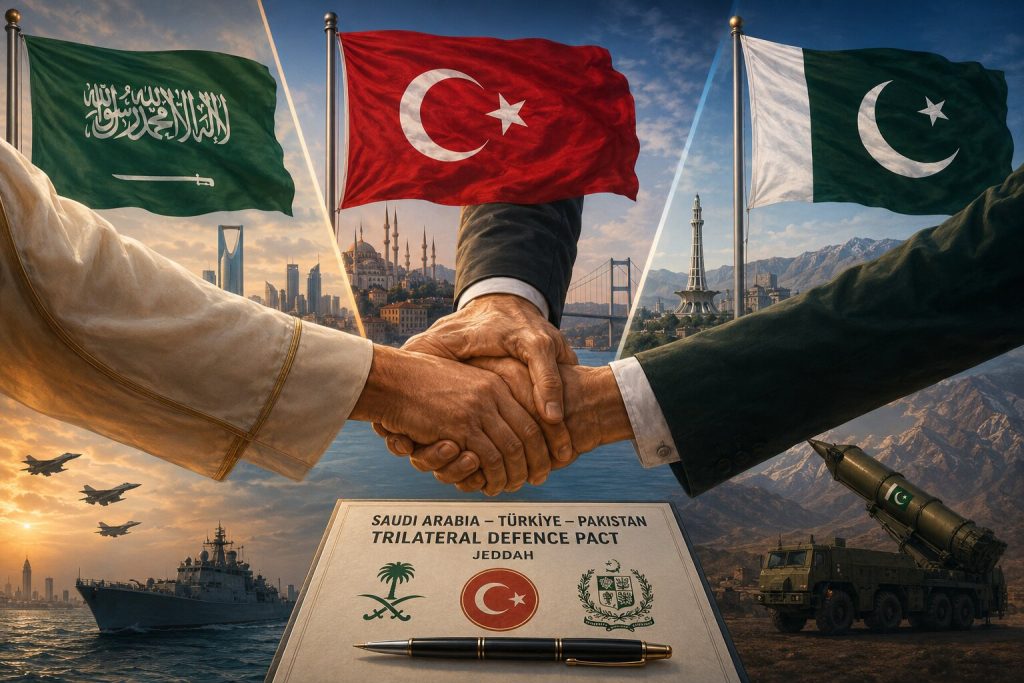
New Delhi: Saudi Arabia, Türkiye and Pakistan are set to sign a trilateral defence agreement in Jeddah on Friday, according to sources close to the Saudi military and government cited by AFP. The three countries had discussed such an arrangement for months, but the widening war between the United States and Iran is understood to have pushed the timeline forward.
“It was under discussion for a long time, but the latest developments in the region expedite it,” one source told Euro News on condition of anonymity. A second source close to the Saudi government separately confirmed that the signing would take place on Friday, in the Red Sea city that has become Riyadh’s preferred venue for high-stakes diplomacy.
The crown prince of Saudi Arabia, Mohammed bin Salman, is due to host the president of Türkiye, Recep Tayyip Erdoğan, and the prime minister of Pakistan, Shehbaz Sharif, for the signing. Sharif, accompanied by Pakistan’s chief of defence forces, Field Marshal Syed Asim Munir, arrived in the kingdom on Thursday for a visit that Islamabad’s foreign ministry says will run from August 6 to 8. Erdoğan is expected to arrive on Friday, the Turkish presidency has said.
Pakistan’s foreign ministry spokesman, Tahir Andrabi, sought on Thursday to frame the visit as more than a response to the immediate crisis. “Although taking place against the backdrop of heightened tensions in the Gulf, the visit will carry significance beyond the immediate crisis and short-term considerations,” he said. That framing matters, because the three governments are keen to present the pact as the product of long-term strategic convergence rather than panic diplomacy.
From bilateral shield to trilateral bloc
The Jeddah signing builds directly on the Strategic Mutual Defence Agreement that Saudi Arabia and Pakistan concluded on September 17, 2025, at Al-Yamamah Palace in Riyadh. That pact commits each country to treat an act of aggression against the other as an attack on itself, language that analysts have repeatedly compared to Article 5 of the Nato charter.
Riyadh has never confirmed that Pakistan’s nuclear arsenal extends a shield over Saudi territory, and the original text of the 2025 agreement makes no mention of nuclear weapons. Pakistan’s defence minister, Khawaja Asif, muddied the picture within days of the signing when he told local television that “what we have, and the capabilities we possess, will be made available according to this agreement,” before partially walking the comment back. The ambiguity has persisted ever since, and it is unlikely to be resolved by Friday’s ceremony.
What drove Riyadh towards Islamabad last year was, in large part, a collapse of confidence in Washington as an unconditional guarantor. Israel’s air raid on Hamas leadership in Doha on September 9, 2025 – a strike that went unpunished by the United States despite Qatar hosting the largest American military base in the Middle East – convinced several Gulf capitals that they needed security options beyond the American umbrella. The 2025 pact with nuclear-armed Pakistan, the only Muslim-majority state with such weapons, was Riyadh’s clearest hedge against that realisation.
Türkiye’s entry reshapes regional maths
Türkiye’s formal induction into the arrangement adds a Nato member with the region’s second-largest standing army and an increasingly assertive defence-export industry, including the Bayraktar and Kizilelma unmanned combat platforms that Ankara has marketed heavily across the Gulf and South Asia. Türkiye and Pakistan already cooperate closely on defence production, and Erdoğan has spent recent months positioning Ankara as an indispensable mediator in regional crises, including the Gaza ceasefire negotiations. His presence in Jeddah signals that Türkiye now wants a formal seat at the table shaping Gulf security architecture, not merely a supporting role as arms supplier and go-between.
Pakistan brings a different kind of leverage. Islamabad has attempted to position itself as a mediator in the US-Iran conflict, drawing on its old ties with Tehran and its newer defence relationship with Riyadh. A trilateral pact with Ankara and Riyadh would let Pakistan convert that mediating posture into something more durable: formal inclusion in a security bloc spanning the eastern Mediterranean, the Gulf and South Asia.
The immediate trigger for accelerating the talks is not hard to locate. Iran closed the Strait of Hormuz after the assassination of its supreme leader, Ali Khamenei, in the US-Israeli strikes of February 28, 2026, and the waterway – through which roughly a quarter of the world’s seaborne oil trade normally passes – has remained a flashpoint ever since. Attacks on shipping have continued even as Tehran and Washington edge towards a partial arrangement with Oman on safe transit routes, and Saudi Arabia has separately told American officials it is bracing for coordinated attacks by Iraqi militias working alongside Iran-backed Houthi rebels in Yemen. Riyadh launched a Red Sea coalition in late July specifically to counter Houthi threats to shipping, and the group has since vowed “full escalation” in response.
Partnership with roots
It would be a mistake to read Friday’s signing purely as crisis management. Saudi Arabia and Pakistan have exchanged troops, training and financial support for close to eight decades, with Pakistani soldiers deployed to defend the kingdom as far back as the 1991 Gulf War. Riyadh has, in turn, repeatedly bailed out Islamabad’s stressed economy with loans and grants, while Pakistani officers train Saudi forces and Pakistan’s industry looks to benefit from the kingdom’s Vision 2030 diversification programme.
That history is precisely why the pact resonates so strongly within Pakistan. Officials in Islamabad have presented the 2025 agreement, and now its trilateral expansion, as vindication after the brief but intense conflict – Operation Sindoor – with India in May 2025, styled domestically as Operation Bunyan-um-Marsoos. Munir’s promotion to field marshal – only the second officer in Pakistan’s history to hold the rank, after Ayub Khan – followed directly from that episode, and his subsequent elevation to the newly created post of chief of defence forces in November 2025 has concentrated unprecedented authority over all three services in a single office.
What it means for New Delhi
For Indian defence planners, the widening of Islamabad’s security guarantees carries two distinct implications. The first concerns deterrence: even without an explicit nuclear commitment, a Pakistan formally underwritten by Saudi and now Turkish backing gains diplomatic cover that could complicate India’s calculus in any future border crisis, particularly given the ambiguity Pakistani officials have themselves cultivated around the nuclear question.
The second concerns hardware and diplomacy rather than weapons. Türkiye’s deepening defence-industrial ties with Pakistan, visible during last year’s conflict in the use of Turkish-origin drones, are likely to intensify further once Ankara is formally bound into a trilateral security framework with Islamabad.
None of this points to an alliance targeted at India by name, and officials in Riyadh, Ankara and Islamabad have each stressed that the pact addresses regional stability rather than any specific adversary. India will nonetheless watch closely how the agreement’s text – still unpublished in the case of the 2025 Saudi-Pakistan accord – is worded when the trilateral version is unveiled, and whether Gulf capitals that New Delhi has cultivated assiduously over the past decade view the pact as complementary to, or in tension with, their growing economic relationship with India.