


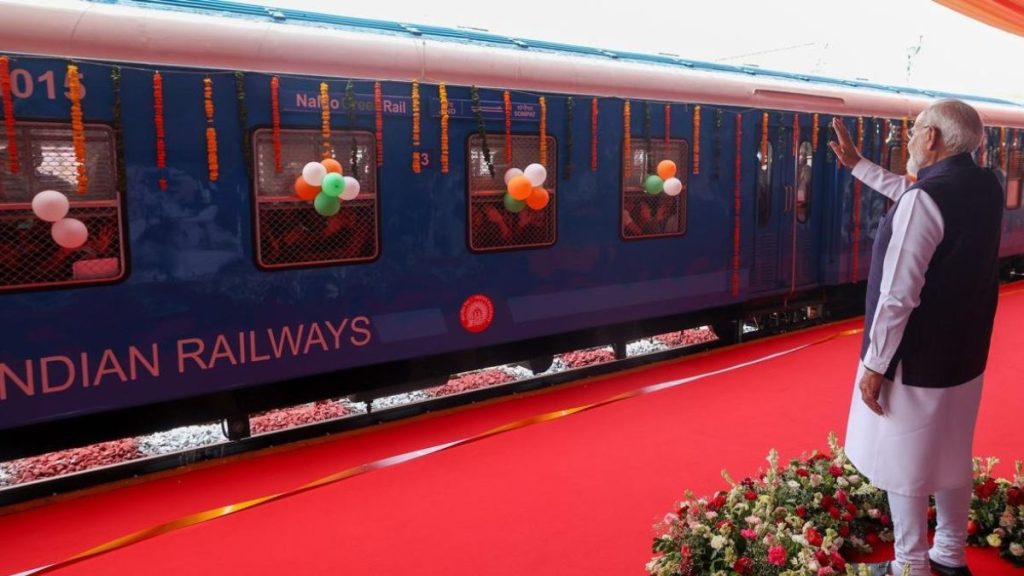
New Delhi: The prime minister, Narendra Modi, flagged off India’s first hydrogen-powered train from Jind, Haryana, on July 17. The train runs on the 89km Jind-Sonipat section of Northern Railway, making India one of a small group of countries testing hydrogen-powered rail technology.
The train was designed and developed domestically under the technical guidance of the Research Designs and Standards Organization, reflecting the government’s Atmanirbhar Bharat initiative. It is a pilot project rather than a commercial, nationwide rollout.
The 10-coach train includes two hydrogen driving power cars and eight trailer coaches, powered by a 1,200 kW hydrogen fuel-cell propulsion system. It has a passenger capacity of about 2,600, an operational speed of 75 kmph and a design speed of 110 kmph.
Inside the train, hydrogen combines with oxygen inside a fuel cell to generate electricity, which powers the train’s traction motors. The only by-products are water vapour and heat, making the train’s operation free of tailpipe carbon emissions.
To support the train, Indian Railways has built the country’s largest railway hydrogen storage facility at Jind, with a capacity of about 3,000 kg of hydrogen. “The facility has received the required licence from the Petroleum and Explosives Safety Organisation (PESO) for the storage and dispensing of compressed hydrogen, while the system underwent an independent third-party safety assessment by Germany-based TÜV SÜD.”
Safety systems built into the train include hydrogen and flame detectors, continuous ventilation, and an automatic shut-off mechanism. The refuelling system is also monitored around the clock.
The project aligns with India’s National Green Hydrogen Mission, which aims to replace fossil fuel-derived hydrogen, build domestic electrolyser manufacturing, and create export opportunities in green hydrogen and ammonia.
During the launch, Modi linked the initiative to energy security. He referred to instability around the Strait of Hormuz, arguing that India’s railway electrification has reduced its vulnerability to fuel-related disruptions from such conflicts.
Germany, Japan, China and the US are among the other countries exploring hydrogen rail technology, with Germany already operating hydrogen trains commercially.