


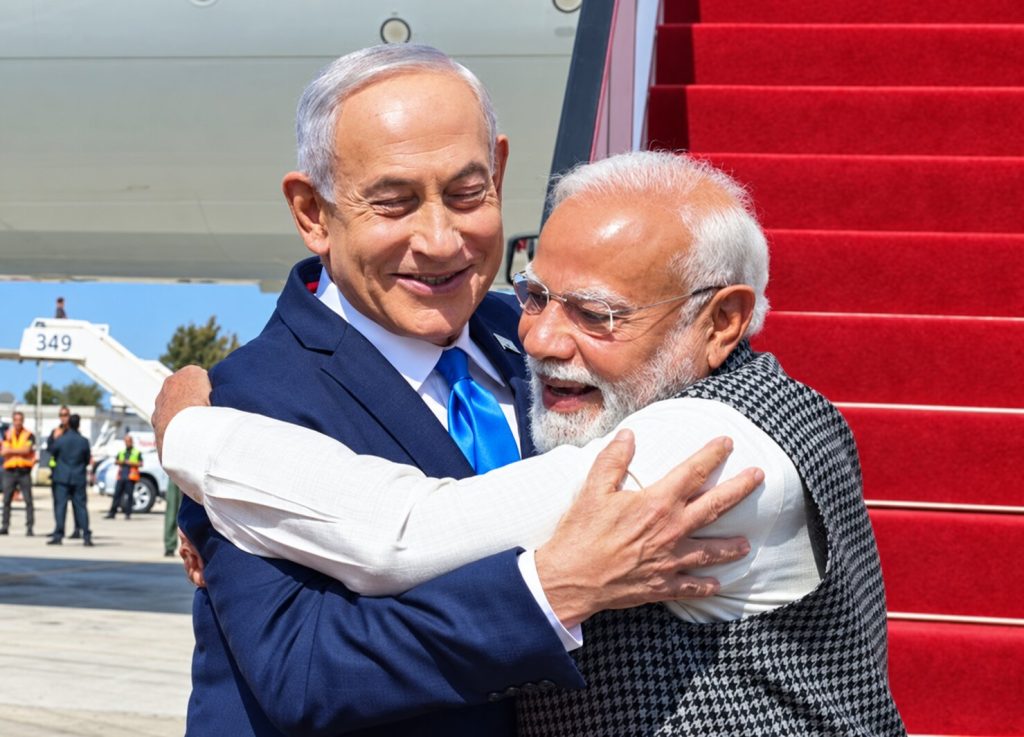
New Delhi: The Israeli prime minister, Benjamin Netanyahu, has invited the prime minister, Narendra Modi, to light a ceremonial torch alongside Indian pilot Smit Machchhar at Israel’s Independence Day celebrations in 2027. The invitation, conveyed during a telephone conversation on Thursday follows Netanyahu’s earlier announcement honouring the Flydubai captain for helping thwart an attack aboard a passenger aircraft.
Announcing the invitation on X, Netanyahu said Modi had thanked him and highlighted the two countries’ cooperation against terrorism on the ground and in the air. His account also referred to the strength of their longstanding relationship, although the reports of the conversation did not confirm Modi’s attendance at the ceremony.
The Indian account of the call focused on bilateral cooperation and the situation in West Asia. The ministry of external affairs said the leaders reviewed progress in relations, reaffirmed their commitment to strengthening their special strategic partnership and emphasized the urgent need to restore regional peace and stability.
Modi reiterated India’s position that dialogue and diplomacy should guide efforts to resolve the region’s conflicts. The two leaders agreed to remain in contact, placing the ceremonial invitation within a wider discussion on diplomatic and security concerns.
Netanyahu had first announced the proposed invitation on October 3 during a separate telephone conversation with Machchhar. He praised the pilot’s actions aboard flydubai flight 1073 and proposed that he and Modi participate in the following year’s celebrations.
Machchhar helped save 174 passengers during an attack inside the aircraft’s cockpit. The broadcaster reported on October 4 that he was receiving medical treatment in Abu Dhabi, and that Netanyahu had wished him a full recovery while conveying his regards to the pilot’s family.
The proposed honour carries significance because the torch-lighting ceremony is the state event that marks the transition from Israel’s memorial day for fallen soldiers and victims of hostile acts to its Independence Day celebrations. Held at Mount Herzl in Jerusalem, it centres on the lighting of 12 torches representing the 12 tribes of Israel.
However, Netanyahu’s invitation does not itself complete the formal selection of torchbearers. The process involves a public advisory committee and subsequent ministerial approval, meaning the announcement should be distinguished from a finalized ceremonial programme.
The diplomatic outreach comes after a further expansion of India-Israel ties earlier this year, when Modi visited Israel on February 25 and February 26. The leaders agreed to elevate relations to a special strategic partnership for peace, innovation and prosperity, building on cooperation in defence, security, agriculture, water management and emerging technologies.
Their joint statement set out plans to deepen collaboration in artificial intelligence, cybersecurity, semiconductors, quantum computing and other advanced technologies. It also welcomed the defence cooperation memorandum signed on November 4, 2025, and outlined a broader direction for future security cooperation.
The relationship rests on more than three decades of formal diplomatic engagement, with full ties established in January 1992. Modi’s July 2017 visit – the first by an Indian prime minister to Israel – elevated relations to a strategic partnership, followed by Netanyahu’s reciprocal visit to India in January 2018.