


New Delhi: Nepal’s foreign minister, Shisir Khanal, met his Indian counterpart, S Jaishankar, in New Delhi on Saturday, a day after meeting the national security advisor, Ajit Doval. Khanal arrived in the national capital on Friday and was received by Munu Mahawar, additional secretary at the Ministry of External Affairs.
Welcoming him to India, the MEA spokesperson, Randhir Jaiswal, said in a post on X that continuing with the tradition of regular high-level exchanges, the visit will help further strengthen the special partnership between India and Nepal. During the meeting, the two foreign ministers discussed various matters related to further strengthening Nepal-India bilateral relations.
Khanal’s visit to India comes three months after Nepal’s new government, led by the prime minister, Balendra Shah, took charge in March after a landslide victory. Shah’s government took over from the interim prime minister Sushila Karki, who had replaced former prime minister KP Oli following violent Gen-Z protests against his government.
The visit comes only days after Shah said in the country’s parliament that the persisting border issue between India and Nepal was not one-sided and that Nepal too had encroached upon Indian territory. This led to a significant backlash in his own country.
In a statement, Nepal’s foreign ministry said it is committed to resolving border-related issues with India through diplomatic negotiations.
“Both countries have expressed their commitment to resolve border-related disputes through diplomatic channels and mutual discussions,” the statement said.
It added that Nepal and India share a centuries-old open border, guided by the Sugauli Treaty of 1816, while noting that certain areas were yet to be fully mapped.
“It is well known that Nepal and India have a centuries-old, long and open border. The current international border of Nepal is established and guided by the Sugauli Treaty of 1816. The Susta and Limpiyadhura, Lipulekh, and Kalapani areas within the Nepal-India border are yet to be mapped. Apart from these places, there are problems of “cross-border occupation” and Dashgaja encroachment in some other places,” the statement read.
The Nepalese foreign ministry further stated that the technical committee of Nepal and India is actively collecting data, repairing border pillars, and jointly studying these areas.
The land border between India and Nepal is an open, porous international boundary spanning 1,751 kilometres. The tensions between India and Nepal came to the fore once again in early May this year when Nepal officially issued diplomatic notes to both India and China regarding the proposed Kailash Mansarovar pilgrimage route passing through the Lipulekh Pass.
Kathmandu said that the region is its territory and urged both nations to refrain from conducting religious pilgrimages or border activities there without its consent.
Reacting to Nepal’s remarks at the time, the MEA said that such “unilateral artificial enlargement” of territorial claims was “untenable”.
The MEA said, “Lipulekh Pass has been a long standing route for the Kailash Manasarovar Yatra since 1954 and the Yatra through this route has been going on for decades. This is not a new development.” It added that India remains open to constructive interaction with Nepal on all issues in the bilateral relationship, including on resolving agreed outstanding boundary issues through dialogue and diplomacy.
In May 2020, the KP Sharma Oli-led government had, through a constitutional amendment, issued a new map incorporating Limpuyadhura, Lipulekh and Kalapani. This had garnered a strong reservation from India with the government saying that Nepal had issued a revised official map with parts of the Indian territory included.
Only days after the release of the official map in Nepal, for the first time, the border between the two countries saw a firing incident take place in June 2020 when Nepal’s Armed Police Force opened fire on a crowd in Bihar’s Sitamarhi district, killing one Indian civilian and injuring two others.
Nepal’s visiting foreign minister meets Doval, Jaishankar
Khanal’s visit to India comes three months after Nepal’s new government, led by the prime minister, Balendra Shah, took charge in March after a landslide victory. Shah’s government took over from the interim prime minister Sushila Karki, who had replaced former prime minister KP Oli following violent Gen-Z protests against his government.
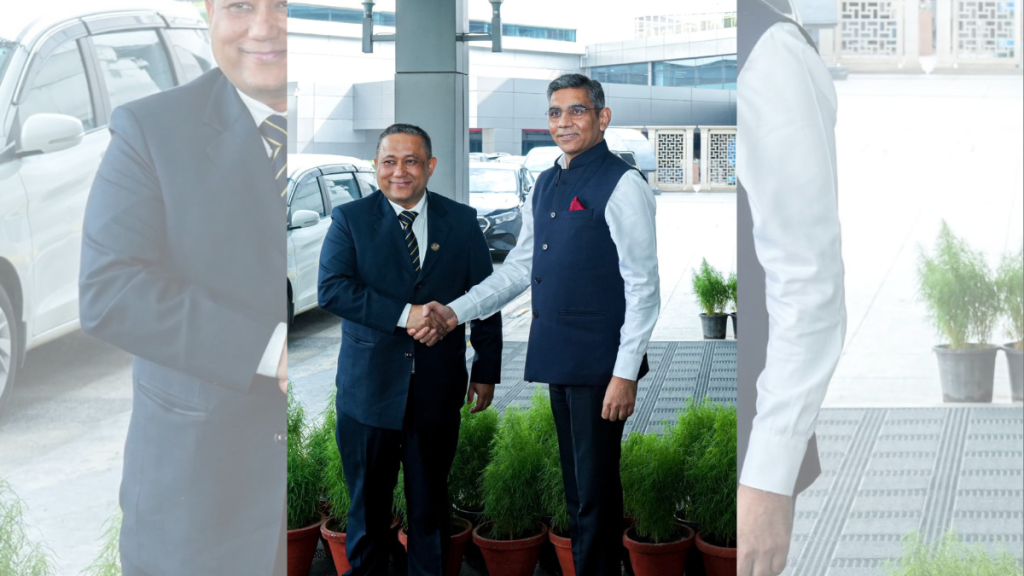
Nepalese Foreign Minister Shisir Khanal with Munu Mahawar, Additional Secretary at the Ministry of External Affairs. Picture Credit: MEA India/X