


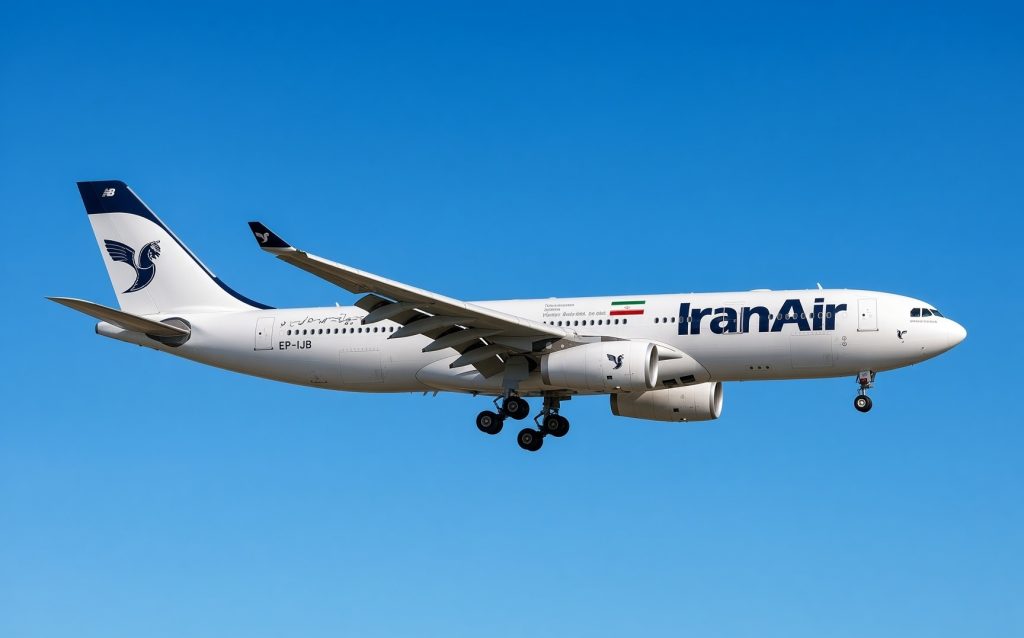
New Delhi: An adviser to Iran’s supreme leader, Mojtaba Khamenei, warned on Friday, that countries across the region would lose access to air travel if Iranian airlines were denied flights and airport services. The warning followed restrictions in the United Arab Emirates and Iraq, where American sanctions are squeezing Iran’s international aviation links.
Mohammad Mokhber issued the threat in a statement on X, accusing governments cooperating with Washington of implementing hostile policies against Iran. His intervention raised the prospect of wider disruption, although the statement did not specify how Tehran intended to enforce its warning or identify a timetable for action.
“Flights in the region are either open to everyone or to no one,” Mokhber wrote, describing this as Iran’s strategy. He said that if Iran could not fly or obtain airport services, other regional countries would also be denied those facilities and warned that Iranians would remember governments aligning with the United States.
The UAE’s General Civil Aviation Authority announced that flights operated by Iranian airlines to and from the country had been suspended from Wednesday until further notice. The regulator explicitly linked its decision to American restrictions on Iranian airlines’ use of airports abroad, confirming that sanctions compliance was driving the suspension.
In Iraq, Najaf International Airport halted all flights to and from Iran from 2am local time on September 25, according to a circular reported by Shafaq News. Airport management instructed airlines and operators to stop preparations for the affected services, but the circular neither explained the decision nor identified the authority that ordered it.
The Najaf suspension closed an alternative that Iranian aviation officials had been exploring after restrictions emerged at Baghdad International Airport. On September 22, Iran’s Civil Aviation Organization said Baghdad would stop receiving Iranian carriers and that discussions were underway to transfer their operations to Najaf.
That option was significant because Iranian destinations dominated Najaf’s traffic: Shafaq reported that 18 of the airport’s 20 scheduled flights on September 23 were bound for Iranian cities. Restrictions widened further on September 25, when Erbil airport’s director told the agency that flights between Iran and airports in Iraq’s Kurdistan region had been suspended indefinitely.
The immediate background is a US treasury sanctions package announced on September 8, targeting 36 individuals and entities supporting Iran’s aviation sector, including 27 Iranian airlines. Washington said the measures formed part of Operation Economic Outcast, its campaign to restrict Tehran’s access to international finance and commercial support networks.
The treasury alleged that Iran used aviation networks to transport weapons, personnel and illicit cargo, while overseas intermediaries helped obtain American aircraft and technology. The US treasury secretary, Scott Bessent, warned that companies continuing to support sanctioned Iranian airlines risked exclusion from the global financial system.
The pressure therefore extends beyond permission to land: businesses providing cargo services, aircraft transfers and sales support can also face sanctions exposure. This helps explain why restrictions can spread across several countries without a single, region-wide airspace closure, as individual authorities and service providers withdraw access to avoid financial penalties.
Washington also suspended three aviation authorizations, including permissions covering certain overflights and visits to Iran by foreign airlines using American-origin or American-controlled aircraft. The Treasury said aviation safety requests would be considered individually, adding another layer of uncertainty for operators assessing whether particular services could continue.
The disruption also threatens travel businesses dependent on Iranian connections, alongside passengers whose journeys now require different arrangements or cancellation. In reporting on the commercial impact, Shafaq cited an Iraqi travel industry representative’s estimate that Iranian carriers accounted for about 75 per cent of Iraqi agencies’ bookings, illustrating the exposure beyond Iran’s own airlines as airport restrictions narrow the routes available to their customers.