


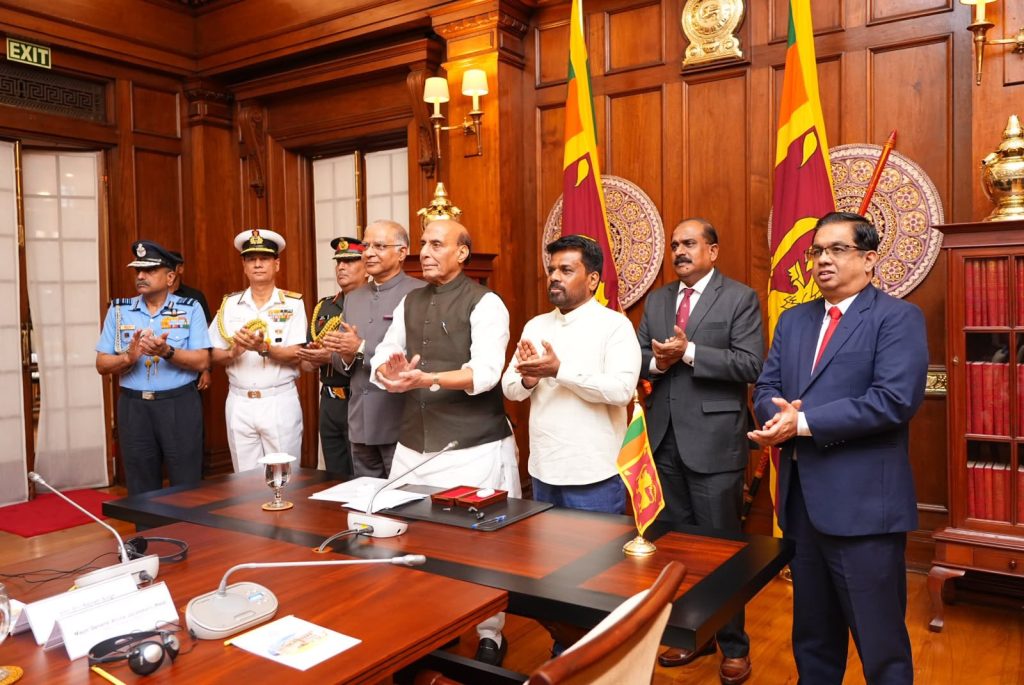
New Delhi: India will stand firmly with Sri Lanka whenever the island nation faces a crisis, the defence minister, Rajnath Singh, has said, reaffirming New Delhi’s commitment to its closest maritime neighbour. Addressing the Indian community in Colombo on Saturday, Singh said the relationship was anchored in geography, civilizational connections and enduring political and economic ties.
Describing Sri Lanka as a close friend, Singh said neighbours could not be changed and India had traditionally regarded countries in its immediate neighbourhood as members of an extended family. He said his arrival in Colombo had given him a sense of belonging and praised the Indian community for serving as a bridge between the two countries.
The remarks carried particular weight because India was among the first countries to assist Sri Lanka during its severe economic and foreign-exchange crisis in 2022. New Delhi extended assistance worth about $4 billion through credit lines, currency support, deferred payments and supplies of fuel, food and medicines when the island was struggling with acute shortages.
India also became the first bilateral creditor to provide the financial assurances required for Sri Lanka to secure its International Monetary Fund programme. It subsequently co-chaired the official creditor committee with Japan and France, helping Colombo restructure about $5.8 billion in bilateral debt owed to participating creditor nations.
Turning to India’s economic trajectory, Singh said New Delhi’s expanding network of trade agreements reflected its growing diplomatic and commercial influence. He contrasted the four comprehensive trade agreements concluded before 2014 with the Narendra Modi government’s trade arrangements covering 38 countries, including several major economies.
The defence minister described the India-European Union free-trade agreement as a landmark accord providing Indian businesses access to a market estimated at about $27 trillion. He said the agreement was not merely a commercial arrangement but also an indication of India’s increasing ability to shape consequential international economic partnerships.
Singh also referred to the India-UK free-trade agreement and highlighted the rapid expansion of India’s defence-manufacturing sector. He said annual defence exports had risen from approximately ₹600 crore to ₹39,000 crore over the previous 12 years, reflecting New Delhi’s drive to emerge as a significant supplier of military equipment.
His three-day visit from September 8 to 10 is the first bilateral trip to Sri Lanka by an Indian defence minister in nearly four decades. Singh is leading a high-level delegation for discussions focused on defence cooperation, maritime security and wider regional stability, according to the Ministry of Defence.
On Wednesday, as RNA Media reported, Singh met the Sri Lankan president, Anura Kumara Dissanayake, in Colombo and conveyed greetings from the prime minister, Narendra Modi. The two sides discussed cooperation for their countries’ development and their peoples’ welfare, as well as measures to advance security, peace and prosperity across the region.
The visit follows the signing of the first India-Sri Lanka memorandum of understanding on defence cooperation during Modi’s visit to Colombo in April 2025. The five-year framework covers military training, joint exercises, capacity-building, high-level exchanges and broader security cooperation.
Defence engagement between the neighbours already includes the Mitra Shakti Army exercise, the Slinex naval exercise, military training and assistance in maritime surveillance. Closer coordination has assumed greater importance because Sri Lanka lies near some of the Indian Ocean’s busiest shipping routes and occupies a strategically sensitive position close to India’s southern coast.
New Delhi views the partnership as an important component of its Neighbourhood First policy and its Mahasagar vision for regional security and development. For Colombo, cooperation with India provides access to economic support, military training and maritime capabilities as Sri Lanka attempts to sustain its economic recovery and manage competing strategic interests in the Indian Ocean.