


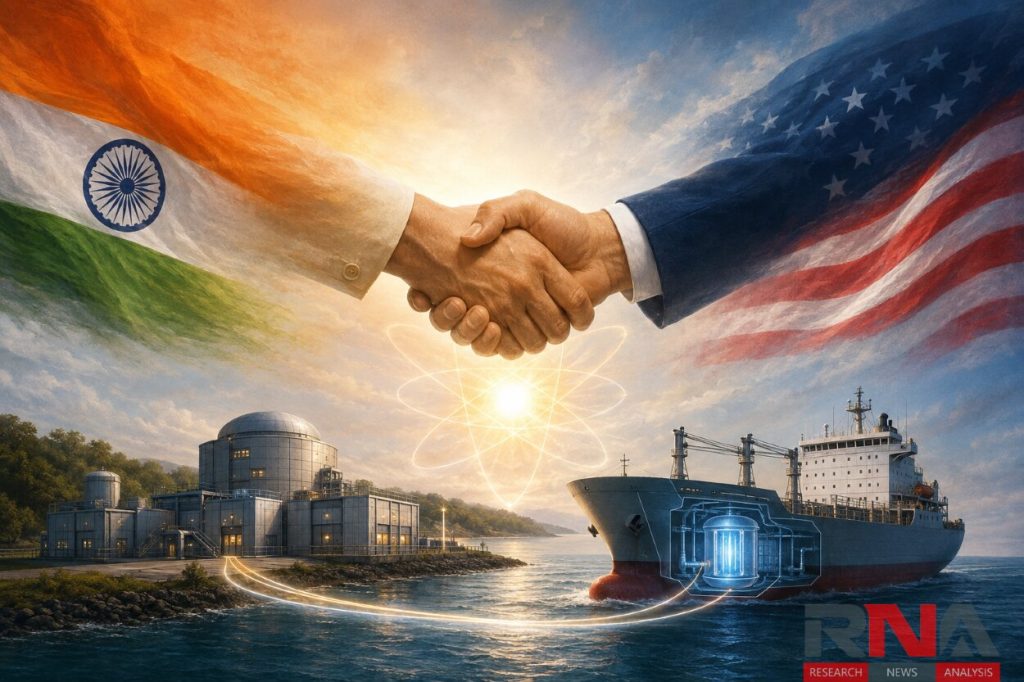
New Delhi: India and the United States have begun a renewed effort to translate their longstanding civil nuclear partnership into operational projects, with policy reform, private investment and small modular reactors moving to the centre of negotiations. The chairman of the Atomic Energy Commission and secretary of the Department of Atomic Energy, Ajit Kumar Mohanty, discussed the next steps with the US energy secretary, Chris Wright, in Washington on Wednesday.
The Department of Atomic Energy said the talks examined recent developments in bilateral civil nuclear cooperation and policy measures that could deepen the partnership for mutual benefit. Although neither side announced a project or commercial agreement, the meeting indicated that both governments were looking beyond diplomatic declarations towards a framework capable of attracting companies and deploying new reactor technologies.
Mohanty was in Washington for the ministerial launch of the International Atomic Energy Agency’s Atomic Technologies Licensed for Applications at Sea (ATLAS) initiative. The two-day event, hosted by the US on August 26–27, brings governments, nuclear regulators, reactor developers and maritime stakeholders together to examine the use of small modular reactors (SMRs) aboard civilian vessels and as offshore energy installations.
ATLAS is intended to help countries develop common approaches to safety, security, safeguards, licensing and nuclear liability before maritime reactors can move from demonstration projects to wider commercial use. It will also examine how different national nuclear and shipping regulations can be harmonized, a particularly difficult requirement for vessels operating across jurisdictions and calling at foreign ports.
Nuclear propulsion could allow commercial ships to operate for long periods without conventional refuelling and sharply reduce carbon emissions from maritime transport. Floating nuclear plants, meanwhile, could supply reliable electricity to islands, ports, offshore industries and remote coastal areas where large land-based power stations or extensive grids may be impractical.
The Washington meeting is significant because civil nuclear cooperation has long been one of the most ambitious but commercially underperforming areas of India–US relations. The landmark 123 Agreement, concluded in 2008 after an initiative announced in 2005, ended India’s international nuclear isolation and facilitated access to global nuclear fuel and technology, but it did not result in the construction of a US-designed reactor in India.
Differences over nuclear liability, high capital costs, technology transfer, localization and the structure of India’s state-controlled atomic-energy sector held back commercial progress. American suppliers were particularly concerned about provisions in India’s earlier liability legislation that could expose equipment manufacturers to claims following an accident, departing from the international practice of channelling primary liability to the plant operator.
A fresh political push came during the February 2025 Washington summit between the prime minister, Narendra Modi, and the US president, Donald Trump. The two leaders committed themselves to building US-designed reactors in India with substantial localization and possible technology transfer, while identifying legal reform and bilateral liability arrangements as necessary for industry participation.
India subsequently enacted the Sustainable Harnessing and Advancement of Nuclear Energy for Transforming India (SHANTI) Act, 2025, replacing the principal laws that had governed atomic energy and nuclear liability. The legislation permits regulated participation by Indian private companies and joint ventures, gives statutory recognition to the Atomic Energy Regulatory Board and recalibrates liability provisions that had discouraged several international reactor suppliers.
These changes are central to India’s Nuclear Energy Mission, which seeks to expand installed nuclear capacity from 8.78 gigawatts as of July 31, 2026, to 100 gigawatts by 2047. The government expects capacity to reach about 22 gigawatts by 2031–32, with public-sector companies, private businesses and joint ventures contributing substantially to the expansion that follows.
The target is ambitious because nuclear power accounted for only about 3.1 per cent of India’s electricity generation in 2024–25. Meeting it will require not only foreign technology and capital but also faster land acquisition, predictable regulation, an expanded domestic supply chain, trained personnel and financing structures capable of supporting projects with long construction periods.
Several US companies have expressed interest in the reopened market, particularly in advanced reactors, components, fuel services and SMRs. A delegation led by the US Nuclear Energy Institute held discussions in New Delhi in May 2026 on private investment and technology partnerships, including the proposed Westinghouse AP1000 project at Kovvada in Andhra Pradesh.
SMRs could offer a more manageable route than immediately relying on very large imported reactors, because they are designed for factory manufacture, modular construction and deployment closer to industrial consumers. Their smaller generating capacity could make them suitable for steel, cement, chemicals, hydrogen production and remote grids, although their economic competitiveness will depend on standardized designs and sufficient orders to reduce unit costs.
India is simultaneously pursuing indigenous reactor designs and has allocated ₹20,000 crore to research, develop and deploy SMRs under its Nuclear Energy Mission. The programme includes a 200-megawatt electrical Bharat Small Modular Reactor, a 55-megawatt electrical design and a high-temperature gas-cooled reactor intended partly for hydrogen production, with at least five domestically designed SMRs targeted for operation by 2033.
Cooperation with the US could therefore complement rather than replace India’s domestic programme, particularly through joint manufacturing, component localization, safety research and the development of common licensing standards. It could also give Indian companies access to an emerging international market for modular and maritime reactors, provided agreements protect sensitive technology and create genuine manufacturing capabilities rather than limiting India to assembly or procurement.
The latest meeting does not by itself resolve the commercial and regulatory questions that have delayed the partnership for nearly two decades. Its importance lies in the changed setting: India now has a revised nuclear law, a defined expansion target and an opening for private participation, while both countries are increasingly focused on compact reactors that may be easier to deploy than the large projects on which earlier negotiations became stuck.