


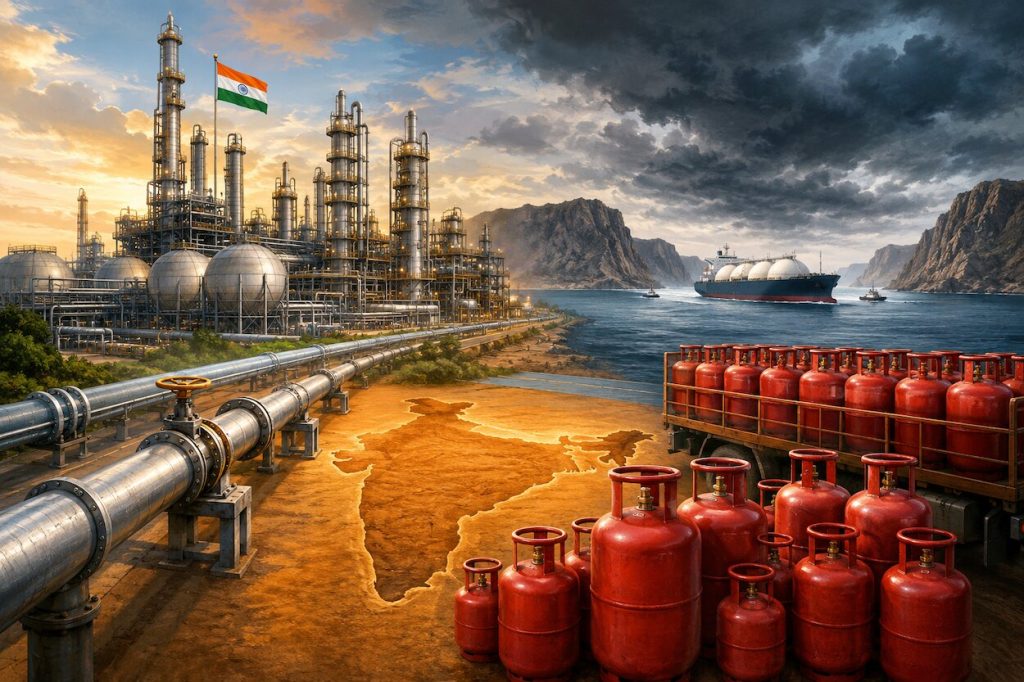
New Delhi: India has established facility-specific production targets for liquefied petroleum gas (LPG), creating a standby mechanism to increase domestic supplies whenever imports are disrupted. Reliance Industries’ refinery serving the domestic market has been assigned the largest individual target under the new energy-security framework.
The Ministry of Petroleum and Natural Gas set a combined maximum production benchmark of 63,810 tonnes a day for 21 refineries and upstream companies through an order issued on August 13, 2026. The prescribed level is more than twice India’s average domestic output in 2025–26 and would meet about 70 per cent of its present daily requirement.
The targets are not intended to operate as routine production quotas but can be activated when the government identifies a supply constraint. They provide the Centre with a pre-determined framework for ordering companies to raise output for specified periods instead of devising emergency allocations after a crisis has begun.
Reliance’s 33-million-tonne-a-year domestic-tariff-area refinery at Jamnagar, Gujarat, has been assigned a maximum target of 18,000 tonnes of LPG a day. The company’s separate 35.2-million-tonne-a-year export-orientated refinery at the same complex has not been included in the production schedule.
Eighteen public-sector refineries have collectively been allocated 31,470 tonnes a day, while Nayara Energy’s Vadinar refinery in Gujarat has received a target of 4,480 tonnes. Upstream producers and gas processors, including the Oil and Natural Gas Corporation and Gail, are expected to supply a combined 6,460 tonnes a day.
The policy follows the serious supply pressure experienced during the recent West Asia conflict, when disruption around the Strait of Hormuz affected shipments from India’s principal LPG suppliers. Before the crisis, the country obtained about 90 per cent of its imported cooking gas from West Asia, leaving household supplies particularly exposed to interruptions along the maritime chokepoint.
India consumed about 33.2 million tonnes of LPG in 2025–26, equivalent to nearly 91,000 tonnes a day, but domestic facilities produced only 13.1 million tonnes during the year. Imports supplied the remaining 21.3 million tonnes, placing the country’s import dependence at more than 64 per cent.
When overseas supplies were disrupted in March, the government directed refiners to divert propane and butane from petrochemical operations to LPG production and prioritized household consumers over commercial and industrial users. Domestic output subsequently increased to about 55,000 tonnes a day at the height of the emergency before the special directions were gradually withdrawn after supplies improved in mid-June.
The new arrangement converts lessons from that disruption into a permanent preparedness mechanism. It authorizes the government to instruct refiners, upstream producers and oil-marketing companies to deliver specified volumes when necessary to protect availability, equitable distribution and consumer prices.
Companies covered by the order must create or strengthen facilities for storing, evacuating and transporting the prescribed quantities through pipelines, railways or road tankers. Refiners have also been asked to examine commercially and technically viable measures such as converting naphtha into LPG and upgrading fluid catalytic cracking units.
Increasing LPG production can, however, require companies to redirect propane and butane from more profitable petrochemical products or petrol-blending components. The framework consequently strengthens supply security but could temporarily reduce refining and petrochemical margins when the higher targets are activated.
The production schedule will be revised on January 1 and July 1 every year to incorporate new refineries, upstream projects and capacity added through technological or infrastructure improvements. With India serving more than 331 million active domestic LPG connections, the system is designed to ensure that another interruption in maritime supplies does not immediately result in rationing or cylinder shortages.