


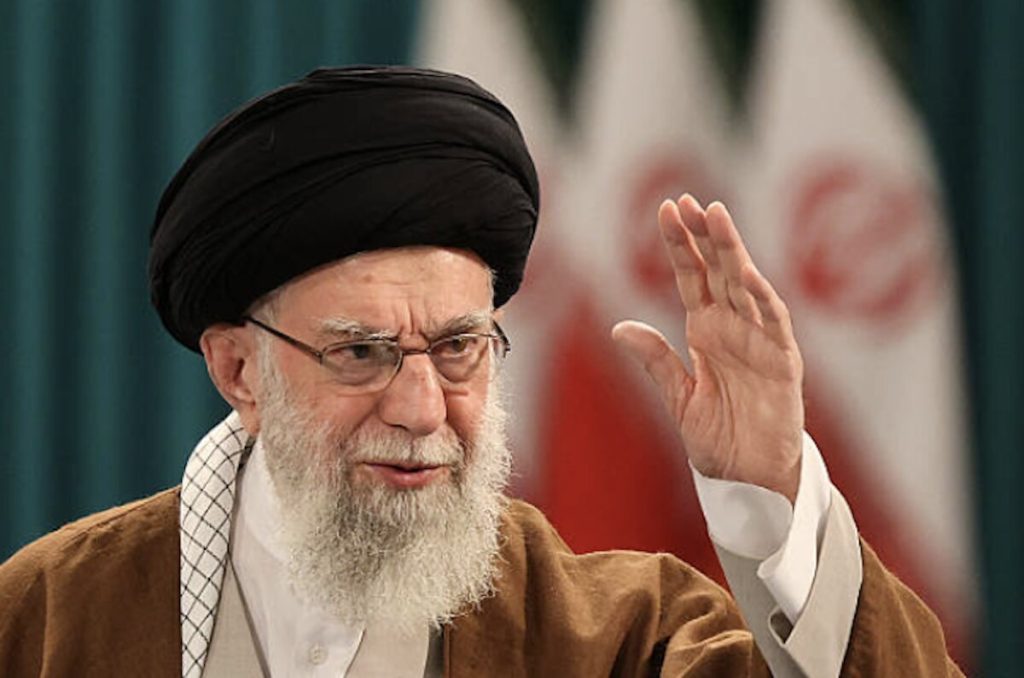
New Delhi: India will send the minister of state for external affairs, Pabitra Margherita, and the governor of Bihar, Lieutenant General Syed Ata Hasnain (retired), to represent the government at the state funeral of Iran’s former supreme leader, Ali Khamenei, who was killed in a joint US-Israeli airstrike on February 28. This appears to be a calibrated diplomatic gesture balancing respect for a long-standing strategic partner with New Delhi’s broader geopolitical interests.
The decision contrasts with India’s much higher-level representation at the funeral of Iran’s former president, Ebrahim Raisi, in May 2024, when the-then vice-president, Jagdeep Dhankhar, led the Indian delegation to Tehran. At that time, the government had also declared a one-day state mourning as a mark of respect following Raisi’s death in a helicopter crash, with the national flag flown at half-mast across the country and no official entertainment held that day.
This time, India’s initial response was notably restrained. No condolence or condemnation message was publicly issued by the government in the immediate aftermath of Khamenei’s death; it was only on March 5, nearly a week after the strikes, that foreign secretary Vikram Misri signed the condolence book at the Iranian embassy in New Delhi – a comparatively junior gesture for the death of a head of state, let alone a leader who had run Iran for over three decades.
The Indian delegation to Khamenei’s funeral was finalized after Iranian president, Masoud Pezeshkian, formally invited the prime minister, Narendra Modi, to attend the state funeral and burial ceremonies. New Delhi, however, decided against sending either the prime minister or another constitutional office-holder of equivalent rank. Officials cited the prime minister’s previously scheduled overseas engagements in East Asia and Oceania during the funeral period.
According to Iranian and Indian government sources, Margherita and Hasnain will attend the ceremonies on behalf of the Indian government. Senior officials from the ministry of external affairs are also expected to accompany the delegation.
The funeral ceremonies are scheduled to be held over several days, beginning in Tehran before concluding with the burial in Mashhad, Khamenei’s birthplace. The ceremonies were delayed for months following his death in the US-Israel joint airstrikes on February 28 because of the regional conflict that followed.
Diplomatic signalling
The composition of the Indian delegation has attracted attention in diplomatic circles because of the symbolic importance attached to funeral diplomacy.
Khamenei was Iran’s highest political and religious authority for more than three decades. He exercised powers that extended well beyond those of the country’s elected president. In Iran’s political system, the supreme leader occupies the apex of the state structure, overseeing the armed forces, judiciary and major strategic decisions.
Against that backdrop, several Indian geopolitical observers view New Delhi’s decision as a carefully calibrated one rather than a diplomatic slight.
According to analysts, India is signalling continued respect for Iran as an important regional partner while avoiding a level of political representation that could complicate its simultaneously expanding strategic partnerships with the United States, Israel and key Gulf Arab states.
Observers also point out that the geopolitical environment differs markedly from May 2024, when Raisi died in an accident and India publicly mourned his death. Khamenei’s killing occurred during a major regional war involving the United States and Israel, making every diplomatic gesture susceptible to broader strategic interpretation.
Several former diplomats and strategic affairs commentators have argued that New Delhi appears to be following its longstanding practice of maintaining engagement with all major actors in West Asia without becoming identified with any competing bloc. In that context, sending a serving minister of state from the ministry of external affairs together with a retired senior Army commander and governor familiar with West Asian security affairs allows India to convey official respect while maintaining diplomatic flexibility.
The inclusion of Hasnain in the delegation is notable beyond protocol.
A former commander of the Army’s Srinagar-based 15 Corps and one of India’s best-known strategic commentators after retirement, Hasnain has remained actively engaged in discussions on West Asian security, counterterrorism and India’s strategic interests in the region. His military background and understanding of regional geopolitics are expected to add weight to India’s representation.
Iran remains strategically important
Despite periodic strains caused by international sanctions on Tehran, India continues to regard Iran as an important strategic partner. Iran occupies a central place in India’s connectivity strategy towards Afghanistan, Central Asia and Eurasia through the Chabahar Port project and the International North-South Transport Corridor.
Tehran also remains relevant to India’s long-term energy security calculations should international sanctions ease.
New Delhi has consistently sought to preserve working relations with Iran even while significantly expanding defence and strategic cooperation with Israel and strengthening its comprehensive partnership with Washington. That balancing act has become increasingly complex following the escalation of conflict in West Asia this year.
Against that backdrop, the decision to send Margherita and Hasnain reflects what many observers describe as India’s continuing policy of strategic autonomy – acknowledging the importance of Tehran while avoiding diplomatic moves that could be interpreted as taking sides in one of the region’s most polarizing conflicts.