


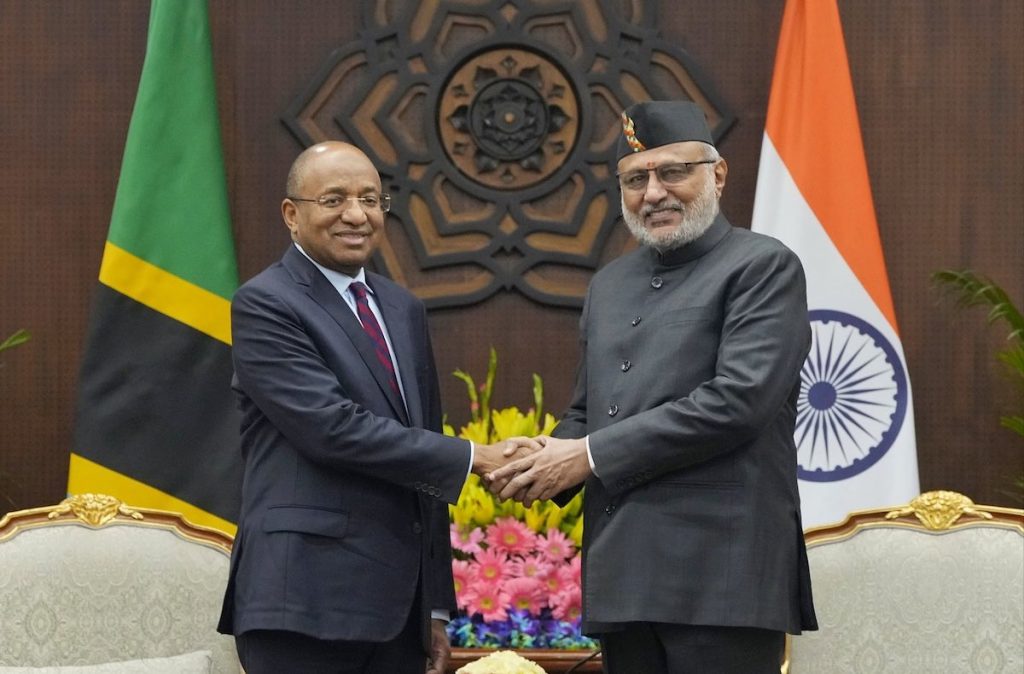
New Delhi: Hussein Ali Mwinyi, the president of Zanzibar, United Republic of Tanzania, and chairman of the Revolutionary Council, held talks with the vice-president, CP Radhakrishnan, and was called on by the external affairs minister, S Jaishankar, in New Delhi on Sunday, as the two countries reviewed the full spectrum of India-Tanzania relations on the penultimate day of his four-day visit. He arrived in New Delhi on Saturday evening, accompanied by his wife, first lady Mariyam Mwinyi, and a high-level delegation of ministers and senior officials.
Mwinyi’s trip, running from July 17 to July 20, began in Chennai, where he was chief guest at the 63rd convocation ceremony of the Indian Institute of Technology (IIT) Madras.
Radhakrishnan and Mwinyi met on Sunday, with the vice-president saying afterwards that the meeting reaffirmed the enduring India-Tanzania partnership and India’s special relationship with Zanzibar, one he described as rooted in centuries-old maritime, cultural and people-to-people ties. The two discussed strengthening cooperation in trade, investment, development partnership, tourism, the blue economy, education, technology and multilateral engagement. Radhakrishnan reiterated India’s commitment to partnering with Tanzania and Zanzibar in advancing shared development goals across priority sectors.
Mwinyi, for his part, spoke of his visit to the IIT Madras campus in Chennai and thanked India for its role in establishing the IIT Madras Zanzibar campus, which he called a landmark in bilateral educational cooperation. He also acknowledged India’s support for water projects in Zanzibar, along with Indian Council for Cultural Relations scholarships and training places under the Indian Technical and Economic Cooperation programme.
Jaishankar met Mwinyi separately on Sunday morning, describing the discussion as productive on social media. The two discussed expanding cooperation in higher education, capacity building, water supply, health, artificial intelligence and digital technology, among other priority sectors. Jaishankar singled out the Zanzibar campus of IIT Madras – India’s first overseas IIT campus – calling it a shining example of the partnership and of India’s commitment to Africa’s education and development priorities.
The Zanzibar campus, established in October 2023, has just completed two years of operation, lending the visit added significance. The India-Tanzania Centre of Excellence in ICT at the Dar es Salaam Institute of Technology, which houses Param supercomputers supplied by India, has also featured in recent bilateral exchanges; Jaishankar visited the centre during a trip to Tanzania earlier this month, on July 6, when he witnessed the signing of the agreement to establish the IIT Madras Zanzibar campus.
No fresh agreements or memorandums of understanding were signed during Sunday’s meetings in New Delhi, with both sides instead using the visit to take stock of an already broadening relationship. Bilateral trade between India and Tanzania has reached $9.02 billion, and officials have indicated that discussions during the visit have also touched on local currency trade settlements and business visas, alongside cooperation in health and education.
Mwinyi’s programme in the capital included laying a wreath at Rajghat in homage to Mahatma Gandhi. He is scheduled to depart India on Monday, bringing the visit – undertaken at Radhakrishnan’s invitation – to a close.
Zanzibar is a semi-autonomous archipelago off Tanzania’s coast in the Indian Ocean, with its own constitution, president, house of representatives and flag, even as the union government in Dar es Salaam retains control over matters such as defence, foreign policy and immigration. Defence cooperation between India and Tanzania is currently guided by a five-year roadmap, and officials have said the visit is expected to lend fresh impetus to ties across trade, cultural, political and strategic dimensions.