


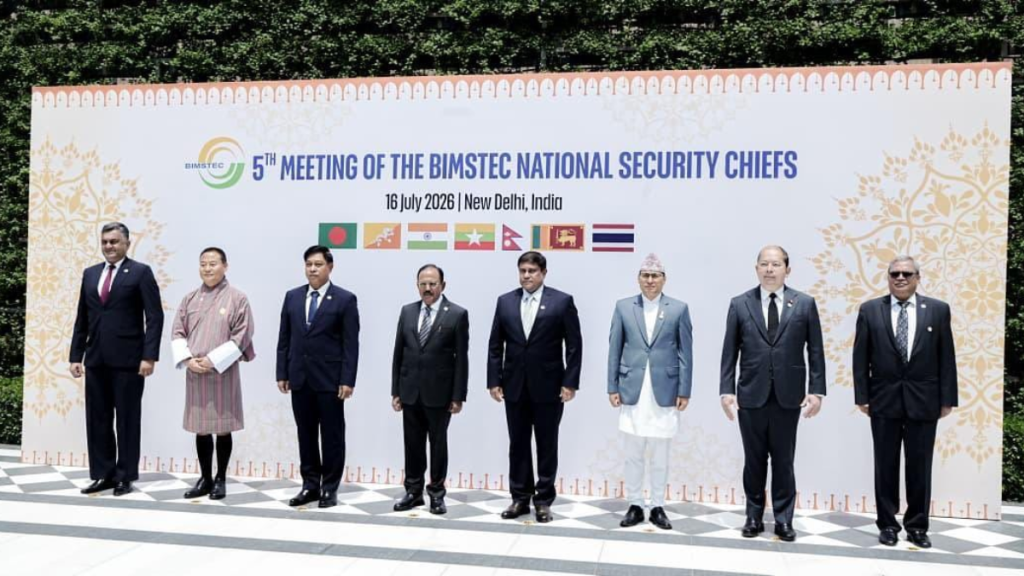
New Delhi: Bangladesh on Thursday called for the revival of the South Asian Association for Regional Cooperation (Saarc) at the fifth Bay of Bengal Initiative for Multi-Sectoral Technical and Economic Cooperation (Bimstec) meeting of National Security Chiefs. The meeting was hosted by the national security advisor, Ajit Doval, in New Delhi.
Saarc, which comprises India, Pakistan, Bangladesh, Nepal, Sri Lanka, the Maldives, Bhutan and Afghanistan has been inactive for a decade now owing to the complete breakdown of ties between India and Pakistan.
India withdrew from the 2016 summit of Saarc that was to happen in Pakistan following the Uri attack on an Indian Army brigade headquarters. At the time, Sri Lanka, Afghanistan, Bangladesh, Bhutan and the Maldives also refused to attend the summit.
The Bimstec comprises countries such as Bangladesh, Bhutan, Myanmar, Nepal, Sri Lanka, and Thailand.
As the current Bimstec chair, Bangladesh has been consistent with this demand for several months. Bangladesh was represented by Brig Gen AKM Shamsul Islam (Retd), defence advisor to the Bangladesh prime minister, Tarique Rahman.
Rehman too had pitched for Saarc’s revival soon after taking charge as Bangladesh’s prime minister in February, saying that it was based on the ideas of his late father Ziaur Rahman, who was the former President of Bangladesh.
He said that Bimstec was now three decades old and that this long journey would attest that security and stability for all countries and communities across our region must precede any economic undertaking.
He added, “It would equally be worthy to draw on the complementarities and good work advanced thru other regional cooperation frameworks in our shared geography, namely SAARC. Most of the countries in this room are witness to the norms-institutions-practicalities advanced within SAARC over long four decades that secured considerable convergence of ideas and initiatives. For instance, in tackling challenges of disaster management, public health, food and energy security, transnational crime.”
He further said in the countries’ work, they could not afford to miss out on that good work. “Bangladesh believes that both the regional cooperation processes, with their distinctive features, ought to move hand in hand.”
Ultimately, he said that effective realization of regional security depends on mutual trust, timely information sharing and practical collaboration grounded in consensus and respect for sovereignty.
“Connectivity may be the engine of BIMSTEC, but security is foundation. Our success will be measured not by declaration, but by the cooperation we deliver. Let us ensure that information moves faster than threat, cooperation comes before crises and our collective efforts protect not only our borders, but also our people, our economy and our shared future,” Brig Gen Shamsul said.
From that vantage point, he said, as the current Bimstec Chair, Bangladesh stands ready to work with all the member states towards building a safer, resilient, and prosperous Bay of Bengal region.
Regarding the Fifth Meeting of the Bimstec National Security Chiefs, the Ministry of External Affairs said in a statement said that Bimstec bridges South Asia and Southeast Asia, two of the most significant and vibrant regions of the Indian Ocean. Over the years, Bimstec has deepened cooperation in regional security, disaster management, transport and trade connectivity, technological issues, and people-to-people contacts.
The MEA added that the national security advisers or heads of delegations discussed practical and result-oriented solutions to combat terrorism and organized crime, ensure security in the cyber, maritime and energy domains; enhance connectivity; facilitate efficient disaster management; and to tackle new and emerging threats.
“They adopted guidelines for the maritime component of humanitarian assistance and disaster relief. These guidelines will help BIMSTEC member states to undertake relief operations in the region in an expeditious manner. They also endorsed a set of guiding principles on the conduct of maritime law enforcement agencies during interactions at sea. These principles are expected to outline reference points for increasing predictability and promoting safety during maritime engagements among member states,” it added.
The Bimstec grouping will celebrate its thirtieth anniversary next year.