


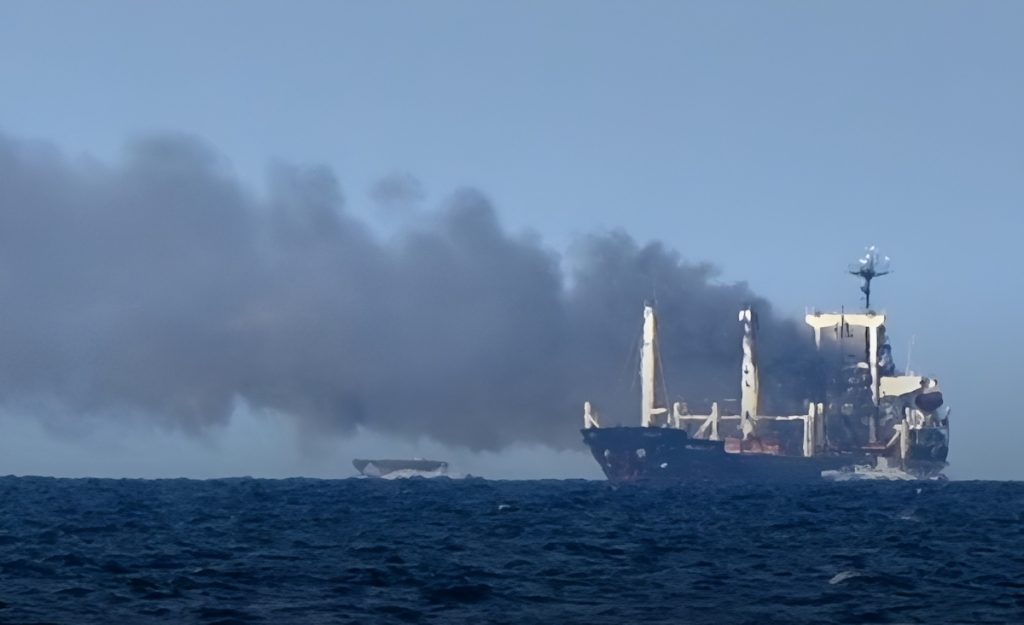
New Delhi: India has issued a fresh advisory cautioning its seafarers against taking up employment on commercial vessels operating in the Black Sea, days after a merchant ship carrying four Indian nationals was struck at the port of Odesa in Ukraine. The advisory, issued by the Ministry of External Affairs on Sunday, comes as the security situation in the Black Sea and adjoining waters remains, in the ministry’s words, highly volatile because of the ongoing Russia-Ukraine war.
Latest strike, familiar pattern
The vessel hit on Saturday had four Indian nationals on board. The Indian embassy in Ukraine said two of them have been confirmed safe, while information on the remaining two was still awaited at the time of the advisory. Search and rescue operations were under way, the embassy said, adding that it was in constant contact with Ukrainian authorities.
The incident is the third involving Indian seafarers in the Black Sea since April this year to result in casualties. An Indian crew member died on July 18 when the vessel MV Omorfi came under attack. A day later, on the evening of July 19, four Indians were killed and a fifth critically injured when the bulk carrier MV Golden Leo was hit by missiles shortly after leaving Odesa with a cargo of grain. Of the 17 crew on board, mostly Indian and Syrian nationals, eight were rescued and taken to hospital in Odesa; the Ukrainian navy said the strike used three cruise missiles and caused a fire on the ship’s superstructure.
New Delhi protested the Golden Leo attack by summoning Russia’s ambassador and conveying what the ministry described as its unequivocal condemnation.
A corridor under pressure
Sunday’s advisory asked Indian nationals intending to take up employment on ships operating in or transiting the Black Sea to carefully weigh the security risks before accepting such assignments, and to ensure that the terms of their employment meet applicable international maritime standards. Those requiring consular assistance were told to contact the Indian embassy or the relevant consulate in the region.
The advisory follows a separate warning issued on Thursday by the Directorate General of Shipping, which called for the highest degree of caution while operating in the Black Sea and recommended voyage-specific security risk assessments before ships enter the region. The directorate said there had been ten attacks since April involving Indian seafarers on foreign-flagged vessels, among them strikes on the tankers MT Asia, MT Louise-1 and MT Nelsa near Novorossiysk, which damaged the ships and forced Indian crew to disembark. It had issued a similar caution a week earlier for Indian seafarers on vessels transiting the Strait of Hormuz, underlining how conflict zones on two fronts are now converging to squeeze the community that keeps much of world shipping moving.
India supplies more seafarers to the global merchant fleet than almost any other country, with more than 320,000 active mariners recorded in 2025 by the shipping ministry – a scale that leaves Indian crews disproportionately exposed whenever a conflict zone intersects a major trade route.
Why Odesa keeps getting hit
Ukraine set up its own shipping corridor along the Black Sea’s western coast in 2023 after Russia withdrew from the UN-brokered grain export arrangement, and has since routed more than 100 million tonnes of food cargo through it, including some 78 million tonnes of grain. Moscow maintains that ships calling at Ukrainian ports support Kyiv’s war effort and has stepped up strikes on port infrastructure and vessels accordingly. Ukrainian officials have called the pattern a deliberate campaign against the country’s economy, its agricultural exports and freedom of navigation more broadly.
Maritime risk analysts say the recent run of strikes marks a shift in Russian targeting, with ships themselves – not merely port facilities – now being hit directly while berthed or departing. That has pushed up war-risk insurance premiums in the affected stretch of the Black Sea by as much as 30 per cent in recent weeks, according to industry assessments, a cost that is likely to be passed on through freight rates and, eventually, food prices.
For Indian seafarers, who form one of the largest single national contingents on the world’s merchant fleet, the calculation is becoming starker: the wages on offer for Black Sea voyages must now be weighed against a route that has turned into one of the more dangerous corridors in global shipping.