


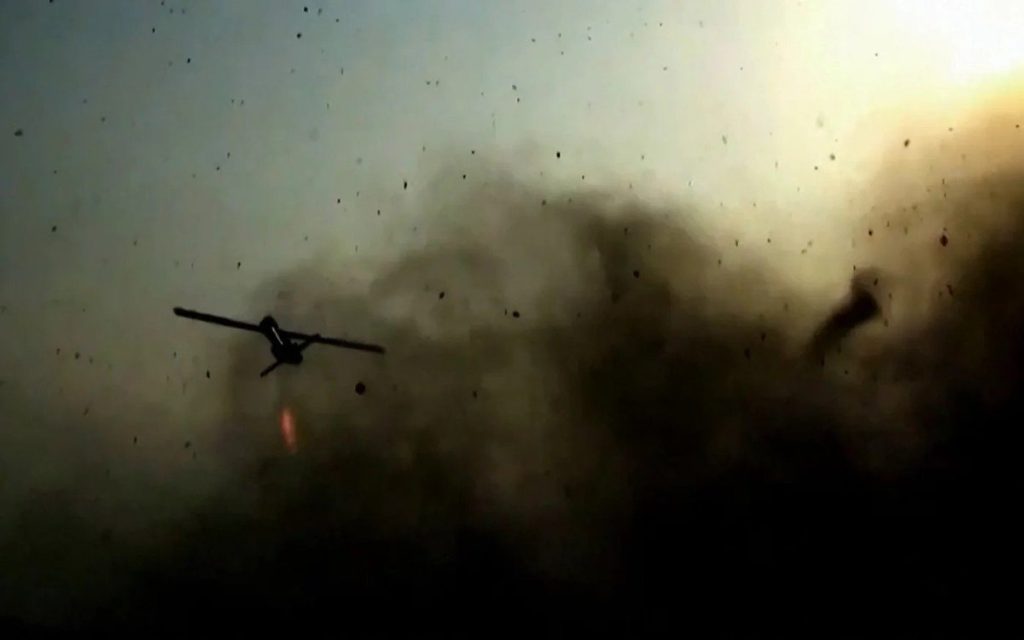
New Delhi: Washington and Tehran are locked in their most intense exchange of fire since the war began in February, with the United States military confirming a sixth consecutive night of airstrikes on Iranian targets. This comes even as Tehran widened its retaliatory attacks against Gulf states hosting American forces, causing serious damages to US bases across the Gulf.
The renewed hostilities – which erupted after the collapse of a fragile memorandum of understanding (MoU) signed in mid-June – have plunged the Strait of Hormuz back into crisis. This has disrupted shipping, driven up global oil prices and drawn appeals for restraint from Gulf capitals, Pakistan and much of the international community.
Latest strikes and blockade
US Central Command (Centcom) said it launched a fresh wave of airstrikes on Iran on Wednesday night, beginning around 9.30pm local time, with the stated aim to “further degrade Iranian military capabilities”. At least three explosions were heard in the western part of Bandar Abbas, a major Iranian port city on the Strait of Hormuz, according to state-run Islamic Republic of Iran Broadcasting.
The strikes came a day after the Pentagon said it had completed a second wave of attacks on Wednesday, targeting Iran’s ability to threaten commercial vessels transiting the strait. The US president, Donald Trump, is reported to be weighing an expansion of the military campaign.
The current bombing campaign follows the collapse of a naval blockade truce. Washington reimposed its blockade of Iranian ports from Tuesday, with the US military reporting the first shooting enforcement of the blockade – disabling the Curacao-flagged tanker Belma with Hellfire missiles after it allegedly ignored warnings while heading towards Kharg Island. Centcom said that within the first 24 hours of enforcement, it had redirected two compliant commercial vessels and disabled one non-compliant vessel.
Iran, in turn, has claimed to have struck and disabled two “rogue supertankers” in the Strait of Hormuz. The UAE said Iranian missiles hit two of its tankers in Omani territorial waters, killing one crew member. The Islamic Revolutionary Guard Corps (IRGC) has also claimed a retaliatory strike on US forces at the al-Tanf garrison area in Syria, in what it described as a response to deadly US strikes on Iranshahr – a claim Centcom has not confirmed.
Iran’s widening barrage
Tehran has widened its retaliation well beyond Israeli and American targets, striking Bahrain, Qatar, Kuwait, Oman, Jordan and the UAE over the past week. On Sunday, Iran launched missile and drone attacks against six countries in a single day, with Qatar’s military intercepting incoming fire and explosions reported in the UAE.
Bahrain’s defence force said it intercepted and destroyed a number of “treacherous” Iranian aerial attacks on the morning of Wednesday. Qatar came under Iranian fire for a second time on Thursday, with its defence ministry announcing it was intercepting a number of air attacks. Kuwait’s fire service extinguished a blaze caused by what it called a “hostile Iranian aerial aggression” near the Mina Abdullah industrial area.
The US military said Iran has intentionally targeted civilians by striking seven commercial ships over a single week, which left nearly a dozen crew members killed, missing or injured.
Analysts tracking the conflict have assessed Iran’s sustained missile and drone attacks on Jordanian air-defence sites – including bases hosting American forces – as a possible “shaping operation” intended to weaken Jordan’s air defences ahead of a resumption of strikes on Israel, though Israel itself has not been struck for several weeks.
What Iran says
Iran’s foreign minister, Seyed Abbas Araghchi, declared the June memorandum void, saying Tehran’s armed forces now have “complete freedom of action”. Iran’s foreign ministry spokesman said the country had abandoned its commitments because Washington had reneged on its side of the deal, and that Tehran had no plans for further talks.
Iran’s top negotiator went further, describing the conflict as “an essential and existential war” with America. A spokesperson for Iran’s joint military command, the Khatam al-Anbiya Central Headquarters, separately warned Washington against attempting to take control of the strait: “We will not, under any circumstances, allow the US to interfere in the management of the Strait of Hormuz.” The spokesperson added that any regional state offering logistical support to American forces would be treated as having committed “an act of war against Iran’s sovereignty and national security.”
The Iranian deputy foreign minister, Kazem Gharibabadi, said Iran would “respond decisively” to any acts of aggression. He added that Tehran would not leave any hostile action unanswered.
What the US says
Trump has offered a mixed and combative commentary on the war’s trajectory. He has characterized the latest exchanges as a “military skirmish” rather than a new, prolonged phase of the conflict, while declining to say how long the fighting might continue. “We’ve demolished their military,” he told reporters and insisted the war was moving “very fast” even as it blew past several deadlines he had earlier predicted for its end.
Trump has also moved to reassert American control over the strait, reinstating the naval blockade and demanding a 20 per cent reimbursement on all cargo shipped through the waterway. “The USA will be, from this point forward, known as the ‘guardian of the Hormuz’ strait,” he wrote. He added that the reimbursement was “a matter of fairness” to cover the costs of providing security.
He has named Israel, Saudi Arabia, Qatar and the UAE among the allies the US expects to be reimbursed by for the protection it is providing, saying, “I want to be reimbursed because we’re protecting a very rich portion of the world.” He separately singled out Japan, Australia, South Korea and Nato members for criticism over what he called their failure to assist in the war effort, while praising Saudi Arabia, Qatar, the UAE, Bahrain and Kuwait for performing “excellently.”
The US defence secretary, Pete Hegseth, said American forces were carrying out more strikes on Iran than on any single day since the war began, framing the intensified campaign as pressure ahead of an ultimatum deadline for Tehran to reopen the strait.
The US secretary of state, Marco Rubio, condemned Iran’s strikes on Jordan as “unacceptable” during a meeting with the Jordanian deputy prime minister and foreign minister, Ayman Safadi, at the state department on Wednesday.
Gulf states react
Saudi Arabia condemned what it called repeated Iranian violations of the sovereignty of neighbouring states, warning that the attacks threatened regional security and undermined international efforts to restore stability. The UAE, Qatar and Egypt also condemned the strikes and renewed calls for restraint even as Gulf leaders intensified diplomatic contacts aimed at reviving negotiations.
Qatar’s prime minister and foreign minister, Sheikh Mohammed bin Abdulrahman Al-Thani, held separate talks with his Iranian counterpart, Araghchi, and Saudi Arabia’s foreign minister, Prince Faisal bin Farhan. He urged all sides to recommit to diplomacy and honour earlier understandings intended to halt the conflict.
Reports have also suggested Saudi Arabia and the UAE have moved closer to enabling operational support for the US-led campaign against Iranian military infrastructure, although this has not been officially confirmed by either government.
Pakistan’s position
Pakistan, which shares a 900-kilometre border with Iran and maintains close ties with both Tehran and Riyadh, has continued to press for restraint from all sides. Islamabad brokered an earlier ceasefire and hosted talks between the two adversaries, and its foreign office has repeatedly urged both countries to honour the Islamabad memorandum of understanding.
“Pakistan urges all sides to uphold their respective commitments under the Islamabad memorandum of understanding,” the foreign office said in a statement, adding that “there is no alternative to continued engagement, dialogue and diplomacy to achieve the shared goal of peace in the region.”
The Pakistani foreign office spokesperson, reaffirming Islamabad’s commitment to mediation, said Pakistan would continue encouraging all stakeholders to resume technical-level discussions. Pakistan’s deputy prime minister and foreign minister, Ishaq Dar, held separate talks with the Saudi foreign minister, Prince Faisal bin Farhan, and the Iranian foreign minister, Araghchi, with all sides agreeing to remain in close contact over the evolving situation.
Araghchi has also engaged directly with Pakistan’s military leadership. In a phone call with the Pakistani army chief, Field Marshal Asim Munir, Araghchi strongly condemned earlier US attacks on Iran, calling them “flagrant violations” of the UN Charter and of the peace memorandum.
Economic fallout, including for India
The renewed conflict has reversed a brief recovery in global energy markets. Brent crude, which had slipped below $70 a barrel on July 1 after the June MoU raised hopes of a durable peace, rose above $76 a barrel by July 8 and has climbed further since, with some estimates putting Brent near $79 a barrel amid the latest escalation.
For India, the world’s third-largest oil importer, the disruption carries direct consequences. Indian benchmark equity indices fell on Wednesday as the oil price spike weighed on banking, automobile and financial services stocks. Trade analysts have warned that any sustained closure or restriction of the strait – through which roughly a fifth of the world’s oil and liquefied natural gas passes – could sharply inflate India’s import bill, stoke inflation and pressure the country’s fiscal position.
However, official in New Delhi said India retains adequate crude reserves and is diversifying its sources of supply to cushion the impact.