


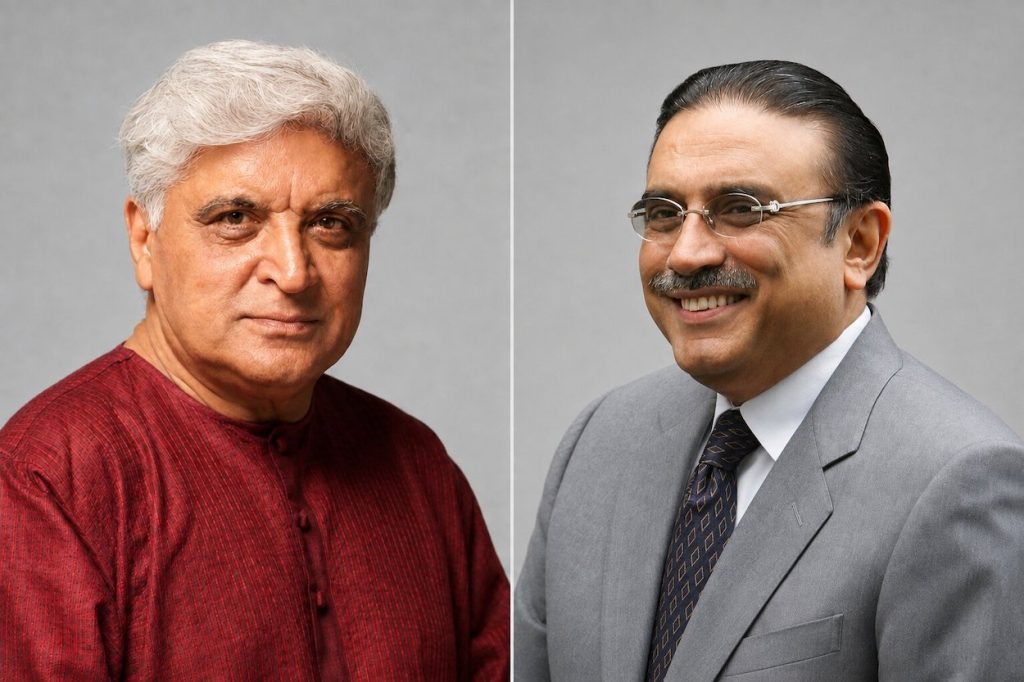
New Delhi: Veteran screenwriter and lyricist Javed Akhtar has criticized the president of Pakistan, Asif Ali Zardari, for saying that the country’s Muslim majority “tolerates” its Hindu population. Akhtar responded with a pointed reference to the Pakistani leader’s long-standing “Mr Ten Per Cent” nickname, turning the controversy into a wider debate about the status of religious minorities in Pakistan.
Zardari made the remarks while addressing an event marking Pakistan’s Independence Day, according to a video widely circulated on social media. Discussing relations with India, he said Indians believed in the idea of Akhand Bharat before claiming that Pakistani Muslims “tolerate 3–4 per cent Hindu population”.
The Pakistani president also asserted that Hindus in his country were free and would prefer to remain in Pakistan rather than live in India. His choice of the word “tolerate”, however, prompted criticism because it appeared to portray a constitutionally recognized community as one accommodated by the majority rather than as citizens possessing equal rights.
Responding on X on Saturday, Akhtar recalled that Zardari first acquired national prominence after marrying the former prime minister, Benazir Bhutto. He then accused the president of being “insensitive to all under the sun which is less than 10 per cent”, an unmistakable allusion to the corruption-related nickname associated with Zardari.
The nickname “Mr Ten Per Cent” emerged from allegations that Zardari demanded commissions on government contracts during Bhutto’s terms in office. Zardari has consistently denied wrongdoing, and Reuters reported in 2019 that he had not been convicted despite spending several years in prison while facing corruption and other charges.
Zardari’s estimate also differs from the categories used in Pakistan’s latest official enumeration [pdf]. The 2023 census recorded about 3.9 million people under the Hindu or Jati category, representing 1.61 per cent of the population, while scheduled castes were listed separately and accounted for another 0.56 per cent.
Most Pakistani Hindus live in Sindh, which has by far the country’s largest concentration of non-Muslim communities. Rights groups have frequently raised concerns about discrimination, forced conversions, attacks on places of worship and the misuse of blasphemy laws against religious minorities, although experiences vary across provinces and communities.
Pakistan’s constitution formally approaches religious freedom as a right rather than a concession from the majority. Article 20 guarantees every citizen the right to profess, practise and propagate a religion, subject to law, public order and morality, while also protecting the right of religious denominations to manage their institutions.
Zardari returned to the presidency in March 2024, becoming the first civilian in Pakistan to hold the office for two non-consecutive terms. The controversy over his remarks comes against the background of severely strained India-Pakistan relations, in which political rhetoric, terrorism and the treatment of minorities remain recurring points of contention.