


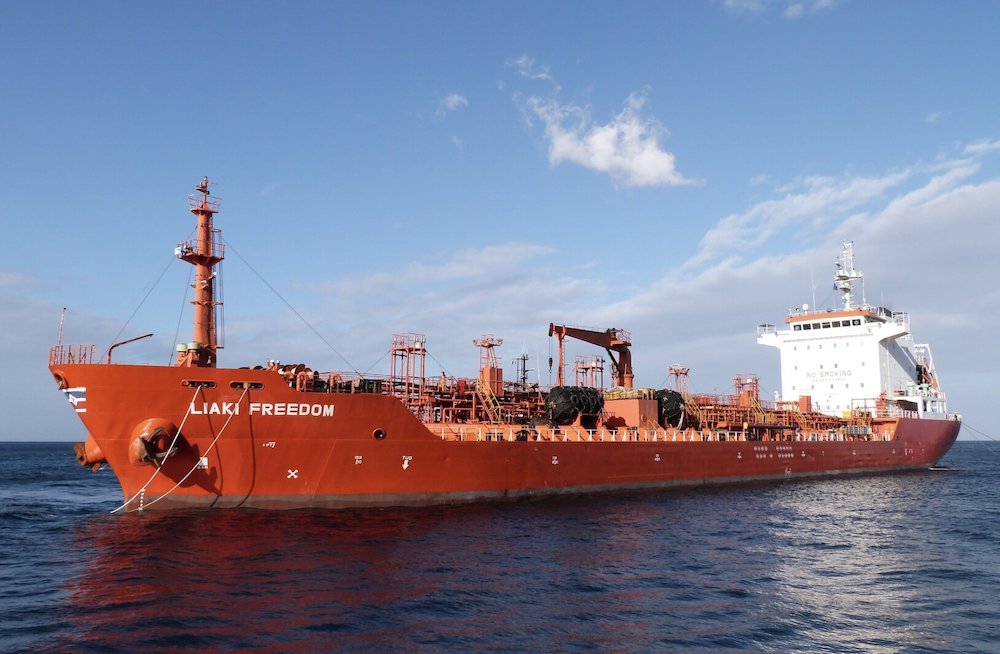
New Delhi: Four Indian sailors were killed in a suspected United States missile strike on an Indian-crewed oil and chemical tanker off the coast of Oman late Friday night, marking the fourth attack on a vessel with Indian crew in less than a week and the deadliest such incident so far.
The vessel, MT Liaki Freedom, a Marshall Islands-flagged tanker, was reportedly struck around midnight while sailing between Khor Fakkan anchorage and Shinas port in Oman. According to vessel-tracking data from MarineTraffic, the ship was on a routine voyage within the Gulf region when it came under attack.
According to an India Sentinels report, a crew member aboard the tanker contacted an acquaintance in India shortly after the incident and described scenes of devastation on board. In an audio recording reviewed by the website, a distressed sailor, a resident of Varanasi, said four crew members had been killed in the strike.
The sailor said he personally helped move the bodies of the deceased into the vessel’s freezer compartment. Describing the force of the explosion, he said one of the victims had been so severely dismembered that the remains could fit into a small garbage bag.
When asked who carried out the attack, the sailor replied that it was a US strike.
As of writing this, there was no official statement from either Washington or New Delhi regarding the incident. However, the circumstances appear consistent with a series of recent US military actions against commercial vessels in and around the Gulf of Oman and the Strait of Hormuz.
If confirmed, the deaths would raise the number of Indian sailors killed in US operations in the region this week to seven.
A pattern of US strikes
The latest incident comes barely two days after three Indian seafarers were killed when the Palau-flagged tanker MT Settebello was struck off Oman. The United States later acknowledged carrying out that attack, saying the vessel had allegedly violated its blockade targeting Iranian-linked oil shipments. India strongly condemned the strike, summoned the US chargé d’affaires in New Delhi, and demanded an immediate halt to attacks on civilian shipping.
The three Indians killed aboard Settebello were identified as chief engineer Patnala Suresh, engine fitter Shivanand Chaurasiya, and deck cadet Aditya Sharma. Twenty-one other Indian crew members were rescued following the attack. This prompted the Ministry to External Affairs to summon the US chargé d’affaires, Jason Meeks, to register a protest.
The Settebello strike itself came after another US action against the tanker MT Marivex earlier in the week. That vessel, carrying 24 Indian sailors, caught fire after being disabled in a US strike near Oman. All crew members were safely evacuated with Omani assistance.
A third vessel, MT Jalveer, was subsequently targeted off Oman, although all Indian crew members aboard escaped unharmed, according to Indian authorities.
The deteriorating security situation in the Gulf has also created unprecedented hazards for merchant shipping. On Thursday, the Indian Navy successfully neutralized a live missile warhead found lodged in the hull of the oil tanker Olympic Life off Kochi, underscoring how the widening conflict is increasingly endangering international maritime traffic.
India has repeatedly called for restraint and for the protection of commercial shipping lanes, particularly through the Strait of Hormuz, one of the world’s most critical energy chokepoints. New Delhi has urged all parties to respect freedom of navigation and avoid actions that endanger civilian mariners.
The latest strike is likely to intensify pressure on the government of the prime minister, Narendra Modi, to seek stronger guarantees for the safety of Indian seafarers operating in the Gulf. India supplies one of the world’s largest maritime workforces, with hundreds of thousands of Indian sailors serving aboard merchant vessels across international shipping routes.
With four attacks involving Indian-crewed vessels reported within a matter of days and the death toll continuing to rise, concerns are growing in New Delhi that Indian sailors are increasingly being caught in a conflict in which India is not a participant but whose consequences are now being felt with deadly force.