


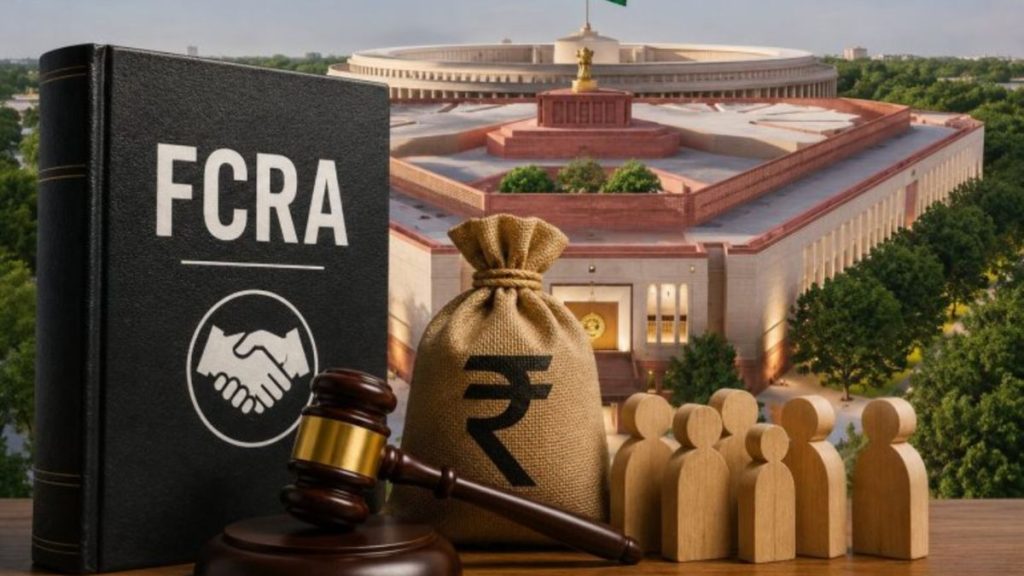
New Delhi: The government on Wednesday moved the Foreign Contribution (Regulation) Amendment Bill, 2026 to a joint committee of Parliament for further scrutiny. The move comes amid opposition to provisions on foreign funding and religious activities.
The proposed panel will comprise 21 members from the Lok Sabha and 10 from the Rajya Sabha. It has been asked to submit its report by the last day of the first week of the Winter Session.
The government had indicated on Tuesday that it was open to sending the legislation to a joint committee after opposition parties, including the Congress, Trinamool Congress and DMK, called for the bill to be withdrawn. The committee route will allow the government to seek wider views on provisions that have become a major point of contention.
As reported earlier by RNA, the government had been preparing to take up the legislation during the monsoon session. The FCRA Amendment Bill, 2026, was originally introduced in the Lok Sabha on March 25.
The bill seeks to strengthen government oversight of organizations receiving foreign contributions and proposes additional conditions governing the use and management of such funds.
What the bill proposes
One of the key provisions concerns the assets and funds of organizations whose FCRA registration is cancelled. Under the proposed changes, a government-appointed designated authority could assume responsibility for their management and disposal.
The bill also proposes a new requirement for organizations seeking continuation of their registration. They would have to show that they received at least ₹10 lakh in foreign contributions over the previous two financial years.
Another contentious provision relates to the use of foreign contributions for religious activities. The bill specifies activities for which foreign funds can be received and used and includes a ban on proselytization.
These provisions have drawn opposition from Christian organizations and political groups, which have raised concerns over the potential impact of the proposed restrictions on NGOs and religious institutions.
Opposition and the road ahead
Several Christian bodies, including the Catholic Bishops Conference of India, have opposed the legislation. The chief ministers of Mizoram and Nagaland, along with the Congress, TMC and DMK, have also raised objections to the proposed law.
Nagaland Lok Sabha MP, S Supongmeren Jamir has separately urged the government to defer the bill until wider consultations are held with stakeholders and political parties. He has raised concerns that some of its provisions could affect organizations involved in education, healthcare and charitable work.
The legislation has also attracted criticism from outside India. The US Republican congressman, Riley Moore, described it as a “clear attack against Christians” – a charge the Ministry of External Affairs rejected.
The government, meanwhile, has maintained that the proposed changes are aimed at strengthening oversight of foreign contributions and ensuring greater accountability in their use.
The referral to a joint committee does not amount to a withdrawal of the bill. Instead, the legislation will now go through another round of parliamentary scrutiny before the committee submits its recommendations.
The development also gives the government additional time to address objections and build support for the legislation. Once the committee completes its examination, the bill can return to Parliament for further consideration.