


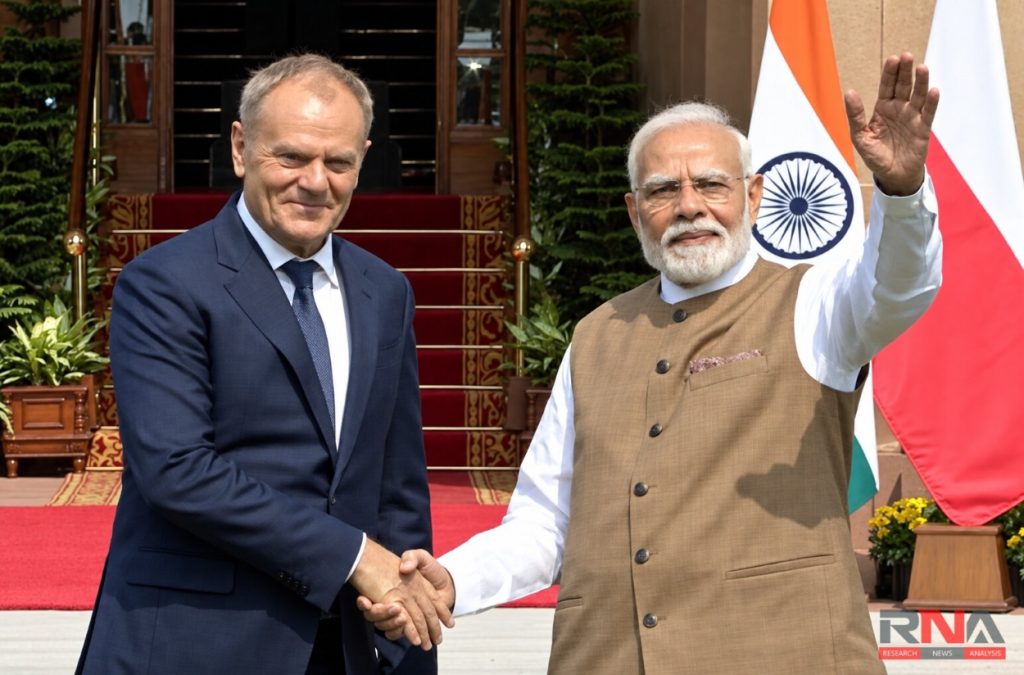
New Delhi: India and Poland agreed to strengthen cooperation in defence, space and nuclear energy on Thursday with the prime minister, Narendra Modi, inviting Polish companies to jointly develop and manufacture products in these strategic sectors. Following talks with the prime minister of Poland, Donald Tusk, Modi also reaffirmed India’s support for meaningful efforts to bring peace to Ukraine and West Asia.
Speaking after their meeting at Hyderabad House, Modi said the discussions had produced decisions to broaden the bilateral strategic partnership. His invitation to Polish industry placed joint development and production at the centre of the proposed expansion in cooperation, giving the relationship a stronger industrial focus.
The talks took place during Tusk’s three-day visit to India, from Wednesday to Friday, accompanied by the Polish finance and economy minister, Andrzej Domanski, and a business delegation. His programme includes business forums in New Delhi and Bengaluru, bringing companies into discussions on how to translate political commitments into commercial partnerships.
The economic ambitions extend beyond individual projects: the Polish government has set a goal of doubling trade with India by 2030. In a statement before his departure, Tusk identified technology and the defence industry as important areas of cooperation and said representatives of nearly 100 Polish companies were accompanying him on his combined tour of India and Vietnam.
Modi said the expanding economic capabilities of both countries offered fresh opportunities and that an India-European Union free trade agreement would further strengthen bilateral engagement. He also stressed their shared commitment to democratic values and the rule of law, alongside the need to reform global institutions to make them more effective.
Tusk, for his part, described the relationship as free of conflicting interests and spoke warmly of his personal rapport with Modi. His remarks emphasized the scope for closer cooperation as both countries seek to expand their economic and technological capabilities.
The diplomatic discussions carried particular significance for Warsaw’s efforts to secure an end to Russia’s war against Ukraine. Before leaving Poland, Tusk said he believed India could play a constructive role and wanted to explore how New Delhi might help move the conflict towards a resolution.
“Be it Ukraine or West Asia, India will continue to support every meaningful effort towards peace,” Modi said after the talks. The statement reaffirmed India’s willingness to support peace initiatives, without specifying a new proposal or negotiating mechanism.
The latest engagement builds on the strategic partnership established during Modi’s visit to Poland in August 2024, when the two countries marked 70 years of diplomatic relations. That agreement broadened the relationship’s scope to encompass security, technology, investment, connectivity and cooperation in international forums.
Their accompanying action plan for 2024–2028 already provides for regular security consultations, closer contacts between defence industries and cooperation in modernizing military equipment. It also identifies stronger supply chains and reduced risks from excessive trade dependencies as shared economic priorities.
Space cooperation similarly has an existing foundation: the action plan envisages an agreement covering safe and sustainable space activities, commercial space operations, and human and robotic exploration. Tusk’s scheduled engagement with information technology and space businesses in Bengaluru offers an opportunity to connect that framework with potential industry partnerships.
On Ukraine, the two countries had already articulated common principles in their 2024 joint statement, calling for a comprehensive and lasting peace consistent with international law and respect for sovereignty and territorial integrity. They also highlighted the war’s effects on food and energy security, particularly in developing countries, providing a broader context for the peace discussions in New Delhi.