


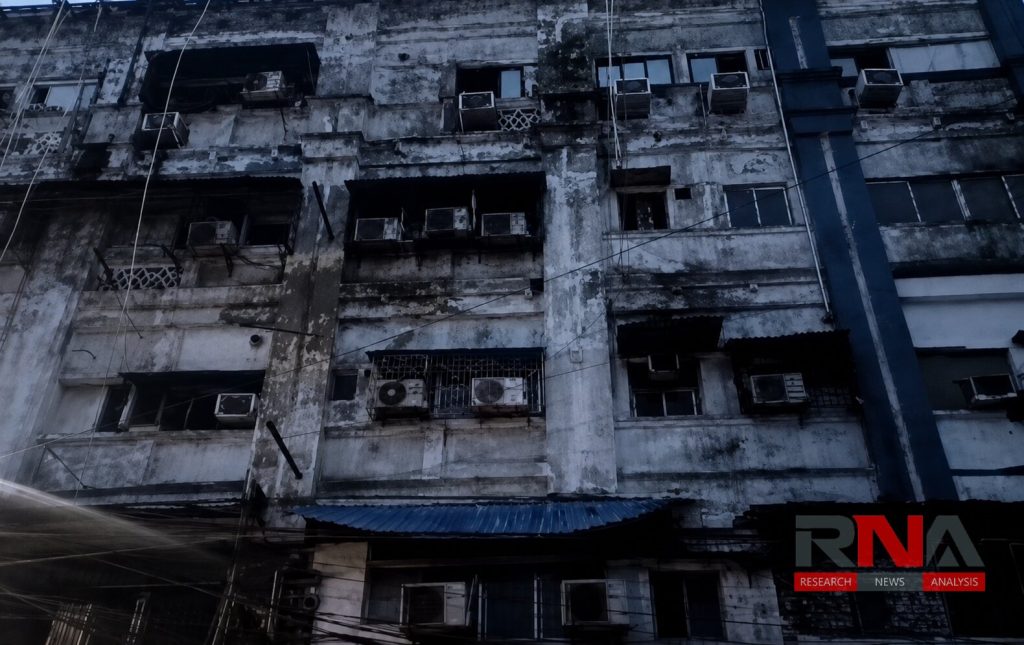
New Delhi: At least nine people, including a four-year-old child, were killed and six others injured after a fire swept through a five-storey building housing several budget hotels on Mirza Ghalib Street early on Wednesday. Bangladeshi nationals who had travelled to Kolkata for medical treatment were among the dead, linking the tragedy to a vast cross-border healthcare economy that extends from hospitals to hotels, transport operators and neighbourhood businesses.
According to reports, the fire erupted at about 1.45am, prompting the deployment of five fire tenders as police and disaster-management personnel joined the rescue operation. A senior official said around 80 people were evacuated, although dense smoke in the staircase made it difficult for firefighters to reach the upper floors of the congested building.
The six injured people were taken to hospital as firefighters continued cooling operations inside the building after bringing the flames under control. Officials warned during the early phase of the operation that the toll could rise because rescuers had not immediately been able to search every room.
Initial reports said all nine people killed were Bangladeshi citizens visiting Kolkata for treatment. However, the state fire and emergency services minister, Kaushik Chowdhury, subsequently told reporters that the dead included both Indian and Bangladeshi nationals and that their identities were still being established, leaving a final nationality-wise breakdown awaited.
Chowdhury said an electrical short circuit was one possible cause, but emphasized that only a forensic examination could determine how the fire began. Other preliminary accounts referred to a possible air-conditioner explosion, but neither explanation had been officially confirmed when this report was written.
The minister alleged that the building did not comply with basic construction and fire-safety requirements and expressed surprise at the number of hotels operating from the premises. Police said the building’s owner was on the run, a case was being registered at New Market police station and raids had begun to trace him.
The location added a disturbing dimension to the incident because the West Bengal Fire and Emergency Services headquarters is situated close to the building. Proximity to firefighters may have accelerated the response, but it could not compensate for dense smoke, restricted internal access or alleged failures in preventive safety.
The blaze came two days after another hotel fire in Tarapith in West Bengal’s Birbhum district killed at least seven people, many of them pilgrims, As RNA Media reported, on Monday. Two incidents do not by themselves establish a statewide pattern, but their proximity has renewed scrutiny of electrical maintenance, emergency exits, occupancy controls and fire clearances in inexpensive hotels accommodating travellers.
Why Bangladeshi patients come to India – and the revenue at stake
Bangladesh is by a considerable margin India’s largest source of foreign medical travellers, even after the political upheaval in Dhaka and restrictions on Indian visas sharply reduced the flow. Of the 507,244 foreign arrivals recorded in India for medical purposes in 2025, 325,127 – about 64 per cent – came from Bangladesh, according to the latest Union government figures.
The longer series reveals both the scale of the movement and its sensitivity to bilateral relations: Bangladeshi medical-purpose arrivals rose from 326,805 in 2022 to 499,951 in 2023, before easing to 482,336 in 2024. Bangladesh consequently accounted for approximately three-quarters of all medical-purpose foreign arrivals in both 2023 and 2024, according to Bureau of Immigration data presented to Parliament.
These figures record arrivals declared as being for medical purposes, rather than unique patients, completed treatments or hospital admissions. They may include repeat visits for consultations, diagnostic tests, surgery and follow-up care, but do not capture accompanying relatives travelling on other visa categories.
The fall to 325,127 Bangladeshi medical arrivals in 2025 represented a decline of nearly 33 per cent from the previous year, largely during a period of strained bilateral relations and reduced visa-processing capacity. Reuters reported in March 2025 that India was issuing fewer than 1,000 medical visas to Bangladeshis on each working day, compared with 5,000 to 7,000 previously, creating space for China and Southeast Asian countries to court patients who could not obtain Indian visas promptly.
That pattern began reversing, especially in Kolkata, in 2026 as visa services were gradually normalized and regular tourist visas resumed on June 28, although volumes remained below their pre-2024 levels.
India’s appeal rests on a combination of geographical proximity, comparatively affordable treatment, specialist capacity and the availability of doctors and coordinators who speak Bengali. Direct flights, trains, buses and land-border crossings make Kolkata particularly accessible, and cultural familiarity reduces the logistical burden on patients who may need to remain in India for several weeks.
The outflow should not be read as evidence that Bangladesh lacks a functioning health system, which includes a substantial pharmaceutical industry and several major hospitals. It reflects persistent concerns over access to advanced tertiary care, diagnostic confidence, waiting times and complex procedures, particularly in oncology, cardiology, neurology, neurosurgery, orthopaedics, gastroenterology, fertility treatment and organ transplantation.
Kolkata is the dominant destination, although the Union tourism ministry does not publish an official city-wise or state-wise division of foreign medical arrivals. An industry assessment covering 2023 estimated that about 60 per cent of Bangladeshi patients went to West Bengal, 30 per cent chose southern cities such as Chennai, Bengaluru and Hyderabad, and approximately 10 per cent travelled to Delhi.
Within Kolkata, large numbers seek treatment at private hospitals along the Eastern Metropolitan Bypass and in southern and eastern parts of the city, including facilities operated by Apollo, Manipal, Narayana Health, Peerless, Desun and Ruby General. More complicated cases also take patients to Chennai, Bengaluru, Hyderabad, Delhi-NCR, Mumbai and Vellore, depending on the speciality, physician referral and expected cost.
The Kolkata system is geographically divided between treatment and accommodation, with many patients visiting hospitals around the bypass but staying in cheaper hotels near New Market. Free School Street, Marquis Street, Sudder Street, Collin Street and Rafi Ahmed Kidwai Road have consequently developed hotels, restaurants, travel agencies, pharmacies and currency-exchange businesses oriented towards Bangladeshi visitors.
Many visitors do not undergo expensive surgery, as a substantial proportion come for outpatient consultations, laboratory investigations, medical reviews and follow-up examinations. This wide variation in the nature of treatment is one reason estimates of their economic contribution differ sharply and cannot be calculated reliably by multiplying arrivals by a single assumed expenditure.
The Union tourism ministry has acknowledged that it does not maintain state-wise medical-tourism revenue data, making any precise national figure for Bangladeshi patients an industry estimates rather than an official statistic. One industry assessment published in 2026 placed the pre-crisis Bangladesh-linked medical-travel market at between $1.2 billion and $1.5 billion annually, but the range should be treated cautiously because it combines patients undergoing vastly different procedures.
Company-level disclosures provide a firmer indication of the money involved: Apollo Hospitals Enterprise earned about ₹320 crore from Bangladeshi patients in FY24, before the figure fell to approximately ₹220 crore in FY25. Analysts estimated that revenues from Bangladeshi patients across India declined by 30–35 per cent during FY25, with the largest impact felt by hospitals in eastern and southern India.
Ratings analysts have estimated that medical travel can account for 8–10 per cent of revenue at exposed hospital groups, with Bangladesh contributing between half and three-fifths of that segment. Before the visa restrictions, hospital executives in Kolkata said Bangladeshi patients alone generated around 15 per cent of revenue at several private facilities, showing that dependence can be considerably higher in individual hospitals than national averages suggest.
Hospital bills are only part of the economic effect because patients commonly travel with relatives and spend on accommodation, food, medicines, local transport, air or rail tickets and other services. Around 400 hotels, lodges and restaurants were estimated to have become connected to the Bangladeshi visitor economy in central Kolkata, making disruptions to medical travel visible far beyond hospital balance sheets.
That network also carries diplomatic significance because patients who receive successful treatment often make repeat visits and recommend doctors to relatives, creating a durable form of people-to-people contact. Conversely, delayed visas or unsafe accommodation can damage public confidence and allow competitors such as China, Thailand, Malaysia and Singapore to expand their share of Bangladesh’s outbound healthcare market.
The Mirza Ghalib Street fire therefore exposes a gap in the way medical tourism is frequently understood and regulated. India may offer accredited hospitals and advanced treatment, but a patient’s journey also includes the inexpensive hotel where the patient and attendants sleep, recover and wait between appointments.
For elderly, seriously ill or mobility-impaired visitors, poorly marked exits, narrow staircases, inadequate alarms and unsafe electrical installations pose risks that an able-bodied tourist might escape more easily. Regular audits of hotels in medical corridors, transparent publication of fire clearances and safer referral arrangements between hospitals and accommodation providers should consequently form part of India’s medical-travel policy.
The immediate priority is to identify the victims, treat the injured and establish the fire’s cause and any criminal liability through evidence. The wider lesson is equally clear – the reputation of India’s medical-tourism sector depends not only on the quality of an operation or consultation, but also on whether foreign patients remain safe during every other part of their stay.