


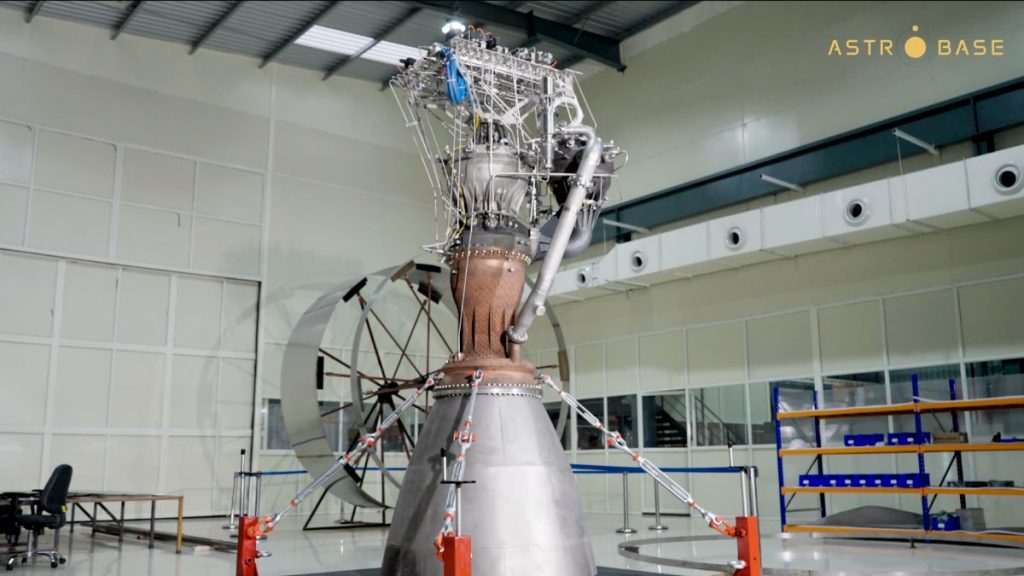
New Delhi: Bengaluru-based startup Astrobase Space Technologies has unveiled Everest, India’s first fully integrated full-flow staged-combustion (FFSC) rocket engine. Designed for a future reusable launch vehicle, the engine marks another milestone for India’s rapidly expanding private space sector.
The reveal puts India in a select group of just four countries, alongside the Soviet Union, the US and China, to have built an engine of this class. FFSC is considered one of the most technically demanding rocket engine designs in existence, and so far only SpaceX has flown one successfully on an orbital vehicle, through its Raptor engines aboard Starship.
What is Everest engine?
Everest is an 80-tonne-class methalox rocket engine, meaning it runs on liquid methane and liquid oxygen. It is designed to generate around 800 kilonewtons of thrust in space, enough to power a future medium-lift launch vehicle.
Unlike conventional rocket engines, Everest uses a full-flow staged-combustion cycle. In simple terms, both the fuel and the oxidizer are first routed through separate preburners before entering the main combustion chamber. This allows the engine to use almost all of the available energy, making it more efficient while placing less stress on critical components.
Engineers regard this as one of the most challenging propulsion systems to develop because it requires extremely high precision under intense temperatures and pressure.
Only a handful of organizations have successfully built engines using this architecture. SpaceX’s Raptor remains the only FFSC engine to have flown on an orbital launch vehicle, while earlier attempts by the Soviet Union in the 1960s were eventually abandoned after technical difficulties.
Why does methane matter?
Methane is increasingly becoming the preferred fuel for reusable rockets. Compared with traditional kerosene, it burns much cleaner, leaving behind far less residue inside the engine. That reduces maintenance between flights and makes repeated launches more practical, an important requirement for reusable launch systems.
The unveiling follows a series of earlier milestones. Astrobase successfully conducted a sub-scale engine test in September 2025 and later completed trials of its high-speed turbopumps, one of the most demanding parts of a liquid-fuel rocket engine.
The company now plans to conduct Everest’s first full-scale hot-fire test at its propulsion test facility near Anantapur in Andhra Pradesh later this year. Friday’s event marks the public unveiling of the completed engine rather than a performance test.
Astrobase has also invested in advanced manufacturing, including large-scale metal 3D printing, to produce complex engine components more efficiently. Its Bengaluru facility houses what the company says is India’s largest industrial metal 3D printer.
Everest is being developed for a reusable medium-lift launch vehicle capable of placing satellites into low Earth orbit (LEO). The company plans to use a cluster of Everest engines on the rocket’s first stage, which is designed to return after launch so it can be flown again.
Reducing launch costs through reusable rockets has become a major focus of the global space industry.
People behind Astrobase
Astrobase was founded in 2024 by Neeraj Khandelwal and Devakumar Thammisetty.
Khandelwal, an IIT-Bombay graduate, previously co-founded cryptocurrency platform CoinDCX and leads the company’s business operations. Thammisetty spent more than 13 years at Isro’s Liquid Propulsion Systems Centre, contributing to propulsion systems for GSLV missions, Gaganyaan and Chandrayaan before moving into research on reusable launch technology in Switzerland.
The startup operates design and manufacturing facilities in Bengaluru and a 21.5-acre propulsion test site near Anantapur. It has also secured support under IN-SPACe’s Technology Adoption Fund, which provides financial assistance to promising space technologies while allowing startups to retain ownership of their intellectual property.
The next major milestone is Everest’s full-scale hot-fire test. If successful, Astrobase will move closer to building a reusable Indian orbital rocket.