


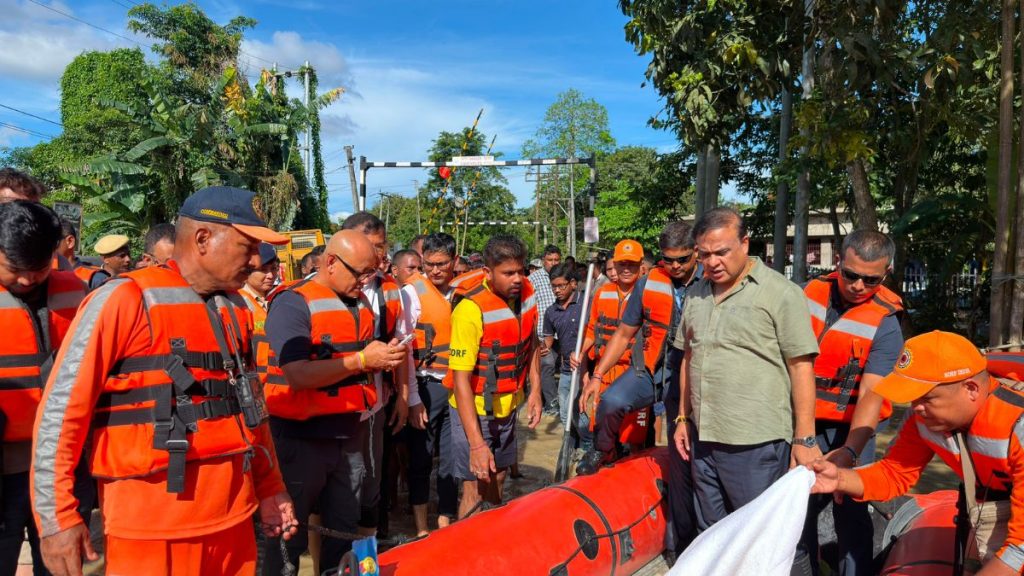
New Delhi: Assam continued to battle widespread flooding on Thursday, with the death toll reaching 41. Rescue operations remained underway across affected districts, while the Centre prepared to send a team to assess the damage.
The Assam chief minister, Himanta Biswa Sarma, said the disaster has impacted more than 9 lakh people in over 1,800 villages across 25 districts.
The latest reports indicate that the impact has widened considerably during the week as swollen rivers inundated fresh areas. Earlier official figures had placed the affected population at more than 6.5 lakh across 11 districts.
The Union home minister, Amit Shah, spoke with Sarma on Thursday and assured the state of central assistance. An inter-ministerial central team is expected to visit Assam to assess damage and determine the support required for relief and rehabilitation.
Sarma, who reviewed the situation in Golaghat, said the floods had caused extensive losses to homes, agricultural fields, livestock and personal documents. The state government has said assistance will be extended to affected families while damage assessments continue.
Rescue and relief operations are being carried out by the Indian Army, Indian Air Force, National Disaster Response Force (NDRF), State Disaster Response Force (SDRF) and state agencies, with boats and aircraft being used to reach marooned communities. Drones have also been deployed to assist in delivering essential supplies to locations where conventional access remains difficult.
As reported earlier by RNA, the Indian Army launched Operation Jal Rahat after severe flooding struck Upper Assam, deploying specialised flood-relief teams to Sivasagar, Charaideo and Jorhat. More than 570 stranded people were rescued during the initial phase of the operation.
The relief effort has since expanded. According to Sarma, more than 148 relief camps are sheltering nearly 30,000 people, while over 3 lakh kg of rice and other essential supplies have been delivered in the worst-affected districts.
Fresh inundation has meanwhile been reported beyond the areas that bore the initial brunt of the flooding. In Golaghat, 134 villages and more than 20,000 people have been affected, according to district administration figures. 17 relief camps have been opened in the district.
In Nagaon, rising waters of the Diju River have entered new areas following runoff from the Karbi Hills. At least 14 villages across Kaliabor, Samaguri and Nagaon Sadar revenue circles have been affected, with the district administration, SDRF and Fire and Emergency Services engaged in relief operations.
Several rivers across Assam continue to remain at dangerous levels. During the peak of the flooding, rivers including the Dikhow, Disang, Buridihing and Dhansiri crossed danger or severe flood thresholds at monitoring points, contributing to extensive inundation in Upper Assam.
Sarma has attributed the exceptional flooding to upstream cloudbursts combined with highly localized rainfall, which he said was 436 per cent above normal. The cloudburst characterization, however, has been questioned in reports citing meteorological authorities; it therefore remains a claim attributed to the state government rather than an established meteorological finding.
With floodwaters continuing to affect new areas even as they recede elsewhere, authorities remain focused on evacuation, food and drinking-water supplies, medical assistance and restoring disrupted connectivity. The state government has also indicated that longer-term rehabilitation measures will follow once the immediate emergency eases.