


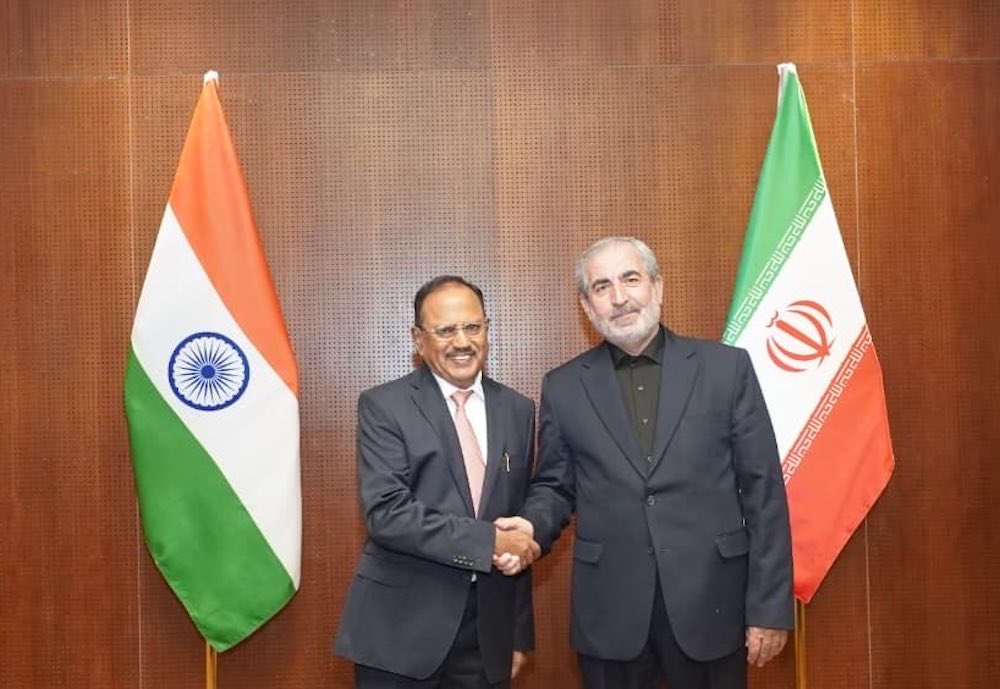
New Delhi: India’s national security adviser, Ajit Doval, on Monday held talks with Ghadir Nezamipour, the deputy secretary for defence affairs of Iran’s Supreme National Security Council (SNSC), in New Delhi. The discussions focused on the rapidly evolving security situation in West Asia, bilateral cooperation, and wider regional developments.
The meeting took place on the sidelines of the two-day BRICS National Security Advisers’ Meeting, which India is hosting in New Delhi from Monday to Tuesday. The talks assumed significance as tensions continue to simmer across West Asia following months of conflict involving Iran, Israel, and the United States, with growing concerns over regional stability, energy security, and the safety of critical maritime trade routes.
According to official information released by the Indian side, Doval and Nezamipour reviewed the prevailing situation in West Asia and exchanged views on issues of mutual interest. The discussions also covered India-Iran bilateral relations and cooperation in multilateral forums, including BRICS.
The Iranian official is among several senior security representatives attending the BRICS security conclave in New Delhi, where member countries are deliberating on emerging global security challenges, counterterrorism cooperation, cybersecurity, and other non-traditional security threats.
While neither side publicly disclosed detailed outcomes of the meeting, the engagement comes at a sensitive moment for the region. India has repeatedly expressed concern over the escalation of hostilities in West Asia and has consistently called for de-escalation and diplomacy.
In a statement issued earlier this month, the Ministry of External Affairs (MEA) said: “India deeply regrets the renewed attacks in West Asia. These developments are a matter of utmost concern to the international community.” The ministry added: “We call on all parties to immediately de-escalate tensions, ensure that civilians are not harmed and conclude ongoing negotiations for a diplomatic solution so that peace and stability can return to the region.”
The Doval-Nezamipour meeting is also noteworthy because Iran remains a key strategic partner for India despite geopolitical complexities and sanctions-related constraints. The two countries maintain cooperation in areas such as regional connectivity, energy security, maritime interests, and developments concerning Afghanistan.
For India, stability in the Gulf and wider West Asian region carries direct strategic implications. The region hosts millions of Indian expatriates, supplies a substantial share of India’s energy requirements, and lies astride critical sea lanes through which a large volume of India’s trade passes.
Doval himself has recently underlined the importance of securing key maritime chokepoints. Speaking at an international security forum in Moscow in May, he stressed the need for “safe and uninterrupted” movement of trade through the Strait of Hormuz and the Red Sea, warning that instability in West Asia could have far-reaching economic and security consequences. He also reiterated India’s support for efforts aimed at reducing tensions and restoring regional stability.
The talks with the Iranian official also come against the backdrop of India’s continuing diplomatic outreach to all major stakeholders in the region. New Delhi has maintained communication with countries across West Asia while advocating dialogue and negotiated solutions to ongoing conflicts.
According to the MEA, the BRICS National Security Advisers’ Meeting being chaired by Doval is focusing on the theme – “Non-traditional security challenges confronting the world today”. Delegates are discussing the changing nature of security threats, including terrorism, emerging technologies, information security, and other transnational challenges.
India is expected to use the BRICS platform to push for stronger cooperation against terrorism and to exchange assessments on major geopolitical crises, including the situation in West Asia. Senior security officials from BRICS member states are participating in the two-day deliberations in the national capital.
For Iran, the participation of a senior SNSC official reflects Tehran’s continuing engagement with BRICS and its growing emphasis on cooperation with emerging powers outside traditional Western-led institutions. The SNSC is Iran’s highest decision-making body on national security, defence, and strategic foreign policy matters.
Although no joint statement was issued following the Doval-Nezamipour meeting, officials indicated that both sides reviewed regional developments and reaffirmed the importance of continued dialogue at a time of heightened uncertainty across West Asia.