


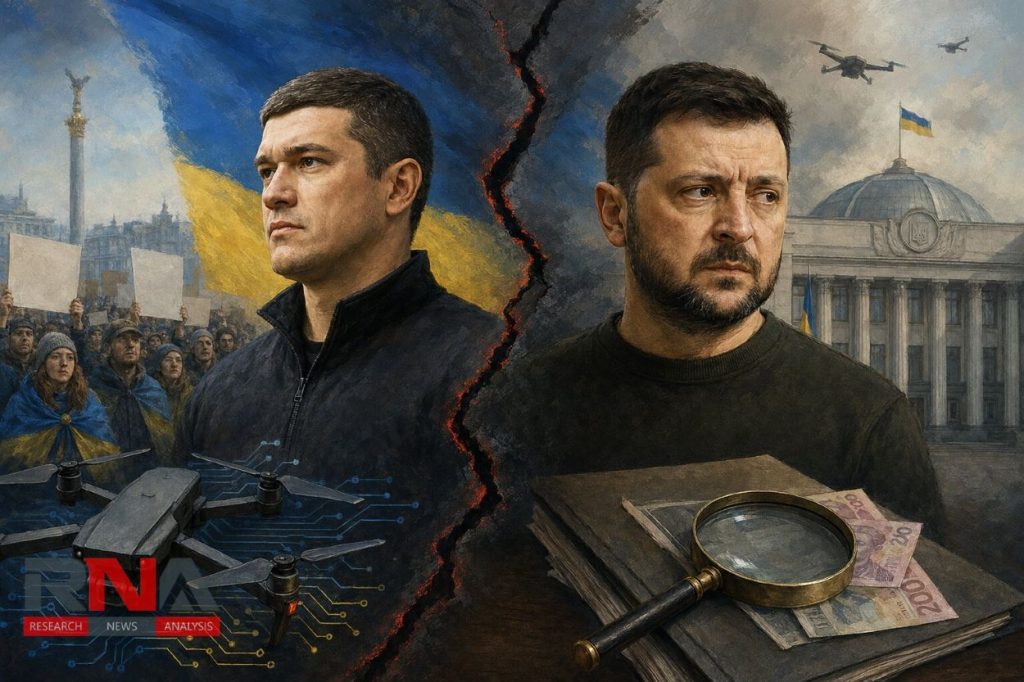
New Delhi: Ukraine’s anti-corruption agencies said on Monday that senior figures linked to the presidential office were implicated in an alleged money-laundering operation, prompting the president, Volodymyr Zelenskyy, to dismiss Iryna Mudra, a deputy head of his office. The disclosure came a day after the former defence minister, Mykhailo Fedorov, demanded a lawful wartime election, turning a dispute over his removal into the most direct domestic challenge to Zelenskyy since Russia launched its full-scale invasion.
The National Anti-Corruption Bureau of Ukraine and the Specialized Anti-Corruption Prosecutor’s Office said investigators had traced 150 million hryvnias, or about $3.4 million, allegedly channelled through shell companies and accounts at a state-owned bank. The money was purportedly laundered to provide bail for a defendant in an extensive energy-sector corruption investigation known as the Midas case.
Investigators said the suspected group included a deputy head of the presidential office, lawmakers and senior officials associated with the state-controlled bank. Ukraine’s anti-corruption authorities did not initially identify the individuals publicly, and none of the allegations amounts to a finding of guilt.
Zelenskyy dismissed Mudra by presidential decree shortly after the investigation was announced, without publicly explaining the decision. Mudra had not responded to the allegations at the time of publication, although Ukrainska Pravda, citing its sources, identified her as one of the figures under investigation.
The alleged operation arose from the wider Midas investigation into a suspected $100-million kickback network connected to Ukraine’s state nuclear-energy sector. That inquiry has already implicated politically connected figures and resulted in the departure of senior officials, adding to concerns about the protection of public money during the war.
The latest case carries particular significance because Ukraine’s progress against high-level corruption remains central to its ambition of joining the European Union. It also gives greater political force to Fedorov’s charge that corruption and resistance to reform are weakening the country’s capacity to fight Russia.
In a video address released on Thursday, Fedorov said Ukraine needed a legal, safe and practical mechanism to restore national elections despite the continuing war. Without directly naming Zelenskyy, he described the country as facing a systemic governance crisis in which personal loyalty could take precedence over competence, results and institutional reform.
The country’s presidential and parliamentary elections have been suspended since martial law was imposed following Russia’s invasion in February 2022. Zelenskyy’s regular five-year presidential mandate reached its scheduled end in May 2024, but Ukrainian law does not permit elections under martial law and provides for continuity of constitutional authority until a successor can be elected.
The difficulties are formidable: hundreds of thousands of service personnel are deployed, millions of Ukrainians are displaced at home or living abroad, and Russian forces occupy about a fifth of the country. An August 5 survey by the Kyiv International Institute of Sociology found that 57 per cent of respondents wanted elections to be postponed until after the war.
Ukraine’s legislature, the Verkhovna Rada, meanwhile approved Yevhenii Khmara as the new defence minister on Wednesday, with 312 lawmakers supporting him against the 226 votes required. Khmara, a former special-forces operative who briefly served as acting head of the SBU security service, had been running the defence ministry in an interim capacity after Fedorov’s dismissal.
His confirmation effectively ended the immediate prospect of Fedorov returning to the ministry, a position the former minister had said was essential to completing his military reforms. Lawmakers also endorsed Andrii Sybiha’s continuation as foreign minister, providing formal institutional backing for Zelenskyy’s reorganized wartime team.
The political upheaval is unfolding as Ukraine intensifies long-range drone attacks on Russian energy and military infrastructure but remains exposed to missile strikes and sustained pressure along the front. Kyiv’s strategic problem is therefore not simply political instability, but whether repeated changes at the top can be managed without disrupting procurement, force modernization and battlefield planning.
Why was Fedorov fired, and why did his dismissal provoke dissent?
Zelenskyy’s stated reason for removing Fedorov was an irreparable conflict between the minister and the then commander in chief, General Oleksandr Syrskyi, which had reportedly begun to paralyse decision-making. Fedorov had served as defence minister for only six months when he was dropped during a broader government reshuffle in July.
The dispute was more than a clash of personalities; it represented competing visions of how Ukraine should fight a larger adversary. Fedorov championed an asymmetric, technology-led model centred on drones, digital battlefield management, measurable unit performance and faster procurement, whereas Syrskyi was associated by critics with a more conventional, infantry-intensive approach and a highly centralized command structure.
Fedorov sought to expand domestic drone production, introduce data-driven allocation of weapons and digitize procurement systems that had long been vulnerable to manipulation. He also supported after-action reviews, new service contracts and mechanisms intended to reduce losses by replacing manpower-heavy operations with precision, automation and better intelligence.
Syrskyi, however, was an experienced commander credited with important roles in the defence of Kyiv and the 2022 Kharkiv counteroffensive. His supporters viewed battlefield discipline and centralized control as unavoidable during an existential war, even as critics accused the senior command of moving too slowly to adapt to technological change.
Fedorov later argued that his attempts to overhaul defence procurement and disrupt entrenched interests contributed to his removal. Zelenskyy maintained that the immediate cause was the breakdown between the minister and the military commander, and no publicly available evidence conclusively establishes that Fedorov was dismissed to halt anti-corruption reforms.
However, the former minister’s performance was not without shortcomings. He had yet to deliver a promised overhaul of Ukraine’s deeply contentious mobilization system, and proposals for new service contracts drew criticism from personnel who had volunteered earlier in the war but still had few routes out of indefinite military service.
The public backlash nevertheless reflected Fedorov’s unusual standing as a politician identified with visible results. Before moving to the defence ministry, he had overseen the Diia digital-government platform, helped secure Starlink connectivity after the Russian invasion and promoted the “army of drones” programme that became central to Ukraine’s war effort.
His removal was therefore interpreted by supporters as a threat to reforms rather than a routine cabinet change. Protesters argued that Ukraine could not afford another lengthy transition at its most important wartime ministry just as technology-driven operations were producing tangible results against Russian forces.
Anger also focused on Syrskyi, who had become a symbol of wider frustration over casualties, mobilization and the treatment of soldiers. Scrutiny intensified after allegations of abuse, mistreatment during training and non-combat deaths within the 425th Separate Assault Regiment, which prompted an investigation and sharpened criticism of the prevailing command culture, as detailed by AP.
Zelenskyy eventually removed Syrskyi and appointed Mykhailo Drapatyi, a younger battlefield commander considered more receptive to technological and organizational reform. That decision eased some concerns within the military, but demonstrations continued because Fedorov was not restored to the defence portfolio.
The poorly explained nature of the original reshuffle aggravated the crisis. Thousands took to the streets of Kyiv and other cities, and demonstrators continued gathering outside the presidential office even after Syrskyi’s replacement, demanding that Fedorov be given the authority required to finish his programme.
The protests also exposed an institutional pressure point created by martial law. With elections suspended, public demonstrations have become one of the few direct methods through which Ukrainians can challenge presidential decisions, although some lawmakers have warned that street pressure should not determine appointments at the highest levels of military command.
Fedorov’s demand for an election has consequently divided even some of his supporters. One section regards it as a necessary warning against indefinite concentration of power, whereas another sees it as premature populism that could deepen political divisions and create an unmanageable security operation during Russian attacks.
His intervention has nevertheless transformed him from a former Zelenskyy loyalist into a potential national challenger. A recent Socis Centre survey placed him third in a hypothetical first round but suggested that he and the former commander-in-chief, Valerii Zaluzhnyi, could each defeat Zelenskyy in a run-off, although such polling remains only a snapshot of opinion during an exceptionally volatile war.
It cannot be established that Zelenskyy removed Fedorov because he feared a future electoral rival, but the decision has produced precisely that political effect. Fedorov’s dismissal, his rejection of alternative government posts and his subsequent election demand have given him an independent identity that he did not possess as a member of the president’s team.
The turmoil does not, by itself, mean that the Ukrainian state is approaching political breakdown. Parliament has confirmed a new defence minister, independent anti-corruption institutions continue to investigate officials close to power, and citizens are openly protesting government decisions despite wartime restrictions.
However, the dispute brings together three anxieties that increasingly shape Ukrainian politics: the cost of the war in soldiers’ lives, the continuing influence of corruption and the absence of normal electoral accountability. Zelenskyy’s difficulty is that wartime unity can no longer be equated with political silence, particularly when personnel changes appear to endanger reforms that many Ukrainians associate with survival.
Khmara’s ability to preserve procurement reforms, technological innovation and cooperation with the new military command will determine whether the immediate crisis subsides. If leadership churn and opaque decision-making continue, Fedorov could emerge not merely as a dismissed minister with public sympathy, but as the centre of an organized post-war political alternative.