


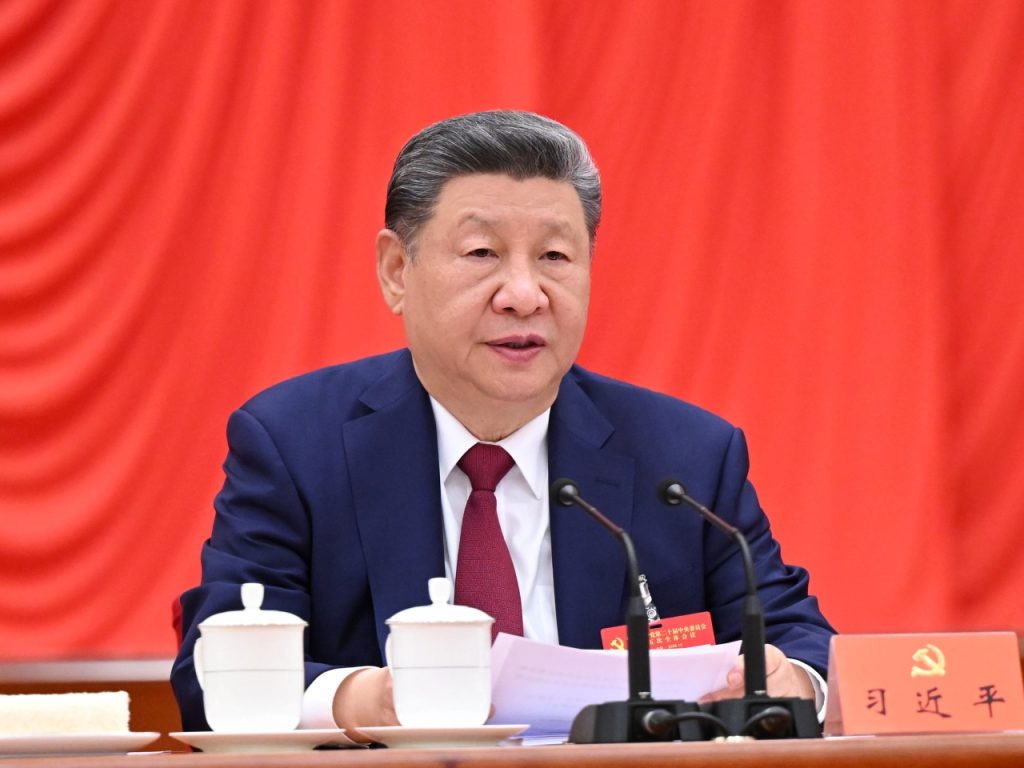
New Delhi: China’s ruling Communist Party confirmed the expulsion of 33 senior figures on Thursday as a leadership meeting exposed the scale of the purges reshaping its civilian and military establishment. The four-day gathering also elevated General Zhang Shengmin to the Politburo and endorsed tighter internal discipline ahead of a congress at which the Chinese president, Xi Jinping, is widely expected to secure a fourth term as party leader.
The fifth plenary session of the party’s 20th Central Committee, held in Beijing from October 26 to October 29, concluded with a resolution strengthening internal governance and the campaign against corruption. Its decisions place political discipline at the centre of preparations for the 21st party congress, which will take place in Beijing in the second half of 2027.
Attendance underscored the extent of the upheaval: 279 full and alternate Central Committee members participated, compared with 315 at the previous plenum in October 2025 and 364 in July 2024. According to a BBC report, this was the first plenum during Xi’s leadership to draw fewer than 300 members.
Reuters reported that turnout represented roughly 74 per cent of the cohort originally selected in 2022, the lowest attendance rate of the post-Mao era. Although purges account for many missing members, absence alone does not establish that an individual has been investigated or expelled.
Sixteen of the 33 people whose expulsions were confirmed came from the military, according to the BBC, making the armed forces a major focus of the latest disciplinary action. The meeting largely ratified earlier decisions, a distinction that means the announcement should not be read as 33 officials being newly removed during the four-day session.
Those named included the former Xinjiang party chief, Ma Xingrui, the former Central Military Commission vice-chairman, General Zhang Youxia, and the former military joint staff chief, General Liu Zhenli. The former senior diplomat, Liu Jianchao, the former industry minister, Jin Zhuanglong, and the former securities regulator chairman, Yi Huiman, were also among those expelled.
As RNA Media had reported, China’s defence ministry had announced the expulsion of Zhang Youxia and Liu Zhenli from the party and military on September 21, citing serious disciplinary and legal violations. That formulation covers allegations of grave misconduct but does not, by itself, provide a detailed public account of the evidence or establish a criminal conviction.
The most consequential promotion involved General Zhang Shengmin, the Central Military Commission vice-chairman, whose elevation restored military representation to the Politburo after earlier removals. His appointment also reinforced the prominence of a senior officer closely associated with military disciplinary enforcement.
The commission, which exercises supreme command over China’s armed forces, has been reduced from seven members at the beginning of the current leadership term to two remaining members – Xi and Zhang Shengmin. In an assessment published before the plenum, the Brookings Institution described the difficulty of rebuilding a trusted high command after the removal of officers elevated under Xi himself.
That disruption raises questions about continuity in military leadership even as China pursues an extensive modernization programme. The personnel changes alone, however, do not establish how far operational readiness has been affected, an issue that remains difficult to assess from outside China’s opaque command system.
The party presents stricter discipline as essential to effective government, institutional integrity and its ability to remain in power. Its official communique endorsed the leadership’s record across economic development, national security, military modernization and foreign affairs, while the accompanying resolution called for sustained internal supervision and anti-corruption work.
Analysts also see a political function in the campaign, which has continued since Xi assumed the party leadership in 2012. The Carnegie China scholar, Chong Ja Ian, told the BBC that removing officials Xi had previously promoted demonstrated the strength of his authority rather than necessarily signalling an effective challenge to it.
The wider significance lies in the approaching leadership transition, when appointments will determine who implements Beijing’s priorities during the next five-year term. In a Carnegie China analysis, Damien Ma argued that promotions could prove more revealing than further dismissals because they show which experience, institutions and political networks the leadership chooses to advance.
A Central Committee plenum is a meeting of the party’s senior leadership between its five-yearly congresses, with authority to address personnel, ideology and major policy questions. This year’s emphasis on internal governance therefore matters beyond the disciplinary cases: it establishes the political conditions under which the next leadership team will be selected.
Xi’s anticipated fourth term remains an expectation rather than a decision announced at this meeting. For now, the confirmed outcome is a renewed commitment to strict party control, another substantial round of ratified expulsions and the promotion of a military discipline figure as preparations for 2027 gather pace.