


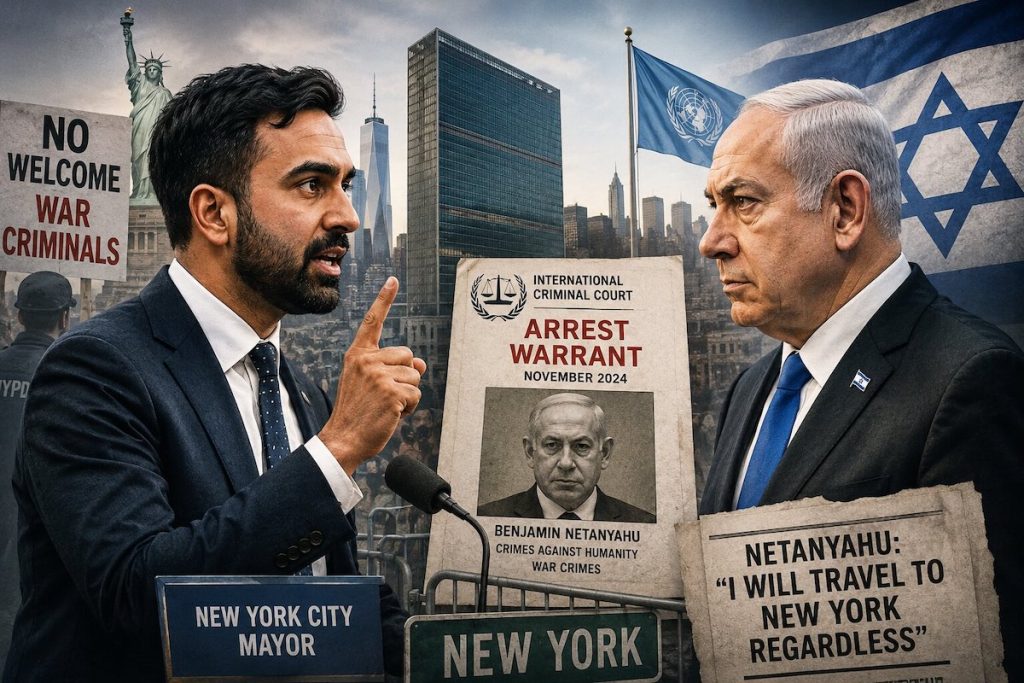
New Delhi: The war of words between the mayor of New York City, Zohran Mamdani, and the prime minister of Israel, Benjamin Netanyahu, has escalated sharply on Sunday, with Netanyahu accusing Mamdani of “fomenting hate” over his repeated calls for the Israeli leader’s arrest on war-crimes charges linked to the Gaza offensive. Speaking from Washington, Netanyahu said Mamdani was stoking hostility by branding him a war criminal who should be detained if he sets foot in New York for the United Nations general assembly in September.
The Israeli prime minister dismissed the International Criminal Court’s (ICC) charges against him as “bogus” and said he intended to travel to New York regardless of the mayor’s objections.
From campaign pledge to legal climbdown
The dispute traces back to Mamdani’s mayoral campaign, when he repeatedly said that, if elected, he would direct the New York police department to execute the ICC’s November 2024 arrest warrant against Netanyahu should the Israeli leader visit the city. The court had issued the warrant against Netanyahu and the then defence minister, Yoav Gallant, alleging crimes against humanity and war crimes over the conduct of Israel’s military campaign in Gaza.
After taking office, Mamdani continued to hold the line, telling the New York Times in mid-July that he believed Netanyahu “belongs in the Hague” and that New York City ought to comply with international law. His remarks drew swift pushback from within his own political camp, with the Democratic congressman Jerry Nadler calling the proposal “simply unrealistic” and noting that the city had no jurisdiction to act on an ICC warrant.
Days later, Mamdani shifted ground. On July 20, he acknowledged that New York City lacked the legal authority to execute the warrant, since the United States is not a signatory to the Rome Statute that established the ICC. Instead of ordering a city-level arrest, he called on the federal government to act, while insisting Netanyahu remained unwelcome. “Benjamin Netanyahu is not welcome in New York City, nor is any other war criminal at large,” he said in a video message, adding that peaceful protest would always be respected by the city.
Trump steps in
The president of the United States, Donald Trump, moved quickly to shut down the possibility of any arrest. In a Truth Social post, Trump wrote that Netanyahu “will not be arrested, in any way, shape, or form, while in the United States of America,” and suggested that those responsible for the war in Iran, rather than Netanyahu, deserved scrutiny. The intervention effectively closed off any federal route Mamdani had gestured towards.
Congressional Republicans have also weighed in on the matter. Senator Ted Budd introduced the “American Allies Protection Act”, legislation that would cut funding to cities acting on ICC warrants against officials from Nato countries – a measure framed explicitly as a response to Mamdani’s stance.
Netanyahu’s latest broadside
In his most pointed remarks yet, Netanyahu on Sunday said he was troubled that once-bipartisan American support for Israel was fraying, particularly among progressive Democrats aligned with Mamdani. He said Jewish residents of New York, home to the world’s second-largest Jewish population outside Israel, had told him they felt “very uncomfortable”, and called the broader trend “wrong”. Netanyahu’s office had earlier suggested Mamdani “should focus on fixing the damage his policies have caused New York” rather than pursuing an arrest warrant.
The Israeli foreign minister, Gideon Sa’ar, has taken a more dismissive tone, telling reporters in New York that he did not wish to enter into a “legal debate” with an elected mayor, while reaffirming that Netanyahu would travel to the city as planned.
Gaza toll frames the dispute
The underlying charge against Netanyahu concerns the conduct of Israel’s offensive in Gaza following Hamas’s October 7, 2023, attack, in which around 1,200 people were killed. Gaza’s health ministry says more than 73,000 Palestinians have since been killed in the Israeli campaign, roughly half of them women and children – figures Mamdani has cited directly in his public statements. Israel has rejected the ICC’s jurisdiction over the matter and has called the warrant politically motivated.
Whether the underlying legal question – can an American city enforce an ICC warrant it has no authority to execute – is ever tested may matter less than the political theatre around it. Both Trump and Mamdani have incentives to keep the fight alive: for Trump, it offers a convenient proxy battle against progressive Democrats; for Mamdani, standing firm on Gaza plays well with the base that elected him, even as centrist allies distance themselves from the specifics.
Netanyahu, for his part, has said he is untroubled by the threat and intends to travel to New York in September as usual, accompanied, he has suggested in the past, by American backing.