


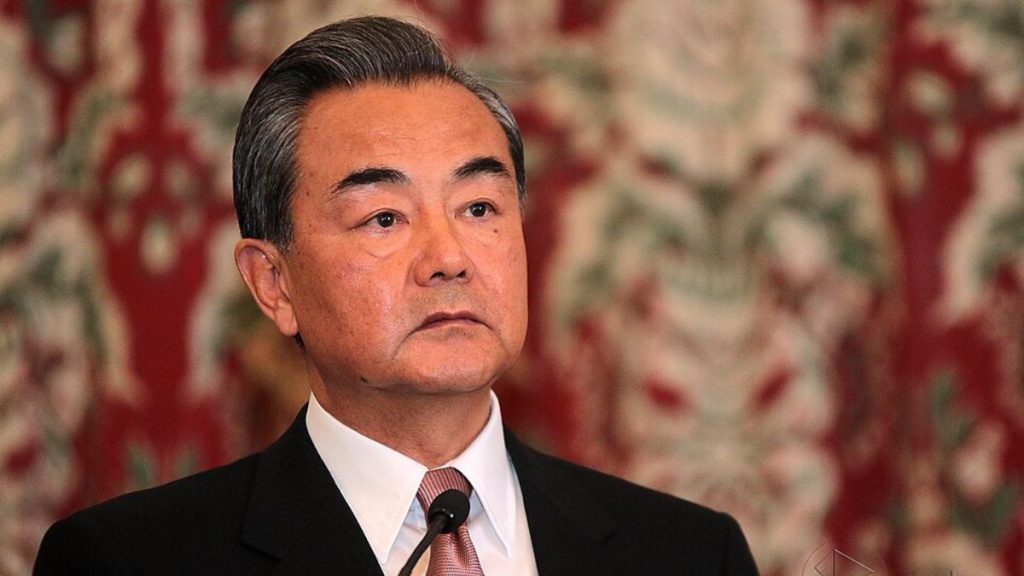
China’s Foreign Minister Wang Yi is all set to host a meeting of the UN Security Council on Tuesday (May 26, 2026) to discuss the UN Charter and the body’s role in the world order, even as recent Chinese diplomatic moves signal a bid to gain a strategic upper hand in global affairs.
The UNSC meeting, under the Chinese presidency of the UN’s most important decision-making body, comes amidst global military conflicts, including the US-Iran and the Russia-Ukraine wars, apart from debilitating trade tensions.
China is one of the five permanent members of the 15-member UNSC and is holding the body’s chair for May 2026, which it assumed on May 1. China’s Foreign Ministry announced Wang Yi would be chairing the UNSC meeting to debate “Upholding the Purposes and Principles of the UN Charter and Strengthening the UN-Centered International System.”
In New York, Wang Yi would also attend a meeting of the “Friends of Global Governance” group on Thursday (May 28) and meet with UN Secretary-General Antonio Guterres and foreign ministers of other nations. After his New York meetings, Wang will fly to Canada for an official visit, the first such trip in 10 years, which concludes on Saturday (May 30).
The Chinese Foreign Minister chairing a UNSC debate should be seen in the context of Beijing’s recent diplomatic moves to set the stage for a strategic one-upmanship over its archrival, the US.
Chinese President Xi Jinping held a summit meeting with his US counterpart, Donald Trump, 10 days ago. This high-profile summit meeting garnered global attention for what the outcomes could be.
Except for great optics, the Xi-Trump summit did not come up with outstanding results that could reset their already tense relationship, though both sides touted the meeting as a breakthrough.
However, in a strategic signalling, China invited Russian President Vladimir Putin to Beijing just days after Trump’s visit.
The Xi-Putin meeting was a clear message that China accords greater importance to its Russian ties than to the US, with which it has been waging a silent war on supremacy in global affairs.
Beijing has always accorded greater weight to protocol and has been adept at timing its ceremonial details to send policy signals. The Xi-Putin summit was one such signal.
Obviously, Xi would have shared notes with Putin on his Trump meeting. Xi and Putin are partners, whereas the Chinese President and his US counterpart are rivals.
The Xi-Trump meeting provided both China and Russia to assess the changing geopolitical landscape, and to weigh the US President, who has less than three years left in office.
The message of the Xi-Putin summit may force Trump to confront an uncomfortable geopolitical reality: Friendship with both Xi and Putin is just wishful thinking.
The Xi-Trump meeting produced few substantive results and merely served to pave the way for reduced conflict and stabilised relations.
They had no joint statement or media briefings, which is indicative of the low standards of the outcomes.
Their meeting read-outs too emphasised different takeaways relevant only to each other, and there was not much in common, including the timing of the release.
The US release talked about Iran’s and North Korea’s denuclearisation. The Chinese statement stressed Taiwan. Both these issues are sticking points in the US-China ties.
By contrast, the Putin-Xi meeting led to the conclusion of a joint statement on a comprehensive strategic partnership and 20 other bilateral documents, covering trade, economic ties, science and technology cooperation.
They also held a joint press briefing on their summit and the discussions, while appearing together in several bilateral events in Beijing.
China described the relationship as having reached its highest level in history and a model for a new type of major power relations.
Just a week after the Putin summit, Beijing will host Pakistan Prime Minister Shehbaz Sharif from Saturday (May 23, 2026) for a four-day official visit.
Shehbaz’s China visit is aimed at strengthening ties between the two countries and celebrating 75 years of diplomatic relations.
Sharif is travelling with senior ministers, including Deputy Prime Minister Ishaq Dar.
During the visit, Sharif will attend business meetings, meet leaders of major Chinese companies, and take part in events linked to the China-Pakistan Economic Corridor (CPEC) Phase 2.
In Beijing, he is expected to meet Chinese President Xi Jinping and Premier Li Qiang. He will also attend celebrations marking 75 years of Pakistan-China diplomatic relations.
The visit is expected to focus on trade, investment, technology, agriculture, and deeper economic cooperation between the two countries.