


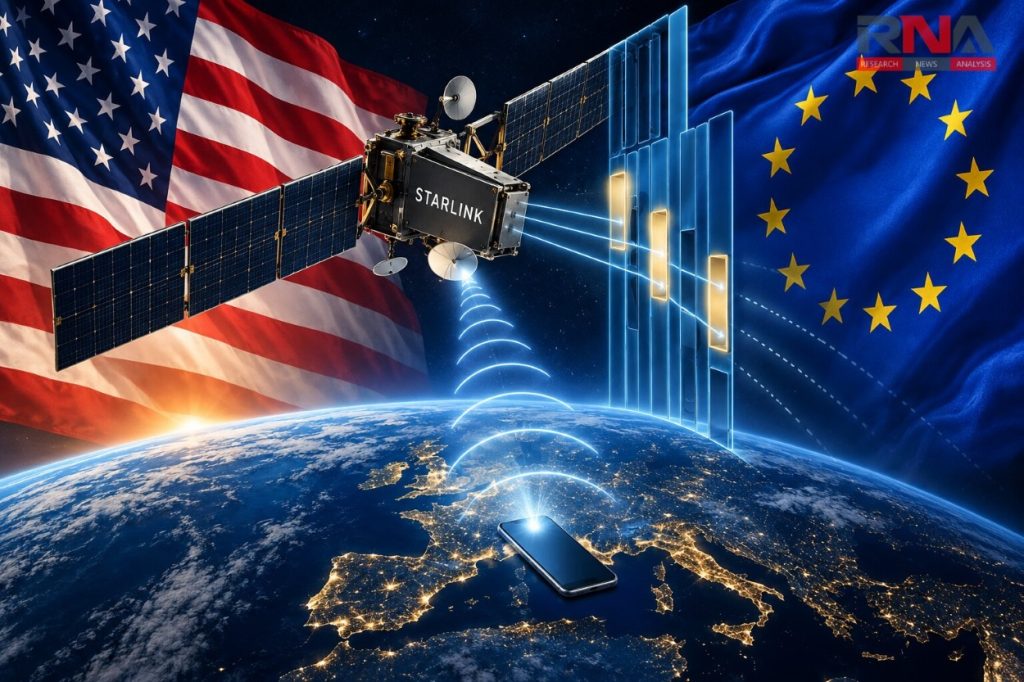
New Delhi: The United States has warned that European companies could face severe retaliation if the European Union proceeds with plans to reserve satellite communications frequencies for European providers, limiting access for rivals including Elon Musk’s SpaceX. The warning brings Europe’s drive for technological independence into sharper conflict with Washington’s defence of American businesses.
The US ambassador to the EU, Andrew Puzder, told the Financial Times that retaliation could be “very devastating for those companies”, citing the importance of the American market. His remarks signalled the possibility of countermeasures rather than the announcement of specific sanctions or restrictions.
At the centre of the dispute is the European Commission’s proposal to reorganize access to the 2GHz mobile satellite services band, adopted on May 27 this year. The frequencies support direct connections between satellites and mobile devices, potentially extending communications to places beyond the reach of conventional mobile networks.
The proposal would establish an EU-wide selection and authorization procedure for services operating beyond 2027, when existing licences expire. Brussels describes the spectrum as a strategic resource for commercial connectivity, security and defence, with common rules intended to help operators provide services across national borders.
The proposed allocation would reserve one-third of the band for government, security and defence services associated with the EU’s Iris² secure-connectivity programme. Half of the remaining commercial allocation would be reserved for European operators, leaving a smaller share available to competitors from outside the bloc.
The dispute therefore concerns access to a valuable segment of the satellite communications market, rather than a blanket prohibition on Starlink throughout Europe. Nevertheless, preferential access could influence which companies develop the next generation of satellite-to-mobile services and how extensively foreign providers can compete.
Puzder accused Brussels of favouring European businesses at their American competitors’ expense, while arguing that the two sides should cooperate against China in artificial intelligence and quantum computing. The commission, however, has said its approach is intended to encourage European entrants and diversify suppliers, while retaining opportunities for non-EU companies.
The commercial stakes became clearer on Monday when Deutsche Telekom, Orange, Telefónica and Vodafone announced that they would explore a joint bid for European mobile satellite spectrum. Their letter of intent represents a preliminary collaboration, with the companies examining how to advance direct-to-device services.
In their joint announcement, the operators identified coverage in underserved areas, more resilient public networks and protection of critical communications as their objectives. They also said the initiative would support the development of a European satellite constellation.
The confrontation comes as the war in Ukraine exposes the strategic consequences of dependence on foreign communications infrastructure. As RNA Media reported recently, the Ukrainian president, Volodymyr Zelenskyy, warned that restrictions affecting satellite connectivity could undermine military operations and cost lives.
The controversy has also prompted scrutiny within Washington, where a bipartisan group of senators requested a Pentagon inspector general investigation on October 15. Their letter sought to establish who authorized or knew about reported Starlink and Starshield disruptions, whether contractual obligations were met and whether American personnel in Ukraine were endangered.
The senators explicitly acknowledged that the causes of some reported communications and warning failures remained unclear. Their intervention nevertheless underlined how commercial satellite services have become embedded in military operations, making decisions about access and continuity matters of national security.
Europe’s immediate difficulty is that reducing dependence requires capabilities that cannot be replaced simply by changing procurement or spectrum rules. European allies lacked readily available substitutes for the US-supported satellite communications and missile-warning capabilities whose disruption Ukraine had reported.
The spectrum proposal consequently sits at the intersection of industrial competition and strategic autonomy. Washington is pressing for access for its companies, while Brussels seeks greater control over infrastructure increasingly important to civilian resilience and defence.