


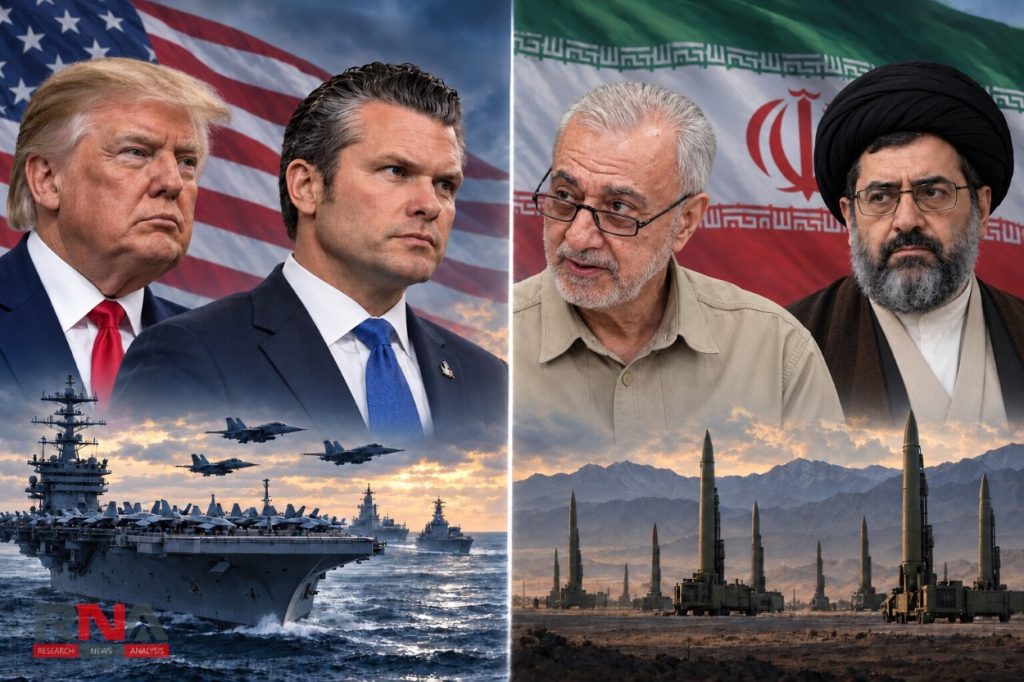
New Delhi: The United States has warned several Gulf Arab countries to prepare for a possible concentrated military offensive against Iran after the November 3 midterm elections, as Washington and Israel develop options for renewed strikes. The warnings, reported by the Wall Street Journal, come as regional governments pursue mediation to prevent another escalation in a conflict that has disrupted energy supplies and shipping through the Strait of Hormuz.
The US president, Donald Trump, has yet to authorize the proposed operation, according to the reporting, leaving the scale and timing of any attack uncertain. Nevertheless, communications through diplomatic and military channels indicate that Washington wants regional partners to prepare for a campaign intended to weaken Tehran’s capabilities and increase pressure for concessions in negotiations.
In the latest public indication that military action remains under consideration, Trump said “anything’s possible” when asked on Wednesday, whether further strikes could follow the elections. His response, carried by Reuters, did not announce a decision or specify potential targets.
The previous day, at a campaign rally in Lubbock, Texas, Trump had suggested that developments involving Iran could come within weeks. “You’ll see Iran in a couple of weeks, if you don’t mind,” he told supporters, while again claiming that earlier American operations had destroyed Iran’s enrichment capacity.
American military preparations reportedly combine additional protection for regional forces with measures to support offensive operations. According to the New Arab’s account of the Journal’s reporting, these include transferring a Patriot missile defence system from Texas to Israel, relocating personnel from exposed bases, replenishing ammunition and preparing bombers and fighter aircraft.
Another aircraft carrier strike group and a Marine expeditionary unit are expected in the region in November, potentially reinforcing approximately 20 American warships already deployed there. Some existing vessels could leave, however, meaning the anticipated arrivals would not necessarily translate into an equivalent net increase in naval strength.
The preparations follow ABC News report on October 22, citing two Israeli sources, that American and Israeli forces had drawn up plans for renewed joint attacks. Those sources linked the expected post-election timing to Trump’s reluctance to cause further disruption in oil markets during the final stretch of the campaign.
Potential targets described to ABC included petrochemical installations important to Iran’s economy and nuclear facilities, including those at Pickaxe Mountain. One Israeli source said power plants were excluded from the plans being discussed, although the anonymously sourced account does not establish the final scope of any operation.
The Israeli prime minister, Benjamin Netanyahu, favours further military action, according to ABC’s sources, but the decision to resume joint strikes rests with Trump. The White House spokesperson, Anna Kelly, told the broadcaster that Washington would not attack Iran before the midterms, while the Pentagon declined to comment on the planning.
Responding to the latest reporting, the White House declined to discuss possible operational arrangements and reiterated its position that Iran must never acquire a nuclear weapon. That response leaves the reported preparations unconfirmed publicly and does not amount to an announcement that hostilities will resume after the vote.
The military warnings coincide with an important assessment from the International Atomic Energy Agency (IAEA), whose director general, Rafael Mariano Grossi, addressed the UN security council on Tuesday. He said the agency had detected no activity indicating that Iran was repairing or reconstructing nuclear facilities damaged in American and Israeli attacks in 2025 and 2026.
Grossi nevertheless stressed that remote observation could not replace inspections at the facilities themselves and urged Tehran to provide the information and access required for verification. His security council briefing distinguished the absence of visible reconstruction from the agency’s continuing inability to establish the status of all relevant nuclear material.
According to the Associated Press, the agency has been unable to verify the status of Iran’s previously reported stockpile of 440.9 kilograms of uranium enriched to 60 per cent since the June 2025 strikes. Iran maintains that its nuclear programme is peaceful, while the unresolved inspection restrictions remain central to international concerns about its activities.
Grossi called for gradual technical steps that could allow inspectors to return and help rebuild confidence for a wider agreement. His assessment underlines a continuing obstacle to any settlement: damage to nuclear facilities cannot, by itself, provide the verification needed to resolve questions about nuclear material and its use.
For Gulf governments, another offensive would also carry the risk of Iranian retaliation against their own territory and infrastructure. Earlier fighting brought missile and drone attacks on military facilities, airports and energy installations, while regional countries are still seeking to replenish air defences depleted during the conflict.
Diplomatic efforts are continuing alongside the military preparations, with Qatar and Pakistan mediating between Washington and Tehran. On Tuesday, Qatar urged Iran to stop threatening Gulf Arab states and reopen the Strait of Hormuz, saying such measures were necessary to demonstrate good intentions and enable mediation to succeed.
A Qatari delegation visited Tehran earlier in the week, while senior representatives from Saudi Arabia, Turkey and Pakistan held separate discussions with Iranian officials on Monday. Reuters reported that the consultations sought to reduce tensions as the conflict continued to affect shipping, oil supplies and security elsewhere in West Asia.
The present war began with American and Israeli attacks on February 28 this year, followed by Iranian missile and drone retaliation and the effective closure of the Strait of Hormuz. A memorandum of understanding reached in June was intended to lead towards a final peace agreement, but broke down over unresolved disputes, including navigation through the waterway.
The immediate question is whether military pressure can produce an agreement before another round of attacks begins. With no final strike decision announced, the coming days will test both the regional mediation effort and Washington’s willingness to pursue an offensive whose consequences could extend well beyond Iran.