


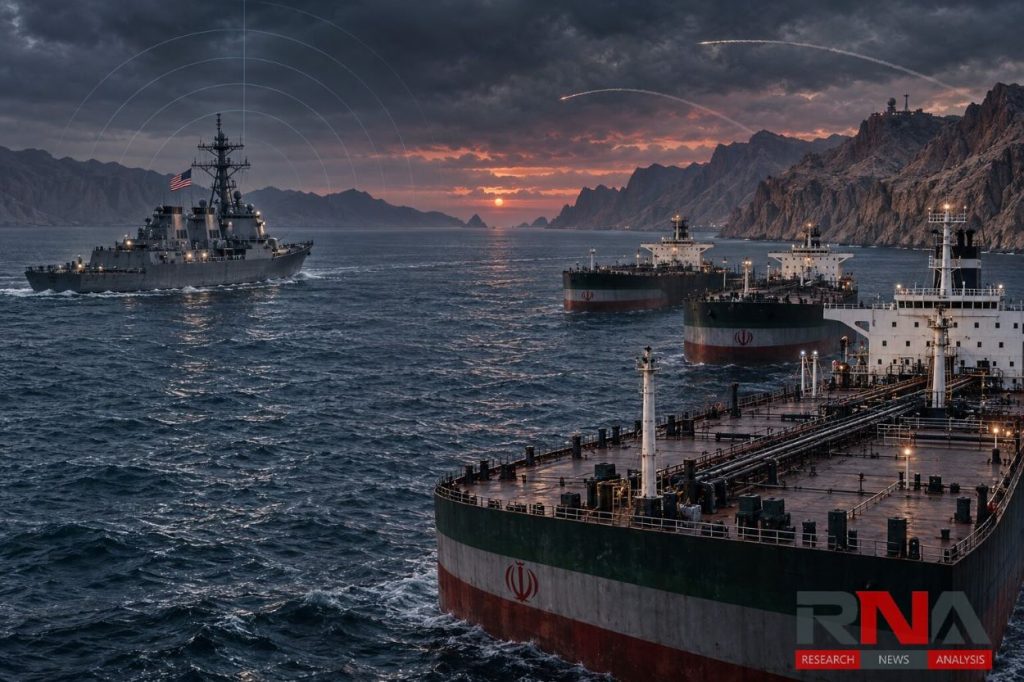
New Delhi: The United States has warned that it will destroy Iranian oil tankers whenever Tehran attacks US Navy vessels, sharpening the military and economic confrontation surrounding the Strait of Hormuz. Iran has responded by threatening faster and more damaging retaliation while acknowledging that sanctions, disrupted oil exports and domestic economic weaknesses are placing its population under increasing strain.
The US secretary of war, Pete Hegseth, issued the warning after American forces struck three Iranian crude carriers on Saturday. “If Iran shoots at US ships, we will destroy (and sink) their oil tankers,” Hegseth said, adding that Tehran could avoid further losses by ending attacks on the American navy.
The strikes followed what the US military described as multiple Iranian ballistic-missile attacks on an American aircraft carrier and a guided-missile destroyer operating in the region. The warships avoided the incoming weapons and no US personnel were injured, according to US Central Command (Centcom).
Two of the Iranian tankers were permanently disabled, while a third vessel, which was not carrying cargo, was destroyed after its crew was instructed to abandon it. One tanker was attacked near Kharg Island, another close to Jask and the empty vessel in the Gulf of Oman, according to AP.
Washington said the vessels formed part of a shadow shipping network that generated revenue for the Islamic Revolutionary Guard Corps and Iran-aligned armed groups. Admiral Brad Cooper, the Centcom commander, said attacking two American warships had brought Tehran a greater economic penalty through the loss of three of its vessels.
Iran’s foreign ministry described the tanker strikes as a war crime and held Washington and its partners responsible for the consequences of what it called military and economic aggression. Iranian state television subsequently claimed that the country’s forces had targeted three oil tankers and three US-linked vessels, although the assertion could not be independently verified.
Tehran signals tougher retaliation
The speaker of Iran’s parliament, Mohammad Bagher Ghalibaf, warned on Sunday that the terms of the confrontation had changed. Any further attack on Iranian interests or national security would receive a “faster, heavier and more painful response”, he said in an address published through his Telegram channel.
The IRGC also threatened more intensive attacks on US military vessels and warned ships against attempting to enter waters that Tehran regards as restricted. Its naval arm said vessels making what it described as suspicious or unauthorized movements could be attacked, further increasing the danger to military and commercial traffic.
The latest confrontation follows a relative reduction in military activity during much of August, after months of intermittent fighting that began with US and Israeli attacks on Iran on February 28 this year. A preliminary ceasefire arrangement reached in June subsequently unravelled, while attempts to revive negotiations over Iran’s nuclear programme and control of maritime traffic have made little progress.
Iran continues to derive strategic leverage from its position beside the Strait of Hormuz, which carried about one-fifth of global oil supplies before the conflict. However, restrictions on Iranian exports and US efforts to disrupt sanctions-evading shipping have increasingly turned the struggle over the waterway into a contest of economic endurance.
Iran confronts deepening economic pressure
Ghalibaf conceded that Iran’s most pressing battle was now being fought over production, employment and household livelihoods rather than solely on the military front. He identified inflation, unemployment, currency instability and poor market management as serious challenges, arguing that the public could withstand hardship but would not accept government inaction or mismanagement.
Iran’s economy minister, Ali Madanizadeh, said the government would answer US pressure through domestic reforms rather than alter its strategic policies under coercion. Responsibility for repairing the economy rested with Iran’s government and people rather than the US treasury, he said, according to Iranian state media.
The economy ministry has also intensified the work of an “Economic War Headquarters” established to manage problems created by sanctions and the conflict. The body is expected to focus on trade disruption, currency volatility, access to essential goods and the financial effects of restrictions on oil exports, Reuters reported.
The pressure is particularly acute because Iran is the third-largest producer in the Organization of the Petroleum Exporting Countries and relied heavily on Kharg Island for crude exports before the war. Iran’s oil minister, Mohsen Paknejad, said the island had endured about 550 strikes in recent months but remained operational, although export flows have been disrupted since Washington began blockading Iranian oil shipments in mid-April.
By striking tankers rather than limiting its operations to naval and missile sites, Washington is attempting to raise the direct financial cost of Iranian attacks without launching another large-scale air campaign. The approach carries considerable risk because Tehran could retaliate against commercial shipping, Gulf energy infrastructure or US bases across West Asia.
Any sustained disruption around the Strait of Hormuz would also have consequences far beyond the combatants by raising freight, insurance and crude-oil prices. India, one of the world’s largest oil importers, is particularly vulnerable to a prolonged supply shock even though it has diversified its suppliers and imports little Iranian crude under the prevailing sanctions regime.
The increasingly explicit threats from Hegseth and Ghalibaf show that both countries are seeking deterrence by promising disproportionate costs. They also underline the danger that an attack causing heavy casualties, sinking a crewed tanker or damaging a major energy installation could rapidly widen a conflict in which diplomatic safeguards have already weakened.