


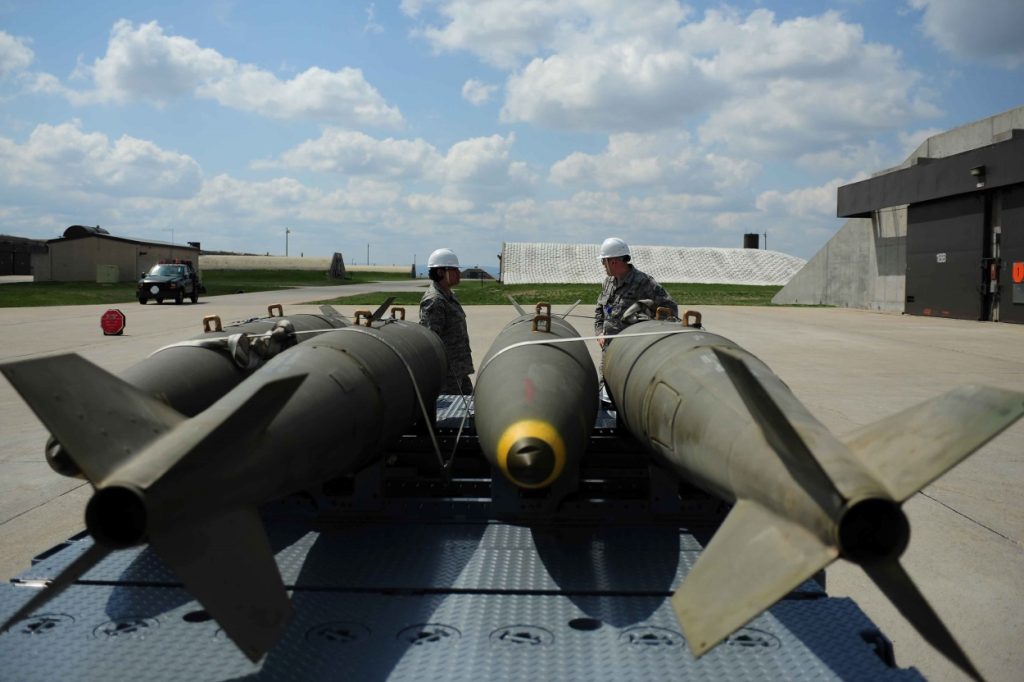
New Delhi: The Trump administration is preparing to sell Israel a multibillion-dollar package of 2,000-pound bombs, according to multiple US media reports citing officials familiar with the deal. The package, reported by the Washington Post and confirmed by the Associated Press, is worth roughly $2.8 billion and includes 40,000 munitions – 20,000 MK-84 (Mark 84) general-purpose bombs and 20,000 BLU-117s, a variant built with a more stable explosive filler for safer storage aboard warships.
Some reports, including one by Al Jazeera, put the total closer to 60,000 warheads once earlier deliveries and a batch of I-2000 “bunker buster” penetrator bombs are counted in. Congress has been informally notified of the sale, most of which will be financed through the country’s “foreign military financing” mechanism – a US programme in which Washington hands Israel the money, which Israel then spends buying American weapons. Neither the state department nor the administration has confirmed the figures publicly, with a spokesperson saying only that the department “does not confirm or comment on proposed arms sales until they have been formally notified to Congress”.
To put the scale in perspective, 40,000 bombs at 2,000 pounds each works out to roughly 40,000 tons of ordnance. That is more than 13 times the tonnage the Eighth Air Force dropped in its heaviest single raid of World War II, the March 1945 bombing of Berlin, though the comparison should be read as a measure of stockpile size rather than of any single strike, since these bombs will be delivered piecemeal over months, not dropped in one campaign.
Bombs, politics, and a paused shipment
This would be the largest single sale of 2,000-pound-class bombs in years. It comes just months after the administration approved a $6.67 billion arms package to Israel in January, and roughly a year after it bypassed the usual congressional review process to push through a near-$3 billion sale containing more than 35,500 of the same bombs.
That was not an isolated manoeuvre. In March, the US secretary of state, Marco Rubio, invoked emergency authority to waive congressional review entirely for a separate $650 million sale of more than 20,000 bombs, days after the US and Israel began a joint air campaign against Iran. Critics argue this pattern of emergency and “informal” notifications has hollowed out the oversight role Congress is meant to play in foreign arms sales, since lawmakers often only hear of a deal after it is already substantially settled.
The munition has a fraught recent history. The then-president, Joe Biden, paused a single shipment of 2,000-pound bombs to Israel in 2024 over fears about civilian casualties in Gaza – the only weapons shipment his administration withheld during the war. Trump reversed that pause within a month of returning to office in January 2025, and the first delayed shipment, reported to contain around 1,800 MK-84s, reached Israel that February.
The renewed sale also lands at an awkward political moment. Reports point to growing strain between Trump and Israel’s prime minister, Benjamin Netanyahu, alongside rising unease among some US lawmakers, including senator Chris van Hollen, over what critics call unconditional military support for Israel’s campaigns in Gaza and Lebanon. Rights groups have long criticized the use of 2,000-pound bombs in densely populated areas, and researchers have previously documented hundreds of such strikes near hospitals in Gaza during the war’s early weeks.
Why does Israel need these bombs?
The MK-84 is not new technology. It traces its lineage to the Vietnam War and remains, at 907kg, the largest of the standard Mark 80-series bombs still in frontline US and allied use. Unguided on its own, it becomes a precision weapon once fitted with a JDAM or Paveway guidance kit, and Israel has used exactly that combination extensively – including, most famously, in the 1981 Osirak strike that destroyed Iraq’s nuclear reactor near Baghdad.
Its punch comes from sheer mass. Packed with roughly 428kg of high explosive, an MK-84 can punch through more than three metres of concrete and produce lethal fragmentation out to about 370 metres, which explains both its military utility against hardened bunkers and tunnel networks, and the civilian-casualty concerns that dog its use in crowded urban settings. The BLU-117 variant swaps in a thermally insensitive explosive filler, chiefly so it can be stored more safely aboard Israeli or US naval vessels without the elevated cook-off risk that plagues older bomb bodies.
The “dumb bomb” label attached to the MK-84 and BLU-117 is somewhat misleading in practice. Both bomb bodies are designed to accept bolt-on tail kits – the GPS-guided JDAM or the laser-guided Paveway series – that convert them into precision-guided munitions without altering the warhead itself. This modularity is precisely why the underlying bomb bodies matter so much in bulk: buying 40,000 of them gives Israel’s air force flexibility to convert as many or as few into precision weapons as a given operation demands, rather than locking in one fixed guidance package years in advance.
The reported inclusion of I-2000 penetrator warheads points to a specific requirement: deep, hardened underground targets. Israel’s campaigns against Hamas’s tunnel network in Gaza, Hezbollah’s positions in Lebanon, and – most significantly – Iran’s fortified nuclear sites have all demanded exactly this capability. The joint US-Israeli strikes on Iranian facilities earlier this year, in which American B-2 bombers used far larger bunker-busting munitions, only sharpened Israeli demand for a deep magazine of penetrator-capable ordnance for any future round of strikes.
Seen in that light, the sale is less a single transaction than restocking. Israel has expended enormous quantities of precision and general-purpose munitions since October 2023, across four active fronts – Gaza, Lebanon, Syria and, briefly, Iran – and a package of this size is meant to rebuild depleted stockpiles for whatever comes next, rather than to arm any one imminent operation.
The sale still has to clear formal congressional notification before it becomes final, and neither Washington nor Tel Aviv has confirmed the exact figures on the record. That is worth watching over the coming weeks.