


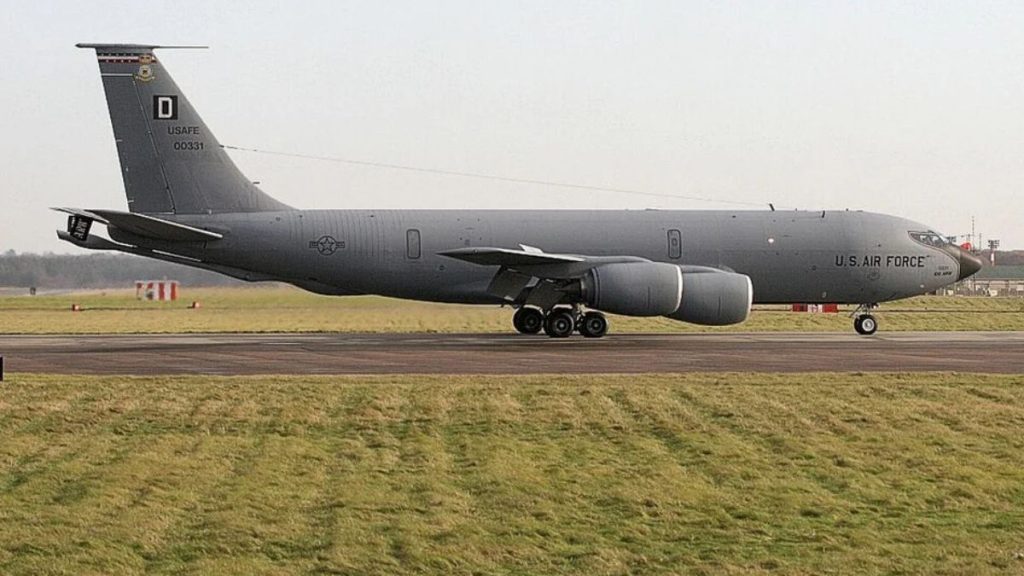
New Delhi: The United States moved military aircraft from RAF Mildenhall in eastern England on Monday, after a reported security threat linked to Iran. The movements coincided with heightened protection at American-operated bases in Britain, although officials have not publicly confirmed the threat’s nature or warned of an imminent attack.
Two US aerial refuelling tankers were initially diverted to Germany, with other aircraft relocated later, the Wall Street Journal reported. Flight-tracking information cited by Sky News showed nine KC-135 Stratotankers and three Osprey aircraft departing the Suffolk base.
Most tankers flew to Germany and Spain, while one reached Prestwick in Scotland; the Ospreys transferred to nearby RAF Lakenheath. The KC-135 fleet refuels military aircraft in flight, extending their range and allowing sustained operations across distant theatres.
Security heightened at US airbases
Security at Mildenhall and Lakenheath was reportedly raised to force-protection condition “Charlie”, the second-highest US military alert level. The classification is used when intelligence indicates that some form of terrorist action is likely, but it does not establish an Iranian operation against either base.
The “Gang of Eight”, comprising senior congressional leaders and intelligence committee heads, also received a briefing on reported Iranian threats to the US on Monday, The Wall Street Journal reported. However, officials have not publicly established whether the intelligence discussed was directly connected to the aircraft movements at RAF Mildenhall.
A US official confirmed enhanced force-protection measures at both installations but declined to detail them. US air forces in Europe-air forces Africa separately said aircraft routinely rotate between bases for training and operational reasons, without confirming why these particular aircraft moved.
The US secretary of state, Marco Rubio, also acknowledged measures to protect American personnel amid reported Iranian threats. “We’ve addressed it by moving people away from the threat,” Rubio told reporters on Monday.
Britain’s defence ministry said it does not routinely comment on other countries’ military activities and that aircraft move according to operational requirements. British minister, Lucy Powell, said airbase security was kept under review and that authorities would respond rapidly when necessary.
Earlier Iran-linked security investigation
The developments follow a separate counterterrorism investigation at RAF Fairford in Gloucestershire, where five men were arrested after suspicious vehicles approached the base on September 27. American B-1 bombers subsequently returned to their US home stations, but officials have not established that the arrests caused the withdrawal.
Two men were charged under Britain’s national security act on October 27, including one accused of assisting an intelligence officer believe to be Iranian. Tehran has denied involvement, and investigators have not linked the Fairford case to the reported Mildenhall threat.
Iranian Army spokesman, Mohammad Akraminia, has warned that retaliation for renewed US attacks could extend beyond West Asia. His comments did not identify either British installation as a target, underscoring the distinction between broad warnings and a verified operational threat.
US intelligence agencies had also detected an increase in suspected Iranian plots targeting American diplomats and government officials overseas, Axios reported in October. Some alleged plots were reportedly at advanced stages, although the report did not establish a connection with RAF Mildenhall.
Aircraft movements coincide with diplomacy
The aircraft movements also came as the US president, Donald Trump, met the Qatari prime minister, Sheikh Mohammed bin Abdulrahman Al Thani, in Washington to discuss efforts to end the Iran war. Trump said the conflict was militarily “effectively over” and indicated that he would hold off on further strikes for now.
Washington nevertheless intends to maintain its naval blockade in the Strait of Hormuz, Reuters reported. Iran has proposed lifting its restrictions on shipping through the waterway if the US ends its blockade of Iranian ports, eases certain sanctions and halts military strikes, but Washington has rejected the proposal.
The combination of heightened base security and continuing negotiations illustrates the uncertainty facing US forces stationed in Europe. Neither the aircraft movements nor the alert establishes that an attack was imminent or that diplomatic talks have collapsed.