


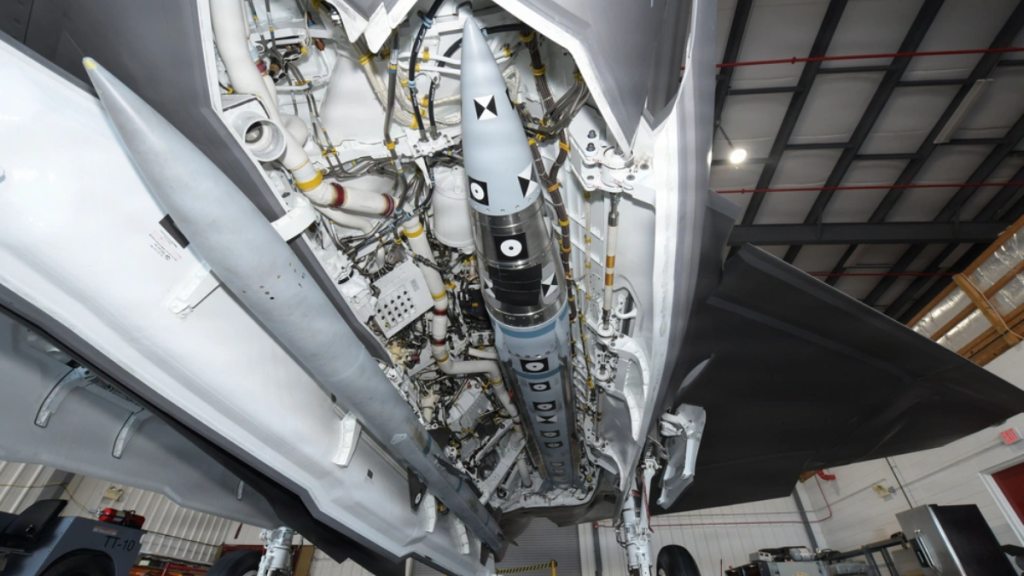
New Delhi: The US navy has unveiled the AIM-424 long range air-to-air missile (LRAAM), also known as Malice, a new weapon designed to extend the engagement range of naval and Marine aviation against advanced airborne threats. Developed by Raytheon, the missile can strike targets at a range of more than 250 nautical miles (463km), according to specifications released by the US navy.
The missile was revealed at the US navy’s Tailhook Symposium in Reno, Nevada, as Washington continues to expand long-range air combat capabilities for a future conflict involving heavily contested airspace. The Us navy said LRAAM is intended to support fleet defence and preserve an advantage in detecting, engaging and defeating threats before they can reach naval forces.
Malice is being developed for fourth-, fifth- and sixth-generation aircraft, giving it a role across both current and future US combat aviation. US Navy-released imagery has shown the weapon being carried by an F/A-18E Super Hornet, while testing and integration efforts have also involved the F-35C.
The missile measures 13.5 feet (4.11 metres) in length, has a 13.5-inch (0.34-metre) diameter and weighs about 1,500 pounds (680kg). It uses a solid-propellant rocket motor, has a 26.2-inch wingspan and carries a blast-fragmentation warhead.
Its extended reach is particularly relevant to fleet air defence. The ability to engage aircraft hundreds of kilometres away could allow naval aviation to target bombers, support aircraft and other platforms carrying long-range weapons before they come close enough to threaten a carrier strike group.
Bloomberg, citing Peter Layton, a former Royal Australian Air Force officer and visiting fellow at the Griffith Asia Institute, reported that Malice could be intended primarily to counter Chinese bombers armed with long-range anti-ship cruise missiles. Layton described the weapon’s potential role as “Fleet air defense, not air-to-air combat.”
However, such long-range engagements depend on more than missile performance. Aircraft and other networked sensors must detect and track targets at considerable distances, while the missile must receive accurate guidance throughout the engagement. A target can also attempt to defeat an incoming weapon by turning away or exploiting electronic warfare and other defensive measures.
The AIM-424 is emerging as part of a broader US push towards longer-range air-to-air weapons. The US navy already operates the AIM-174B, derived from the SM-6, while the US military is also advancing the AIM-260 Joint Advanced Tactical Missile for future air combat requirements.
The US navy has not disclosed when Malice will enter operational service. Its unveiling nevertheless signals a growing emphasis on extending the distance at which US naval aviation can detect, engage and neutralize threats, particularly those capable of carrying stand-off weapons against ships.