


New Delhi: China is getting a temporary opportunity to test the US military presence in the western Pacific as Washington keeps a large part of its naval strength focused on the war with Iran. The shift has come as Beijing carries out military exercises around disputed areas and continues to challenge US allies in the region.
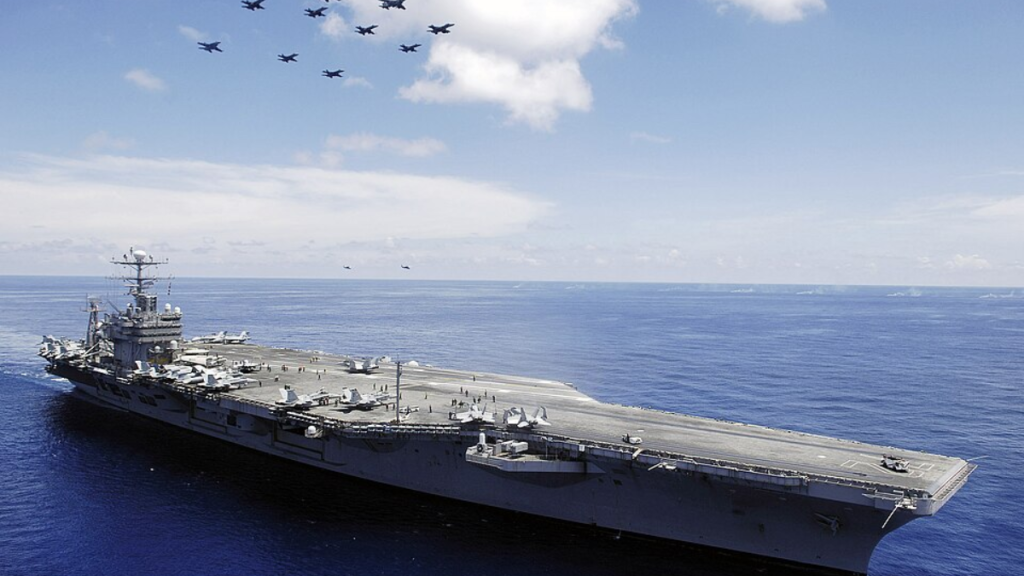
The US Navy is preparing to move the USS George Washington from the Pacific to the Middle East, where it will replace the USS Abraham Lincoln. The Lincoln has remained deployed beyond its planned return in May as the US continues its military operations against Ira.
The move will leave the western Pacific without a US aircraft carrier for a period, although another carrier could be sent to the region within the next few months. The temporary gap is significant because aircraft carriers are among the most visible symbols of US military power and are used to reassure American allies.
Beijing increasing pressure
China has stepped up military activity in areas where it has territorial disputes with US partners. Chinese forces conducted drills near Scarborough Shoal in the South China Sea this month, while a Chinese guided-missile destroyer carried out a live-fire exercise near Japan’s southern waters last month, AP reported.
The exercises involve areas that are closely watched by the Philippines and Japan, both of which have important security ties with Washington. The US carrier’s absence does not mean Beijing is expected to launch an immediate military operation, but it gives China an opportunity to demonstrate its capabilities while American naval resources are focused elsewhere.
Bryan Clark, a former US Navy submariner and defence analyst at the Hudson Institute, told AP that Beijing could use the situation to send a message to countries such as Japan, the Philippines and Indonesia. China could seek to portray itself as the stronger regional power while questioning whether the United States can maintain its security commitments.
Washington says it can return forces to region
US officials have sought to assure regional partners that the carrier movement does not represent a permanent reduction in American military power in the Pacific. Admiral Frank Bradley, head of US special operations command, visited Manila and said American forces could project power around the world and return their focus to the region when the Middle East situation is under control.
The reassurance comes as some analysts question whether the United States can maintain its military commitments in Asia while continuing a prolonged operation against Iran. Greg Poling, director of the Southeast Asia Program at the Center for Strategic and International Studies, said the development was difficult to reconcile with Washington’s earlier goal of reducing its involvement in the Middle East.
Evan Sankey, a policy analyst at the Cato Institute, told AP that aircraft carriers also provide psychological reassurance to US allies. Their absence can add to concerns that Washington is distracted by events in the Middle East.
Iran operation stretching carrier fleet
The pressure is not limited to where US carriers are deployed. The Abraham Lincoln has spent more than 240 consecutive days at sea, while the USS Gerald R Ford completed an 11-month deployment in May, one of the longest carrier deployments in decades.
The United States has 11 aircraft carriers, but only some can be deployed at any one time. Others are undergoing maintenance, training or preparation, limiting the number of ships available when several regions require American naval power at the same time.
The current pressure could continue even after the Iran operation ends. Bryan Clark said carriers returning from long deployments would need maintenance, potentially creating a backlog at the two US shipyards that carry out major work on nuclear-powered aircraft carriers.
The USS Theodore Roosevelt could potentially move towards the Middle East, allowing the George Washington to return to the Pacific. But continued rotations could put further pressure on the fleet and reduce the number of carriers available for other operations.
The situation has also raised questions about the future role of aircraft carriers in US naval strategy. Long-range missiles and drones have made large warships more vulnerable, while submarines and smaller ships can provide other options for striking targets.
Admiral Daryl Caudle, chief of naval operations, has called for greater use of smaller and newer ships instead of relying heavily on large carriers. For Washington, the challenge is now to maintain pressure on Iran without allowing the demands of that conflict to create greater room for Beijing to expand its military influence in the Pacific.