


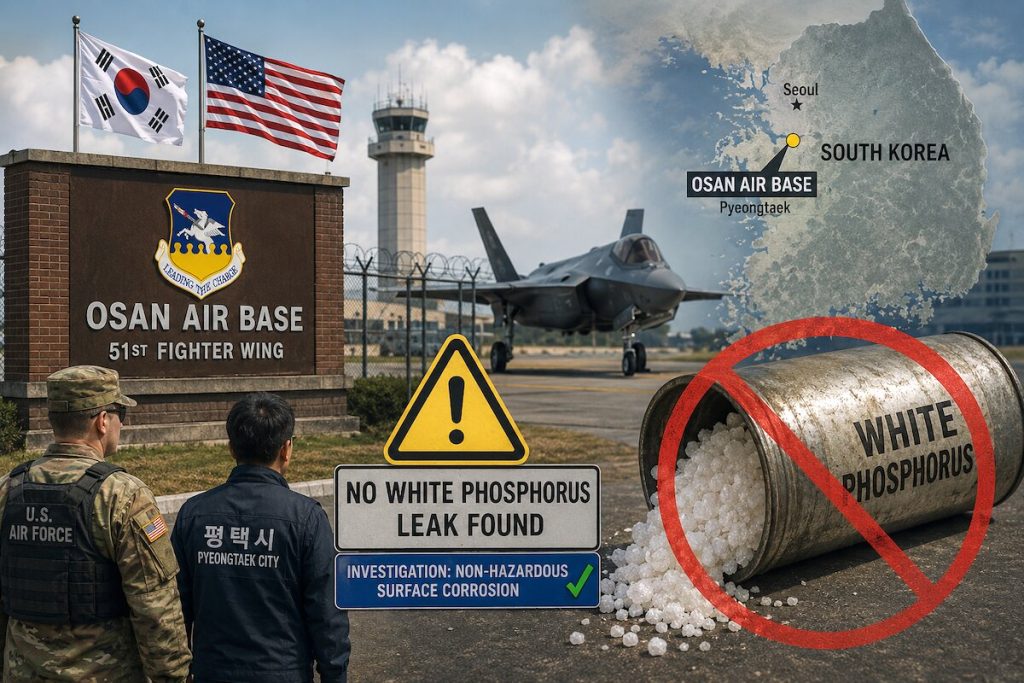
New Delhi: The US military has said that a suspected white phosphorus leak at its Osan airbase in South Korea, which forced a brief evacuation order for nearby residents last month, never actually happened. In a statement issued on Thursday, the 51st Fighter Wing said its investigations found no trace of the hazardous chemical at the site.
The scare began on July 28 when the Pyeongtaek city government sent emergency text messages to residents living near Osan airbase, south of Seoul. The messages urged people to move to safe locations and avoid skin exposure, after reports emerged that white phosphorus had leaked from the facility at around 5pm.
Local police reportedly cordoned off an area between 300 and 500 metres from the base, diverting pedestrians and vehicles away from the perimeter. City officials lifted the evacuation advisory later the same evening, saying they had been informed that decontamination work at the base was complete.
On the day of the incident, the 51st Fighter Wing did not confirm a white phosphorus leak. It instead described the episode as a “ground mishap” that occurred at 5.08pm, and said a 1,000-foot – roughly 300-metre – safety cordon had been established around the base purely as a precaution.
The wing also pushed back on suggestions that the entire base had been evacuated, calling such reports false. It said the safety of service members, their families and residents of Pyeongtaek remained its highest priority, and that South Korean police and emergency services had been consulted throughout.
The finding
Thursday’s statement went further, addressing the substance of the original alarm directly. The military said the crystallization and residue spotted during a routine munitions inspection that day was not white phosphorus, and contained no trace of it whatsoever.
A follow-up analysis instead attributed the residue to non-hazardous surface corrosion, built up through prolonged environmental exposure. No injuries were reported at any stage of the episode, the statement added.
The 51st Fighter Wing’s commander, Colonel Ryan Ley, thanked Pyeongtaek for its cooperation. “We appreciate the city’s close partnership in keeping our community safe, and we thank everyone for their patience as our team worked to resolve this situation,” Ley said, according to the statement.
Why white phosphorus alarms people
White phosphorus is a controversial substance used in incendiary munitions and smoke shells. Once ignited, it burns at extremely high temperatures, capable of setting structures alight and burning human flesh down to the bone.
Its use in populated areas has drawn international scrutiny in several conflicts in recent years, and incendiary weapons of this kind fall under Protocol III of the UN Convention on Certain Conventional Weapons, which restricts – though does not outright ban – their deployment near civilians. That background helps explain why even an unconfirmed leak near a residential area triggered swift precautionary action from local authorities.
Osan airbase is one of the most significant American military installations on the Korean peninsula, hosting units under the US Seventh Air Force. The United States maintains roughly 28,500 troops across South Korea, a presence that Washington and Seoul describe as a deterrent against potential aggression from North Korea.
The episode, though ultimately attributed to natural corrosion rather than any chemical hazard, is a reminder of how quickly public concern can escalate around US military facilities operating close to Korean civilian communities. It also underlines the pressure such bases face to communicate transparently and swiftly when safety scares arise.