


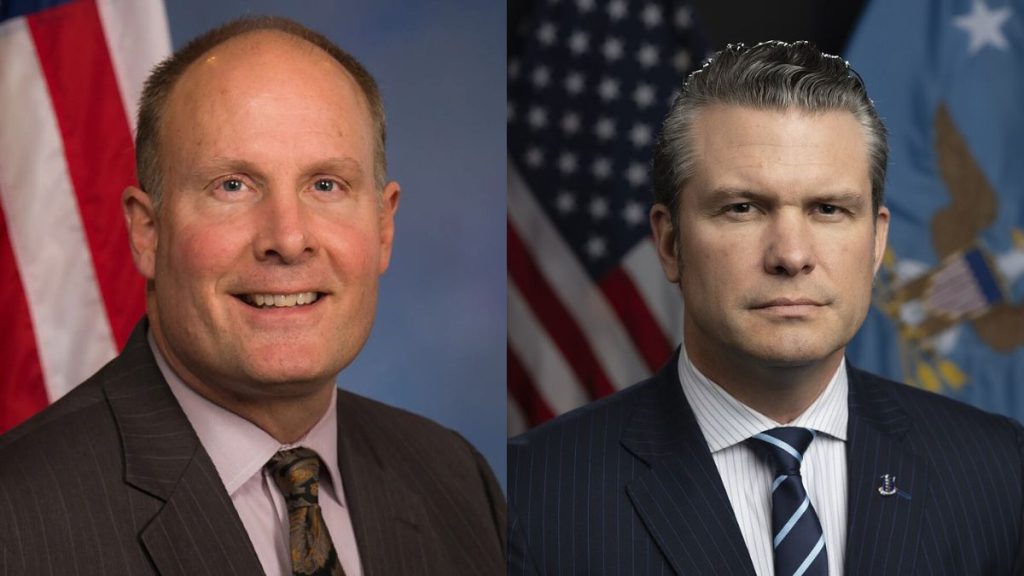
New Delhi: John Moolenaar, chairman of the US house select committee on China, has urged the US defence secretary, Pete Hegseth, to expand restrictions on defence funded research involving Chinese universities, laboratories and talent-recruitment programmes.The proposal, made public on Wednesday, targets institutions the committee says have links to China’s military research network, but it has not changed existing US policy.
Moolenaar recommended adding 14 Chinese academy of sciences institutes, 62 laboratories and national defence laboratories, 58 universities and 22 foreign talent-recruitment programmes to the Section 1286 list. His request also covers the China Scholarship Council and researchers receiving its support.
How the proposed restrictions would work
The list, established under Section 1286 of the Fiscal Year 2019 National Defense Authorization Act, identifies foreign institutions and talent programmes considered research-security risks. The Pentagon’s July 2026 update named 130 academic and research institutions across China, Russia and Iran.
Since fiscal year 2026, Pentagon funding cannot support fundamental research conducted in collaboration with listed entities or using their equipment. The rules put specified research partnerships at risk of losing defence funding but do not prohibit all academic exchanges involving Chinese researchers.
Moolenaar also urged the Pentagon to bar researchers, graduate students and postdoctoral scholars receiving China Scholarship Council funding from participating in defence-funded projects for the duration of that support, regardless of their formal role in the research. His letter raised concerns about academic freedom, student surveillance, ideological control and potential espionage associated with the programme. However, these concerns do not establish wrongdoing by individual scholarship recipients.
Military research links raise concerns
The committee cited institutional agreements, military procurement relationships and links with China’s defence research system. It highlighted work in artificial intelligence, semiconductors, quantum computing, hypersonics, aerospace, underwater systems and electronic warfare, fields with civilian as well as military applications.
Some proposed universities are jointly supported by China’s state administration for science, technology and industry for national defense, the committee said. Its assessment concerns institutional connections, not evidence of wrongdoing by every researcher at the named organizations.
Tsinghua University is among the proposed additions, according to Reuters. Its center for international security and strategy already appears separately on the Pentagon’s published list, highlighting the distinction between an institution-wide proposal and an existing centre-level designation.
The proposal follows the Pentagon’s scrutiny of 30 US academic institutions over foreign research partnerships and identified research security risks. The department directed the institutions to review their international research relationships and take corrective measures, according to the committee. All 30 had responded by early September, although officials were still examining their submissions.
The American Federation of Teachers and American Association of University professors criticized the directive over concerns about due process and academic freedom.
Unlike export controls governing transfers of specified technologies, Section 1286 primarily restricts eligibility for defence research funding. Moolenaar’s Wednesday request does not itself amend the list, and any further designations would require Pentagon action.