


New Delhi: The United States carried out fresh strikes against Iranian targets in the Strait of Hormuz on Monday, a day before US midterm elections. The attacks mark the first known US strikes on Iran since early September, after a gap of nearly two months.
A US official said the strikes targeted Iranian personnel using surface-to-air missiles against American assets, Reuters reported. The official, speaking anonymously, described the operation as “defensive” and limited in scope rather than a return to full-scale military action.
Explosions were reported on Iran’s Qeshm Island late Monday, with more blasts reported near the port city of Bandar Lengeh, Al Jazeera reported.
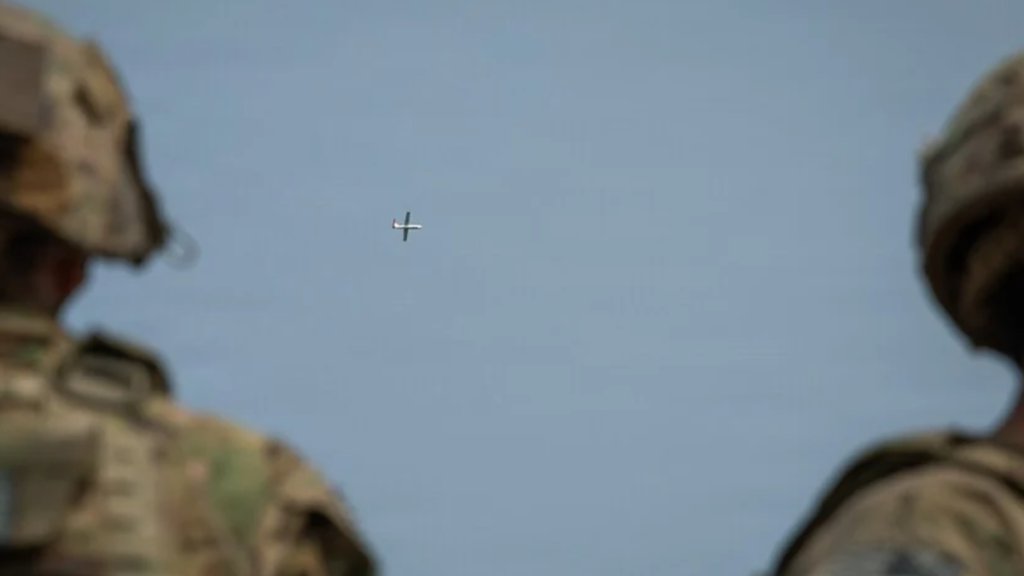
Meanwhile, Iranian navy claimed to have captured a fourth US reconnaissance drone intact west of the Strait of Hormuz on Monday, IRNA reported. The drone was identified as an MQM-170 Outlaw, allegedly used to monitor Iranian air defence systems near the Persian Gulf coast and Qeshm Island.
The military action came despite the United States president, Donald Trump, previously saying Washington would not launch fresh strikes before Tuesday’s elections. The conflict has become a political vulnerability for Republicans because of its financial cost and impact on fuel prices.
US-Iran negotiations continue
The United States vice-president, JD Vance, expressed optimism about a possible agreement with Tehran before the strikes were reported. According to reports, he confirmed sending a letter to Iranian security chief, Mohsen Rezaei, last week and said he had discussed negotiations with Trump on Monday.
Meanwhile, Iran’s supreme national security council chief, Mohsen Rezaei, confirmed receiving a letter from Vance but said he had not responded. In an interview on Saturday, he said, “their tone has completely changed, and this is a very good sign.” He added that Iran had not yet made any new decision on its nuclear doctrine.
The Iranian foreign ministry spokesman, Esmaeil Baqaei, said Tehran would judge Washington by its actions rather than the tone of its diplomatic messages. Speaking at a press conference in Tehran, he said the US had repeatedly undermined diplomatic efforts and that “the ball is entirely in Washington’s court” to meet Iran’s demands.
He added that reopening the Strait of Hormuz and restoring regional security would require the US to lift its naval blockade and address Tehran’s demands.
Qatar has also been mediating between the two sides. Its representatives held two rounds of discussions with Iranian officials last week and are working on a framework under which Iran would stop attacks on shipping in exchange for the US lifting its blockade of Iranian ports. Further talks are expected this week.
Netanyahu pushes for fresh strikes
The Israeli prime minister, Benjamin Netanyahu, has urged Trump to consider another round of strikes against Iran after the US elections. According to the Associated Press, citing regional officials, Netanyahu raised the issue during a telephone call with Trump over the weekend.
Netanyahu is reportedly seeking a swift but extensive US air strikes. However, Trump has not committed to further military action.
Several US allies in the Middle East have warned against escalation. They fear renewed attacks could prompt Yemen’s Iran-backed Houthi rebels to intensify strikes on Saudi Arabia and Red Sea shipping, while Iran-backed militias in Iraq could also become involved.
Thousands of US troops remain deployed in waters around Iran to enforce a naval blockade aimed at stopping Iranian oil shipments. A third US aircraft carrier and additional troops are also heading to the Middle East.
Meanwhile, Trump sought to downplay the conflict during a speech in Washington on Monday a day before US mid-term election, saying the US had not been involved in fighting for months. He also pointed to falling oil prices as a sign that markets expected a possible agreement with Tehran.
The Associated Press reported that the conflict has cost US taxpayers at least $47 billion. Iran’s supreme leader, Ayatollah Mojtaba Khamenei, has meanwhile warned that any threat from the US or Israel would invite an immediate response, without geographical restrictions, RNA Media reported.