


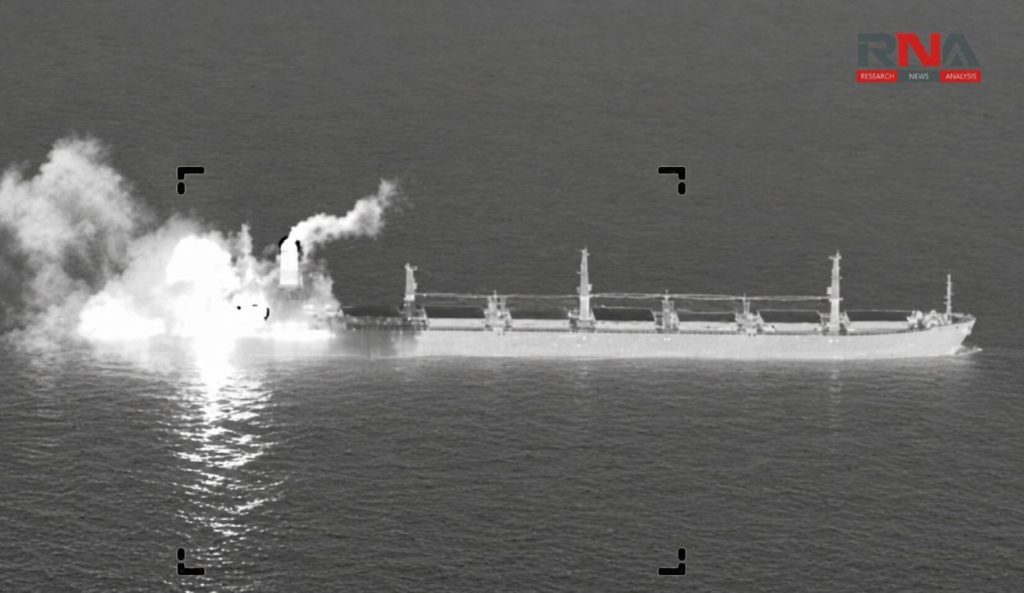
New Delhi: A US fighter jet struck a Panama-flagged commercial cargo ship in the Gulf of Oman on Saturday, disabling its propulsion after the crew allegedly disregarded repeated warnings to comply with Washington’s naval blockade of Iran. The US Central Command (Centcom) said the vessel had previously left an Iranian port and that no crew members were injured in the attack.
The vessel was identified as the MV Ocean Molica, also known as the MV Arika Sun, with Centcom saying a precision munition hit its stern. The command described the action as an operation to stop a blockade violation, although its account did not identify the Iranian departure port, the ship’s destination or the cargo aboard.
Media could not immediately reach the bulk carrier’s operator for comment. The allegation that the crew deliberately attempted to evade the blockade, and the assertion that everyone aboard escaped injury, therefore remain attributed to the US military.
The strike underscores the continuing use of military force against commercial shipping connected to Iranian ports, even when vessels sail under another country’s flag. In this case, the connection cited by Centcom was the ship’s departure from Iran; its statement did not allege that the Ocean Molica was carrying weapons or belonged to Iran’s Islamic Revolutionary Guard Corps (IRGC).
According to Centcom’s statement, US forces resumed the blockade of vessels entering or leaving Iranian ports on July 14. The command said four commercial vessels had been disabled and 135 ships ordered to turn back during approximately three months of enforcement.
It separately reported destroying 10 tankers associated with what it described as the IRGC’s multibillion-dollar shadow shipping network over the same period. Those figures are US military tallies, and the statement did not place the Ocean Molica among the tankers it alleged were linked to that network.
Centcom also renewed instructions for mariners operating in the Gulf of Oman and the approaches to the Strait of Hormuz to follow blockade warnings and monitor navigational notices. Crews were advised to communicate with US naval forces using bridge-to-bridge radio channel 16.
The attack comes as commercial vessels face mounting danger across the region’s energy export routes. According to global marine data, shipping through Hormuz had fallen to its lowest level in more than two months, following a surge in tanker attacks that heightened concerns about supply disruptions and supported crude prices.
Separately, Iran’s IRGC navy claimed on Saturday that a supertanker attempting to leave Hormuz through a route Tehran had not authorized struck naval mines and suffered a major explosion. The Financial Times reported that the Iranian force did not identify the vessel, leaving important details of that incident unresolved.
These incidents involve different restrictions on shipping: Washington is enforcing a blockade of Iranian ports, while Tehran is seeking to dictate which routes vessels may use through Hormuz. Together, they expose merchant ships to competing military demands along a passage connecting the Persian Gulf with the Gulf of Oman and the Arabian Sea.
The scale of the economic exposure is substantial. According to the International Energy Agency’s Hormuz factsheet, approximately 20 million barrels of crude oil and petroleum products passed through the strait each day in 2025, representing around a quarter of global seaborne oil trade.
For India, the vulnerability extends beyond crude oil to liquefied natural gas, or LNG, used across industry and the energy sector. The agency identifies India as a major destination for oil shipped through Hormuz and says India, Bangladesh and Pakistan each obtained almost two-thirds of their LNG supplies through the passage in 2025.
Alternative routes offer only a partial cushion against prolonged disruption. Saudi Arabia and the United Arab Emirates have pipelines that bypass Hormuz, but the agency’s pre-war assessment found their available capacity substantially below the volume normally shipped through the strait, while Gulf LNG exports have no comparable alternative maritime outlet.