


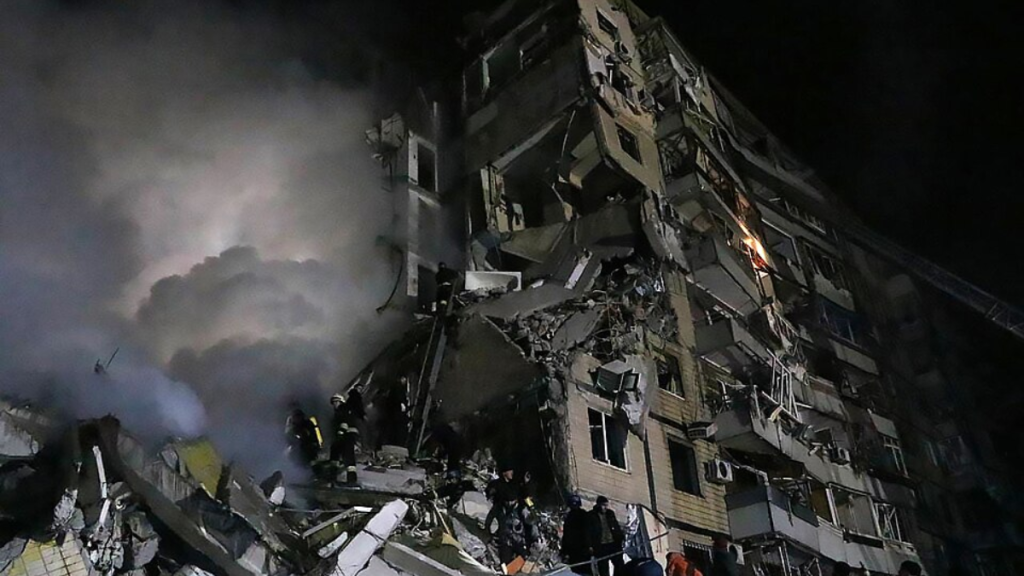
New Delhi: The US and Iran continued their missile and drone attacks on each other for the second straight day on Thursday, as both sides threatened to return to full-fledged war in West Asia, as a peace deal between them looks far more distant now. After nearly two months of ceasefire, the war seemed to have returned to the region, triggered by the downing of a US Air Force Apache gunship by Iran on Monday.
The US president, Donald Trump, vowed to hit Iran hard if it did not sign a peace deal forthwith, escalating the hostilities. The retaliatory strikes saw the US returning fire on Iran’s military installations along the coast for targeting its helicopter in the Strait of Hormuz. Tehran wasn’t staying quiet either. It began targeting US military bases in the Gulf region on its neighbouring nations’ territory.
The latest exchange of missile and drone attacks is the most serious threat to a fragile ceasefire that remained intact for nearly two months after being announced on April 8. The resumption of military operations reduced hopes that peace would return to the region, rich in oil and a main source of global energy supplies, sending oil prices up by nearly $3 and extending gains in early Asian trade on Thursday.
Trump told Fox News on Wednesday that the American airstrikes would stop shortly, but that he would resume heavy bombing of Iran if its leaders do not sign a peace deal with the US immediately. The US military said its latest airstrikes on Wednesday targeted “military surveillance capabilities, communication systems, and air defence sites across Iran” and this military operation was in response to Tehran’s “unwarranted and continued aggression” on American assets in West Asia.
The US Central Command (Centcom) announced that the retaliatory strikes were completed in four hours after they began in the early hours of Thursday. Iran’s Islamic Revolutionary Guard Corps (IRGC) said it launched counterattacks on 18 American military targets in Kuwait, Bahrain, and the US Navy’s fifth fleet, headquartered in Bahrain. The IRGC also targeted the al-Azraq air base in Jordan for the second time in two days, this time firing 12 ballistic missiles at the military facility. Kuwait’s air defence systems responded to the Iranian attacks, intercepting hostile aerial targets. Bahrain’s air defence forces also engaged and destroyed Iranian aerial threats, according to an X post by the media adviser to Bahrain’s king.
Iran closes Strait of Hormuz, US denies
Iran’s military claimed it had fired at two US warships in the Strait of Hormuz and warned it could continue to attack any vessel passing through the narrow waterway, key to oil supply chains. The Centcom, however, denied that the Strait of Hormuz was closed by Iran or that Iranian attacks hit any of its warships. Iran’s news outlets reported explosions in several cities across the nation, including in Sirik, Kargan, Bandar Abbas, Minab, and Karaj, all near the Strait of Hormuz, apart from Varamin in northern Iran, closer to the Caspian Sea.
US war secretary Pete Hegseth claimed the American retaliatory strikes were aimed at forcing Tehran to sign a peace deal to end the West Asian conflict. He told reporters in Florida that the airstrikes would “advance our military interests and also enhance our diplomatic position,” though he did elaborate on how the latest escalation in the war would be beneficial to the peace process. “We will strike them hard tonight, and hopefully, Iran makes a good decision. If we need to negotiate with bombs, we’ll negotiate with bombs,” Hegseth added.
Iran’s foreign ministry spokesperson Esmaeil Baghei accused the US of hitting water reservoirs that supplied drinking water to 10 villages, claiming this was a violation of international laws. “This is not collateral damage…it is a calculated war crime and a flagrant violation of human rights,” Baghei said.
Israel, Hezbollah continue fighting
Meanwhile, fighting between Israel and Iran-backed Hezbollah in neighbouring Lebanon continued unabated, as Tel Aviv struck southern Lebanon, killing at least 13 people on Wednesday, according to the Lebanese military. Hezbollah also claimed fresh strikes on Israeli military positions throughout the day. The Israeli military acknowledged at least two “launches” hitting troop positions in southern Lebanon, and that sirens were sounded in several areas of northern Israel early on Thursday.
The war, which began on February 28 with the US-Israel airstrikes on Iran, has gone on for over four months now, with a two-month ceasefire providing some relief to both sides, though they have hit each other intermittently during the stoppage of war since April 8. Iran has insisted that any peace deal should include Lebanon, where Tehran-supported Hezbollah joined the war in the early days to target Israel.
The peace talks did not progress after the first direct meeting between the American and Iranian delegations in Islamabad in mid-April, as both sides were adamant on their negotiation points. The US has demanded Iran stop its nuclear programme and reopen the Strait of Hormuz unconditionally, while Tehran wanted the US naval blockade of its ports to end, apart from unfreezing of its assets abroad.
UN chief calls for peace
As the West Asian situation deteriorated since the beginning of the week, the United Nations secretary-general, Antonio Guterres, posted on X that the region “is being pulled deeper into crisis & the consequences reach far beyond.” Asking all parties to work toward a diplomatic settlement, Guterres said, “This week has brought wider attacks and further deterioration, where the ceasefire is more like a ‘lesser fire’. We should not minimize the risks of ‘lesser fire’ becoming ‘full fire’. No more attacks. No more excuses.”
Guterres followed up that post with another, noting that he fully supported a monopoly on weapons by the Lebanese government. “Since March, we have witnessed a serious escalation – as Israel intensified its operations in Lebanese & Hezbollah fired deeper into Israel. All parties must work towards a diplomatic settlement that fully respects the territorial integrity, sovereignty & political independence of Lebanon,” the UN chief said. “The process must start with a comprehensive ceasefire respected by all parties everywhere, alleviating the suffering of communities on both sides of the ‘blue line’. I hope further negotiations will contribute to lasting peace & stability,” he added.