


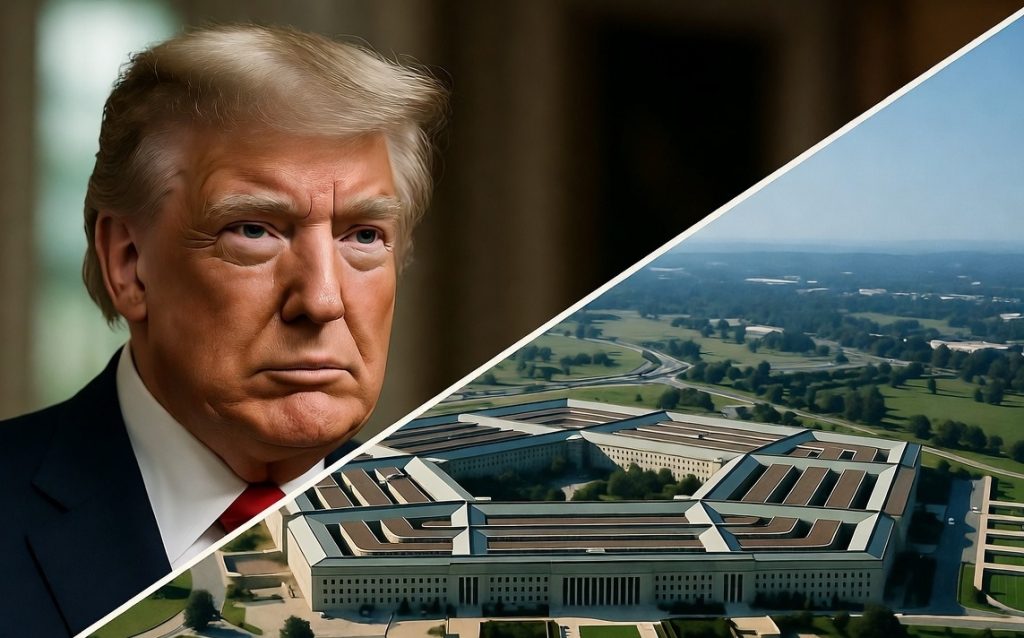
New Delhi: The United States is sharpening its military preparedness on two fronts. First, accelerating weapons production at home after the Iran conflict exposed pressure on munitions reserves; second, moving to build a war-ready stockpile in Australia to support future Indo-Pacific operations.
Together, the two steps signal a broader American effort to reinforce both its defence industrial base and its forward military logistics network, as Washington adjusts to the demands of prolonged conflict, supply-chain strain, and strategic competition across multiple theatres.
Trump invokes emergency law to up arms production
The US president, Donald Trump, has invoked the Cold War-era Defense Production Act to push American defence companies to increase output of critical weapons systems after the conflict with Iran raised concerns over the adequacy of US stockpiles.
In a presidential determination, Trump said bottlenecks in the defence industrial base, supply-chain vulnerabilities, and long production lead times posed risks to national security. The order is aimed at expanding the production of key military hardware and munitions at a time when the Pentagon is under pressure to replenish inventories drawn down by recent operations.
The decision reflects a growing realization in Washington that the US defence industry may struggle to sustain the pace of consumption seen in modern warfare. Precision-guided munitions, missile interceptors, and other advanced systems are expensive, complex, and often dependent on a narrow supplier base, making rapid replenishment difficult even for the world’s largest military power.
The Iran conflict appears to have sharpened those concerns. Reports in the American media said US officials have been assessing the strain on weapons reserves and examining how quickly key systems can be replaced in the event of another crisis. Trump’s intervention is therefore both an emergency response and a longer-term industrial signal, which reflects that the United States now sees manufacturing depth as central to deterrence.
The broader lesson is one that militaries across the world, including in India, are already absorbing – wars are not decided only by cutting-edge platforms, but by the ability to keep producing, moving, and sustaining firepower over time. In that sense, the US move is also a reminder that industrial resilience has become a strategic asset in its own right.
US military plans war-ready stockpile in Australia
Meanwhile, the US military is advancing plans to establish a permanent war-ready weapons stockpile in Australia – a move that would significantly strengthen its logistical posture in the Indo-Pacific.
According to reports based on US military planning documents, the project envisages warehouses, offices, and support infrastructure in Victoria, with an initial allocation of about $30 million. The stockpile is meant to support the US Marine Corps and is expected to be fully operational by 2028.
The rationale for such a strategy is simple. Australia provides strategic depth, sound infrastructural support, and some security from the missiles that threaten those places near East Asia that are less well protected. In using Australia as a base, the US will be able to maintain its military presence in any future operation without relying entirely on supply routes from the American mainland.
The proposal also fits into a wider shift in US military planning in the Indo-Pacific, where emphasis is increasingly being placed on dispersal, pre-positioning, and survivable logistics. Rather than concentrate assets in a few major hubs, Washington and its allies are seeking to create a more distributed network that can endure disruption in wartime.
For India, the development bears watching not only as an Australia-US alliance issue, but as part of a broader restructuring of power projection in the Indo-Pacific. It shows how the US is preparing for a security environment in which readiness will depend as much on where weapons are stored as on how many are produced.