


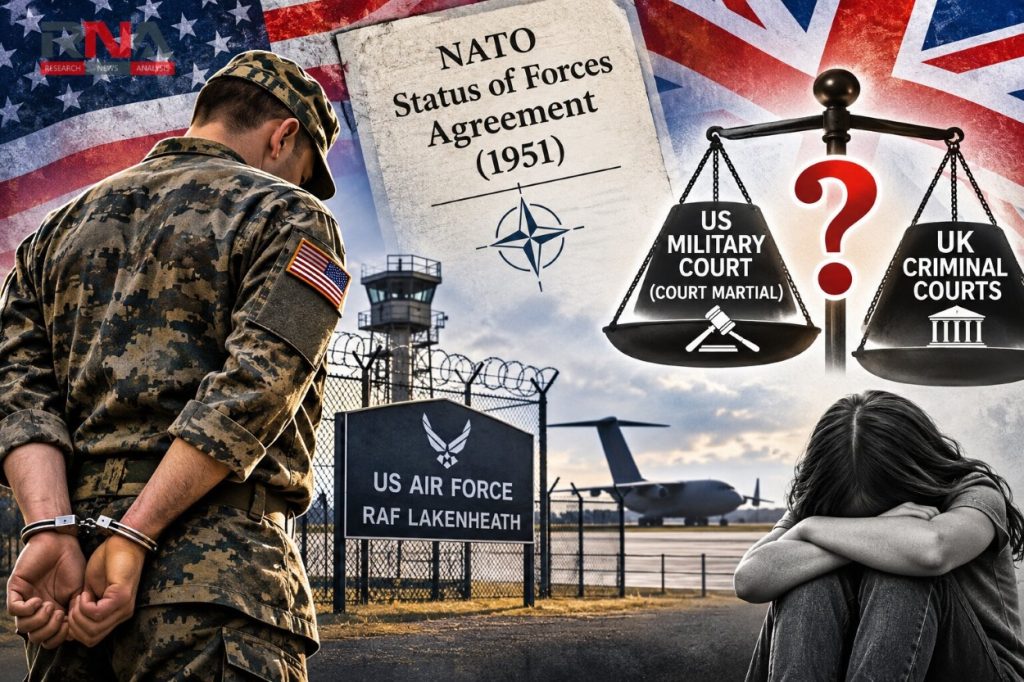
New Delhi: A growing scandal involving American military personnel convicted of child sexual abuse offences in Britain has raised serious questions over the functioning of a decades-old military agreement between London and Washington. An investigation has found that 18 of at least 21 US airmen convicted of such offences in the United Kingdom over the past decade were prosecuted under American military law rather than through the British criminal justice system.
The findings, published by the Guardian on Saturday, have intensified scrutiny of the jurisdictional arrangements governing American troops stationed on British soil. At the heart of the controversy is whether British police and prosecutors have been too willing to surrender their authority to US military investigators, even in cases involving offences committed outside military establishments.
The revelations come against the backdrop of a British government review involving several departments and senior police officials into the handling of criminal cases involving American military personnel. Concerns over the issue have also reached Parliament, where lawmakers have questioned whether existing arrangements adequately protect victims and safeguard the integrity of the British judicial system.
Cold War-era military pact under scrutiny
The legal framework governing American military personnel in Britain dates back to the early years of the Cold War, when Western countries were institutionalizing their military cooperation against the Soviet Union. The 1951 Nato Status of Forces Agreement, incorporated into British law through the Visiting Forces Act 1952, regulates the legal status of troops stationed in allied countries.
Under Article VII of the agreement, the country deploying military personnel generally enjoys primary jurisdiction over offences arising from official military duties or directed exclusively against its personnel, their dependants, property or national security. In other cases where both countries have jurisdiction, the host country ordinarily has the primary right to prosecute.
However, either country can request the other to waive its primary jurisdiction, creating scope for criminal cases to be transferred between civilian and military authorities. The agreement does not confer blanket immunity on foreign military personnel from prosecution under the laws of the host country.
The distinction is particularly significant in cases involving off-duty American personnel accused of crimes against British civilians. The Crown Prosecution Service’s guidelines on jurisdiction outline the circumstances under which British courts can exercise authority over members of visiting forces.
Cases expose jurisdictional divide
One of the cases illustrating the controversy involves Jacob Ozbirn, an American airman formerly stationed at Royal Air Force (RAF) Mildenhall in Suffolk. He came under investigation following an online operation conducted by members of the public posing as underage girls, after which Derbyshire police transferred the case to American military authorities.
According to US military judicial records, Ozbirn was convicted at a court martial in May 2018 and sentenced to three years in prison, dishonourable discharge and reduction to the lowest enlisted rank.
Other military prosecutions have resulted in substantially heavier punishments. In 2016, technical sergeant Brandon Justice was sentenced to 47 years in prison following a court martial at RAF Lakenheath for multiple offences involving children, while staff sergeant Christopher Toolan received a 30-year prison sentence in 2024.
The latest cases indicate that the problem has persisted. The US air force’s public court martial register records separate proceedings against two airmen at Lakenheath in October 2026, both involving personnel subsequently reported to have been convicted of offences related to child sexual abuse.
British authorities, however, have not invariably relinquished jurisdiction. In June, an Oxford crown court sentenced Sam Jarvis, an American airman stationed at RAF Croughton in Northamptonshire, to 18 months in prison, suspended for two years, for sexually assaulting a 12-year-old girl.
According to the American military publication Stars and Stripes, Jarvis was also ordered to compensate the victim and comply with sex offender registration requirements for 10 years.
Transparency and accountability concerns
The controversy is not simply about the severity of punishments handed down by American military courts. It also concerns public scrutiny of judicial proceedings, the rights of victims and the institutional independence of the process through which military personnel are prosecuted.
Unlike ordinary civilian jury trials in Britain, contested American courts martial can involve panels drawn from serving military personnel. Former military lawyers have raised concerns that institutional loyalties could influence how such panels assess allegations against fellow servicemen.
Limited public access to proceedings and incomplete documentation of cases have compounded those concerns. Nevertheless, available information does not establish that every prosecution conducted by American military authorities involved an inappropriate transfer of British jurisdiction.
London faces pressure to act
The British government’s review followed revelations in June concerning Jacob Wulfson, an American fighter pilot convicted by a court martial of strangling a British woman in Cambridge. He was acquitted of a separate sexual assault charge.
During a House of Lords debate in September, the government acknowledged concerns about jurisdictional decisions in cases involving visiting military personnel. It reaffirmed its commitment to treating sexual offences seriously and ensuring compliance with existing legislation.
American military authorities, meanwhile, maintain that jurisdictional decisions are reached through consultations with British law-enforcement agencies and that the US air force is committed to prosecuting offenders within its ranks.
Wider implications for US-UK alliance
Britain hosts more than 12,000 American military personnel across at least 15 installations and facilities, making it an important component of Washington’s military presence in Europe. Its bases support American combat aviation, intelligence collection, aerial refuelling and logistical operations.
The controversy also has implications beyond Britain, given the widespread use of status of forces agreements in international military cooperation. For governments hosting foreign troops, the challenge lies in accommodating legitimate operational and disciplinary requirements without compromising domestic criminal jurisdiction or the rights of their citizens.
For London, the immediate question is whether shortcomings in the application of its military agreements with Washington can be addressed through stricter enforcement of existing legislation or require more fundamental legal reforms.