


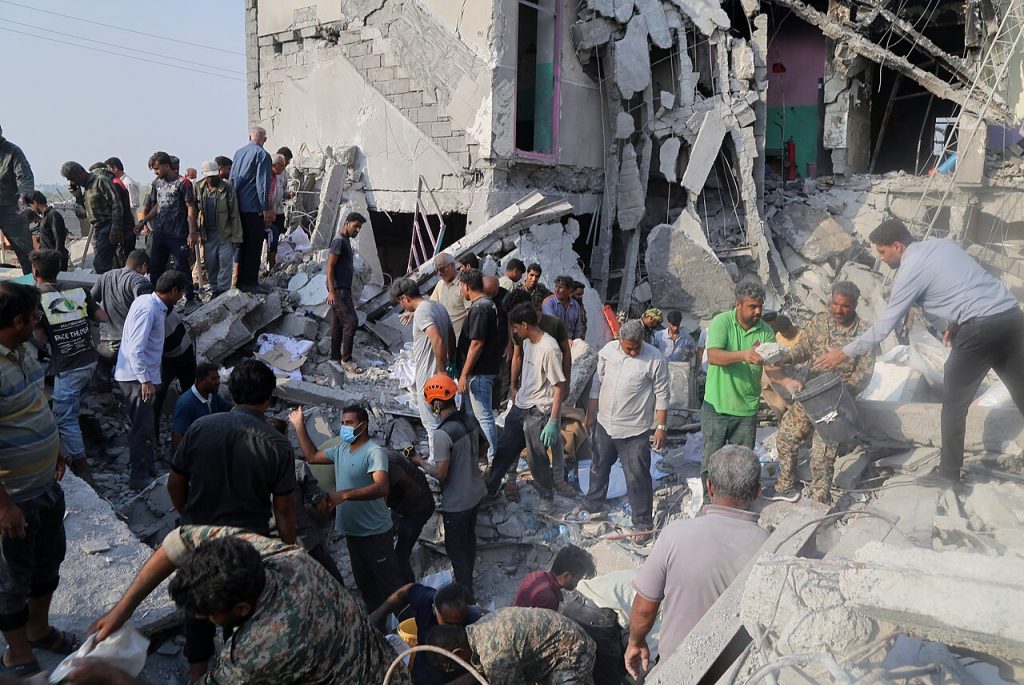
New Delhi: A United Nations fact-finding mission has found reasonable grounds to believe that US forces carried out a strike on a primary school in southern Iran in February, killing around 150 people, including about 120 children, and that the attack amounted to a war crime under international law. The mission also attributed a separate strike on a sports facility in the Iranian city of Lamerd to US forces and concluded that it too constituted an indiscriminate attack and a war crime.
The findings by the Independent International Fact-Finding Mission on Iran mark the most authoritative international attribution so far of responsibility for the February 28 attack on Shajareh Tayyebeh Primary School in Minab. The mission’s report is due to be submitted to the UN human rights council in Geneva and examines the conduct of US forces during the Iran war that began in February.
The Minab strike caused one of the largest civilian death tolls of the conflict. Iranian officials have said that more than 150 people were killed, including around 120 schoolchildren, although casualty estimates reported in the immediate aftermath varied.
The UN investigators concluded that the school was a clearly identifiable civilian object and found no evidence that it was being used for military purposes when it was struck. They classified the attack as indiscriminate because it caused extensive civilian deaths and damage to civilian infrastructure, bringing it within the definition of a war crime under international law.
The mission’s finding goes beyond simply establishing that civilians were killed. Its investigators examined the intelligence and targeting process and concluded that US forces had relied on information indicating that a senior Iranian military commander was present at the site but failed to adequately verify or update that intelligence before launching the attack.
According to the investigators, the failure to establish that the building was a legitimate military objective amounted to more than negligence. They concluded that the US directed the strike at the school while aware of a substantial risk that it was a civilian object, a finding that goes directly to the legal requirements governing distinction and precautions in attack.
The conclusion follows months of uncertainty over who carried out the Minab attack. In March, an initial US military investigation had indicated that American forces were probably responsible, while the Pentagon subsequently elevated the inquiry but has not publicly released its preliminary findings.
US officials have previously denied deliberately targeting civilian facilities. In June, the US president, Donald Trump, said that “nobody” had purposefully attacked a girls’ school in Iran, citing the American investigation, while US military officials have said the incident remained under investigation.
Evidence gathered independently before the UN finding had already pointed towards a US strike. A Guardian investigation used verified video, satellite imagery and analysis of missile fragments to establish that the school was adjacent to an Islamic Revolutionary Guard Corps complex and that the missile identified at the site was a Tomahawk – a weapon operated by the United States in the conflict.
The location of the school is central to the targeting controversy. Although the building was once part of a wider IRGC complex, satellite imagery showed that it had been separated from the military compound by a wall for years and displayed clear characteristics of a functioning educational facility, including school murals and playing areas.
The UN mission’s conclusion therefore turns the central question from one of attribution into one of accountability under international humanitarian law. The investigators were not merely assessing whether an American weapon struck the site, but whether the circumstances surrounding the selection and execution of the attack violated the rules designed to protect civilians during armed conflict.
The second case examined by the mission occurred in Lamerd, where a strike on a sports centre killed and injured 22 civilians and damaged nearby residential buildings and a school. The investigators likewise concluded that the attack was indiscriminate and constituted a war crime.
There is, however, a significant dispute over responsibility for the Lamerd attack. US Central Command (Centcom) said in March that American forces had not launched any strikes into Lamerd on the day in question, placing the mission’s attribution in direct conflict with the US military’s public position.
The term “reasonable grounds” is also important. The UN mission is a fact-finding mechanism rather than a criminal court, meaning its conclusion establishes an evidentiary finding and a basis for further accountability proceedings rather than constituting a judicial conviction of an individual or a final court ruling on state responsibility.
For Washington, the report creates a particularly difficult accountability question because the Minab investigation had already reportedly raised concerns inside the US military. The publication of the UN findings increases pressure for the Pentagon to disclose what its own inquiry established about the targeting process, the intelligence used and the chain of command involved in authorizing the strike.
The Minab attack is also significant because of the nature of the protected site. International humanitarian law requires parties to an armed conflict to distinguish between military objectives and civilian objects, while attacks must also take precautions to minimize civilian harm; schools receive particular protection when they are not being used for military purposes.
The UN finding does not by itself settle every question surrounding the strike, particularly the precise chain of command or the individual responsibility of those involved. It does, however, provide a formal international finding that the circumstances of the Minab and Lamerd attacks met the mission’s threshold for war crimes.
The findings are likely to intensify demands for transparency from the United States at a time when the wider conduct of the Iran war is under increasing international scrutiny. For India and other countries seeking adherence to international humanitarian law, the case also highlights the difficulty of maintaining civilian protection when intelligence assessments, rapidly changing battlefields and long-range precision weapons converge in densely populated areas.
The immediate issue is therefore not simply who fired the missile at Minab, but whether the available intelligence was sufficiently reliable to justify treating the site as a military objective. The UN mission’s answer is that the evidence provides reasonable grounds to conclude that the United States failed that test and that the resulting attack constituted a war crime.