


New Delhi: At least 13 people, including a child, were killed and dozens more wounded after Ukraine launched a large-scale drone attack on the Russian republic of Tatarstan on Monday. The strike on the industrial city of Nizhnekamsk – home to major oil refineries – ranks among the deadliest single attacks on Russian soil since Moscow’s full-scale invasion of Ukraine began more than four years ago.
Regional authorities gave differing casualty figures through the day, with the toll rising from an initial 12 dead and 39 injured to 13 dead and 75 injured as rescue operations continued. The head of Tatarstan, Rustam Minnikhanov, confirmed the attack and offered condolences to the families of the victims, describing the strike on Nizhnekamsk as “massive” and aimed at both industrial and civilian facilities.
Nizhnekamsk lies roughly 1,200 kilometres east of the Ukrainian border and has a population of about 240,000. The Ukrainian military said its forces had struck the Taneco oil refinery in the city, sparking a fire, as part of what Kyiv describes as efforts to degrade Russia’s military-industrial capacity. Neither side’s claims could be independently verified.
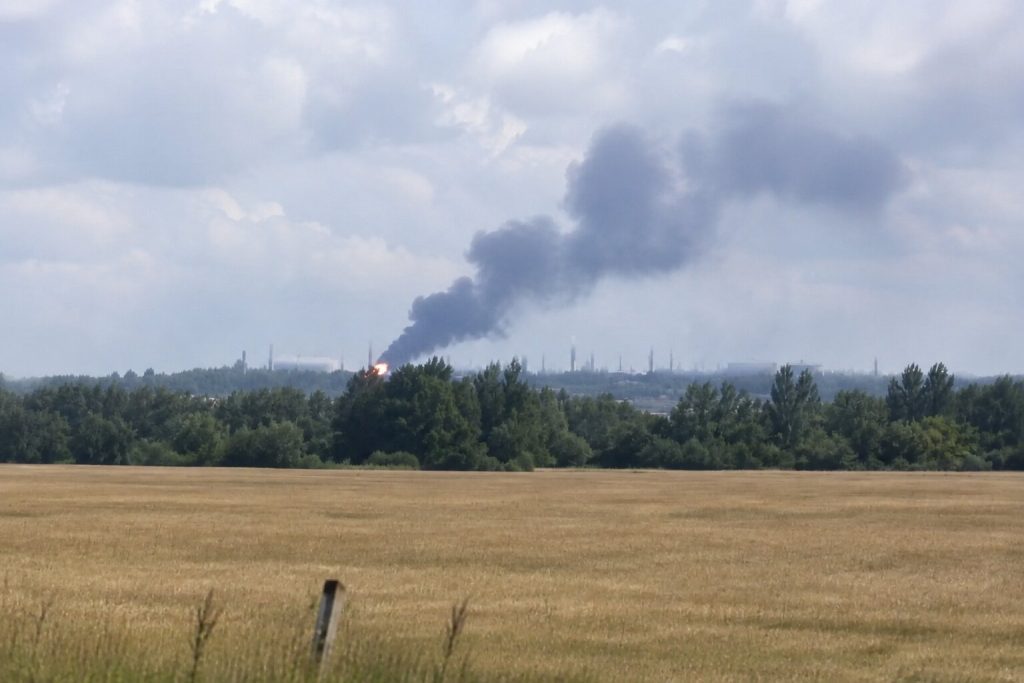
The Investigative Committee of the Russian Federation (IRCF), which is answerable to the president of Russia and a wide-ranging mandate, said “civilian individuals who were not involved in any military operations” were present at the site, signalling that a criminal probe would follow. Unverified footage circulating on social media showed thick black smoke rising over the petrochemical hub, which is also home to a major petrochemical company besides its refineries.
The Nizhnekamsk strike formed part of a far wider assault. Moscow said more than 450 Ukrainian drones targeted 16 regions of Russia along with occupied Crimea overnight, one of the largest such barrages reported since the war began.
Drones were intercepted or destroyed over Bryansk, Kursk, Kaluga, Tula, Belgorod, Oryol, Voronezh, Rostov, Penza, Ulyanovsk, Saratov, Orenburg and Samara, as well as over the Moscow region and Krasnodar Krai, according to Russian officials. The mayor of Moscow, Sergei Sobyanin, said 23 drones had been shot down as they approached the capital, while the governor of Rostov region, Yury Slyusar, claimed more than 70 drones were destroyed overnight in his region alone.
Ukraine’s long-range drone campaign has increasingly reached deep into Russian territory, with some strikes now reported as far as Siberia – around 2,000 kilometres from the border. The campaign has repeatedly targeted refineries and fuel infrastructure, contributing to fuel shortages and denting Russian refining capacity in recent months.
The president of Ukraine, Volodymyr Zelenskyy, addressed the intensifying exchange of strikes in a social media post on the eve of the attack. “We do deliver entirely justified responses, and every Russian strike will be met with our response,” he said. “Russia’s war will be felt more and more at their own home – in Russia.”
As RNA Media reported earlier on Monday, Russia’s own bombardment of Ukraine continued unabated. The Ukrainian Air Force said Russian forces had launched 126 attack drones overnight, alongside a Kh-59/69 guided air-launched missile and three Banderol loitering munitions fired from over the Black Sea.
Russian strikes also caused fatalities on Ukrainian soil. A Russian artillery strike killed five people in the village of Bugaivka in the Chuguiv district of Kharkiv region, according to the regional prosecutor’s office, while separate drone attacks were reported to have killed at least four people in Belgorod and left a man dead after a strike on a taxi in the Kherson region.
The rising civilian toll on both sides drew concern from the Vatican. Pope Leo, addressing worshippers gathered for Sunday prayers, said tragic incidents were multiplying and causing an ever-growing number of civilian victims, including children, and renewed his appeal for international humanitarian law to be respected by both sides.
The United Nations has recorded a marked increase in long-range strikes by both Moscow and Kyiv this year, accompanied by a corresponding rise in civilian casualties. Analysts note that the geographic spread of Monday’s attacks – from Tatarstan in Russia’s heartland to Kharkiv near Ukraine’s front line – is a reflection of how the war has broadened well beyond the trenches into a contest over energy infrastructure and industrial capacity on both sides.