


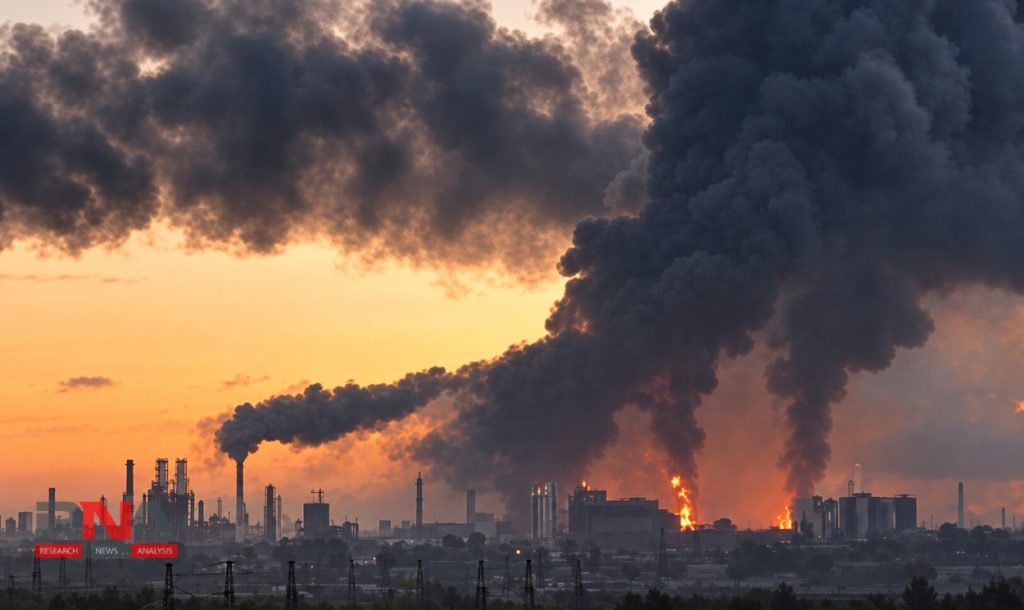
New Delhi: Ukraine says its long-range attacks have put more than half of Russia’s oil-refining capacity out of operation, intensifying a campaign aimed at disrupting the fuel supplies and economic resources sustaining Moscow’s war. The claim remains independently unverified, but comes days after the Russian president, Vladimir Putin, acknowledged that Ukrainian refinery strikes had inflicted measurable damage on his country’s economy.
The Ukrainian defence minister, Yevhenii Khmara, said on Saturday that assessments by intelligence specialists and analysts from the general staff and defence ministry indicated that more than 51% of Russian refining capacity had been disabled. According to the ministry, the damage reflected a sustained series of coordinated operations rather than the consequences of a single attack.
Facilities named in the assessment included refineries in Moscow, Yaroslavl, Perm, Ilsky, Saratov and Syzran, alongside the Kirishi refining complex and oil infrastructure at Ust-Luga. Khmara argued that the cumulative disruption was weakening Russia’s economy and its ability to maintain supplies to troops, although the announcement did not provide an independently audited, facility-by-facility account of operating capacity.
The distinction between capacity struck, capacity temporarily unavailable and capacity permanently destroyed is significant when assessing the Ukrainian figure. The published accounts do not establish how long affected processing units will remain offline, making it premature to interpret the claim as the permanent loss of half of Russia’s refining industry.
Refining capacity also differs from crude oil production: refineries convert crude into usable products, including petrol and diesel, while extraction takes place upstream. Disabling processing facilities can therefore squeeze fuel availability without producing an equivalent reduction in the amount of crude Russia pumps.
Kyiv regards the facilities as military targets because they supply fuel and generate revenue supporting Russia’s armed forces, according to Kyiv Independent. The newspaper reported that the latest assessment exceeded the 45% reduction in refining capacity claimed by Ukraine’s general staff on September 21; both figures originate from Ukrainian authorities.
Moscow has nevertheless acknowledged economic consequences from the attacks, which have helped turn energy infrastructure into a central theatre of the conflict. Speaking at the Valdai Discussion Club on October 1, Putin said Ukraine had partly achieved its objective of damaging Russia’s economy and estimated the losses at approximately 1% of gross domestic product.
In his remarks, Putin described the refinery attacks as strikes on civilian targets and said Russia had responded by attacking facilities important to Ukraine’s economy. His acknowledgement supports the broader picture of economic disruption, but does not independently confirm Kyiv’s estimate of disabled refining capacity.
An Associated Press report said repeated Ukrainian attacks had contributed to widespread Russian fuel shortages earlier this year, prompting restrictions on petrol sales. Those domestic consequences have extended the impact of the campaign beyond military supply chains to businesses and ordinary consumers.
Ukraine has also signalled that it intends to expand the operations, rather than treat the latest assessment as their culmination. The defence ministry said production and procurement of long-range attack drones had tripled in 2026, describing further growth in these capabilities as a priority.
The Ukrainian president, Volodymyr Zelenskyy, told Reuters in an interview that Kyiv would intensify refinery strikes in response to what he described as a Russian policy of attacking urban infrastructure to force residents to leave. He said Ukraine would avoid targeting civilians, while identifying Russia’s oil industry as a focus of its response.
Russia’s defence ministry subsequently announced that it would step up attacks on Ukraine, naming military facilities, defence industries and supporting infrastructure as targets. Both countries deny deliberately targeting civilians, but their competing statements point to continued escalation against the infrastructure underpinning their economies as Ukraine approaches another winter at war.