


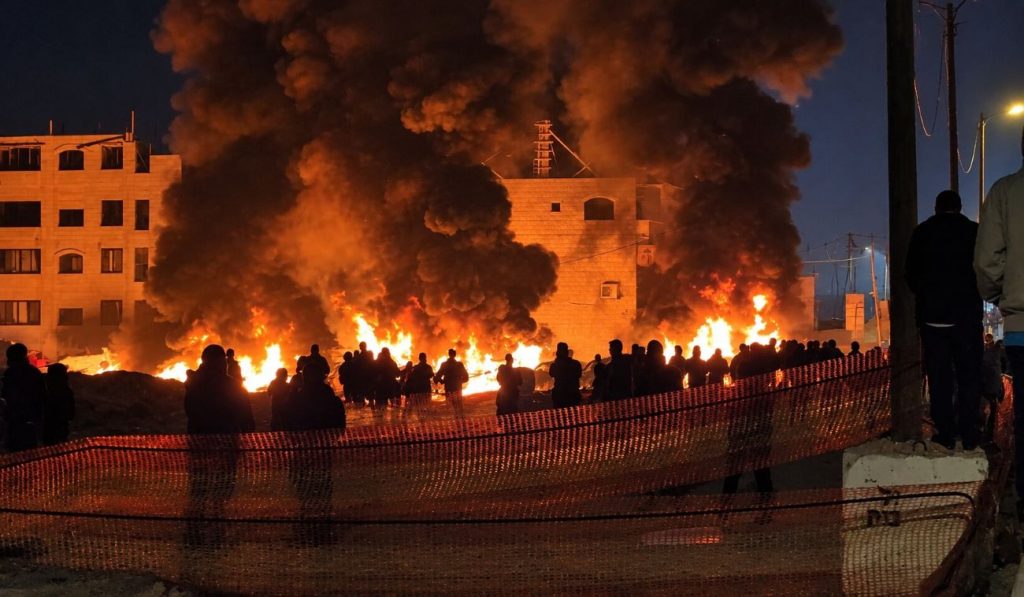
New Delhi: The United Kingdom has announced sweeping restrictions on trade and commercial dealings with Israeli settlements in the occupied West Bank, accusing violent settlers of driving the forced displacement of Palestinians with support from sections of Israel’s government. Israel responded within hours on Tuesday by ordering the closure of the British consulate in East Jerusalem and curtailing London’s involvement in Palestinian security and Gaza coordination efforts.
Announcing the measures in the UK parliament, the kingdom’s foreign secretary, Ed Miliband, said Britain would prohibit imports from Israeli settlements and prevent companies from providing them with financing, construction, infrastructure, property and advertising services. The restrictions, expected to take effect within nine months, will also cover arms export licences and other supplies deemed to “materially contribute” to Israel’s occupation of Palestinian territories.
Miliband said the British government believed that “settler terrorists” were carrying out ethnic cleansing in parts of the West Bank by demolishing homes and public infrastructure and forcing Palestinian families from their land. He accused the Israeli authorities of repeatedly failing to stop the violence and said some members of the government had encouraged actions contributing to Palestinian displacement.
The announcement marks a significant hardening of Britain’s position because London will now regard Israel’s occupation of the West Bank in its entirety – and not merely the settlements built there – as unlawful. Miliband said Britain should have adopted that position earlier and argued that condemnation without practical action had failed to protect Palestinians or preserve the possibility of a negotiated two-state settlement.
Britain will also impose personal sanctions on individuals accused of promoting or facilitating settler violence and prohibit the advertising of settlement properties in the UK. Miliband, however, drew a distinction between Israel and the policies of its government, maintaining that Britain remained committed to Israel’s security as well as the establishment of an independent Palestinian state.
France and Canada announced comparable bans on settlement goods, with several European countries supporting further coordinated measures to defend the two-state solution. The immediate economic effect may be modest because exports from West Bank settlements form only a small part of Israel’s overall trade, but the measures carry considerable diplomatic weight because they come from some of Israel’s longstanding western partners.
The UK’s decision builds on earlier sanctions imposed by Britain and other western governments on settlers, organizations and financial networks accused of enabling attacks against Palestinian civilians. Israel has consistently rejected such measures, arguing that they unfairly target Israelis and seek to impose an external political position on a disputed territorial conflict.
Israel closes British consulate in retaliation
Israel denounced the British action as politically motivated and announced a series of retaliatory steps after consultations between the Israeli foreign minister, Gideon Saar, and the country’s prime minister, Benjamin Netanyahu. Saar described Miliband’s allegations as “outrageous lies” and accused London of interfering in Israel’s sovereign affairs and its electoral process ahead of the country’s election in late October.
The most consequential measure is the closure of the British consulate in East Jerusalem, which represents the UK in its dealings with the Palestinian Authority and Palestinians in Jerusalem, the West Bank and Gaza. Shutting the mission will substantially reduce Britain’s direct diplomatic access to Palestinian officials and could complicate its humanitarian and political engagement in the occupied territories.
Israel will also exclude Britain from the US-led coordination mission for Gaza and terminate British training for Palestinian Authority security personnel in the West Bank. Saar said certain British elected representatives and other UK nationals would be barred from entering Israel, broadening the dispute beyond trade restrictions into diplomatic and security cooperation.
Israel disputes the prevailing international view that its West Bank settlements violate international law, citing Jewish historical and religious connections to the territory and describing its final status as a matter for negotiations. The United Nations, the Palestinians and most governments regard the settlements as illegal and consider their expansion a major obstacle to a viable Palestinian state.
The dispute has intensified over Israel’s planned E1 settlement project east of Jerusalem, which critics say could sever the northern West Bank from its southern districts and isolate East Jerusalem from surrounding Palestinian communities. Israel captured the West Bank and East Jerusalem in the 1967 Arab-Israeli War and later annexed East Jerusalem in a move that has not received broad international recognition.
For Britain, the sanctions are intended to raise the financial and political cost of settlement expansion without imposing wider restrictions on Israel’s population or economy. For Israel, the closure of the consulate and suspension of cooperation signal that measures directed at the settlements will invite consequences across the broader bilateral relationship.