


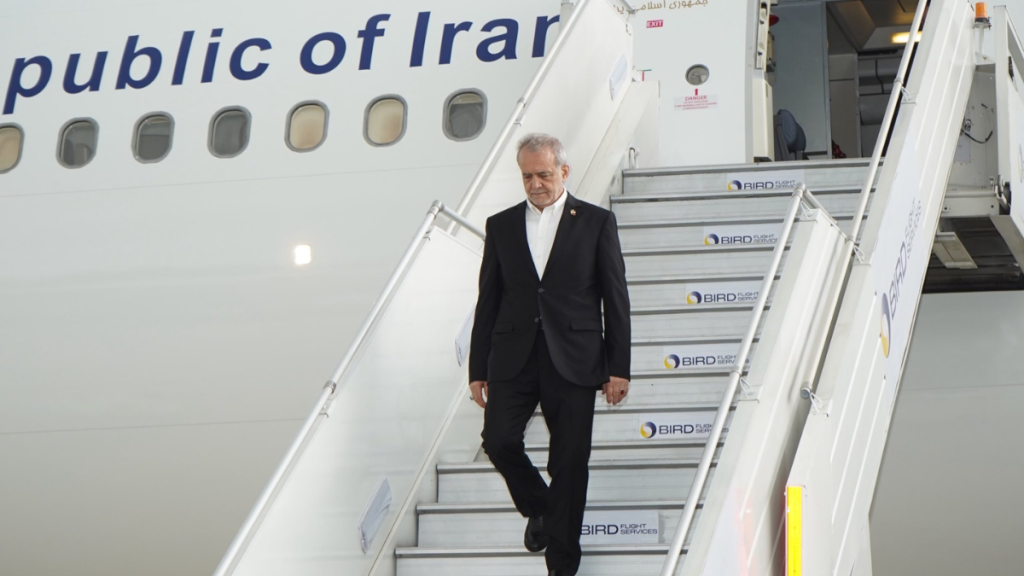
New Delhi: The Iranian president, Masoud Pezeshkian, has said the United States expected Iran to collapse within days of its military attack, comparing Washington’s calculations to what he described as its approach towards Venezuela and Syria. During his visit to New Delhi for the BRICS Summit, Pezeshkian also called for closer regional cooperation, urged Gulf countries not to allow their territory to be used for attacks on Iran and said Tehran’s relations with prime minister, Narendra Modi, were improving “on a daily basis”.
In an exclusive interview with India Today on the sidelines of the BRICS Summit, Pezeshkian said his relationship with Modi had steadily strengthened since he took office, citing the deep historical and cultural links between India and Iran. He said both sides were looking to build a new structure for bilateral cooperation, with Chabahar Port, trade and regional connectivity forming important areas of engagement.
‘Trump changes position every day’
Pezeshkian took aim at the United States president, Donald Trump, shifting statements on Iran, saying Tehran was unsure which of his positions it could rely on. He said Trump “is saying something every day”, claiming that on one day he speaks of destroying Iran, while on another he describes the country as a friend, making it difficult for Tehran to determine what Washington’s actual position is.
The Iranian president also accused the US of pursuing a “divide and rule” strategy across the region, arguing that Washington was encouraging Arab countries to view Iran as a threat while selling them weapons and seeking to exploit the region’s oil resources.
Pezeshkian said the US had underestimated Iran’s ability to withstand the conflict and believed it could topple the government rapidly. He claimed Washington thought it could “conquer” Iran, establish a puppet government and repeat what he described as the model used in Venezuela and Syria.
He said the US and Israel had killed Iran’s leaders, military commanders, officials, innocents and scientists and attacked infrastructure, but the strategy had failed to produce the collapse Washington expected. According to Pezeshkian, the attacks instead strengthened unity inside Iran, including among sections of the population that had previously been critical of the government.
Iran says Gulf states are ‘brothers’
Pezeshkian said Iran was not at war with Saudi Arabia and insisted that Tehran did not regard the UAE or other Gulf countries as enemies. He described the regional countries as “brothers” with which Iran had longstanding trade and social ties, arguing that the dispute was with US military bases operating from their territories rather than with the countries themselves.
He urged neighbouring states not to permit their territory to be used for attacks on Iran.
Hormuz talks with Oman
Pezeshkian said Iran was negotiating with Oman on a maritime framework for the Strait of Hormuz, amid concerns over shipping, energy supplies and the safety of Indian seafarers. He said the waterway could reopen under internationally recognized principles if the US ended what Tehran describes as its blockade and related activities.
He said a meeting involving Arab foreign ministers and Oman was expected to work towards an arrangement on Hormuz, with the International Maritime Organization subsequently expected to announce its status. The comments came after Modi raised concerns over the safety of Indian vessels and seafarers during his bilateral meeting with Pezeshkian on the sidelines of the BRICS Summit.
Pezeshkian pushes Chabahar, BRICS cooperation
On India-Iran ties, Pezeshkian invited greater Indian investment and partnership at Chabahar Port, describing Iran as a geographical crossroads connecting north and south as well as east and west. He said Tehran was ready to work with India to revive connectivity routes associated with the historic Silk Road and expand trade and economic cooperation.
He said the grouping could help its members build alternative channels for trade, investment and development while moving towards a more multipolar economic order.
On Iran’s nuclear programme, Pezeshkian rejected allegations that Tehran was seeking nuclear weapons and accused Western countries of spreading what he described as propaganda against Iran. He reiterated Tehran’s commitment to the NPT and criticized what he called double standards over Israel’s nuclear capabilities, while saying Iran remained open to negotiations.